
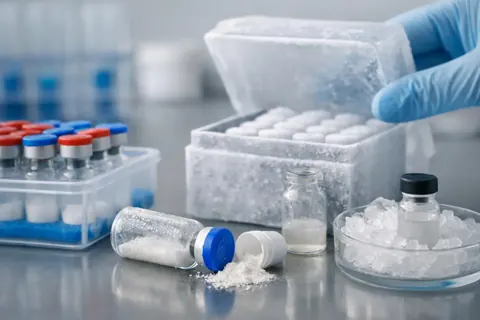
An unexpected research result can begin with an ordinary storage mistake rather than an analytical failure. A poorly sealed container, an undocumented transfer or repeated temperature changes may alter a peptide without producing an obvious visible warning. The appearance of a vial is therefore a weak basis for judging whether its contents remain suitable for an experiment.
Storage deserves the same attention as batch identification and analytical documentation. A laboratory report describes the sample tested under particular conditions; it does not establish that material remains unchanged throughout transport, storage and handling. Researchers need a record that connects those stages rather than treating receipt of a certificate as the end of quality control.
The seven errors below concern research materials only. Peptides supplied for research use are not for human consumption, and storage guidance does not establish suitability for human use.
1. Choosing conditions before checking the material
A familiar storage routine can become a liability when it is applied to every peptide. Sequence, formulation and physical form all influence stability. A sealed lyophilised material and a preparation in solution should not automatically be assigned the same conditions simply because they carry the same compound name.
Start with compound-specific documentation and the requirements of the planned laboratory work. Where handling information is incomplete, clarify it rather than borrowing conditions from an unrelated product. Neither a general internet recommendation nor the storage history of another peptide provides a reliable substitute.
This also changes how researchers should think about planning. The useful question is not which storage method is generally considered best, but which conditions are supported for the particular material and its intended research context. There is no universal temperature or storage duration that can be inferred from the word “peptide”.
2. Treating a refrigerator as proof of control
Putting a vial into a refrigerator records its location, not necessarily its conditions. Temperature stability, placement within the unit and repeated door opening can all matter. Domestic appliances in particular may offer less consistent conditions than controlled laboratory equipment.
Refrigeration can be appropriate for some materials, but it should not be assumed to satisfy every storage requirement. Equally, moving a material to colder conditions without supporting guidance is not a complete solution. The decision needs to follow the documented requirements of the compound and its form.
Researchers should distinguish a nominal equipment setting from the conditions experienced by the sample. When reviewing unexpected variation, a note saying “kept refrigerated” may be less informative than a clear record of the storage environment and any known interruptions.
3. Overlooking humidity and condensation
Lyophilisation does not make a peptide immune to moisture. Opening a dry preparation repeatedly can expose it to ambient humidity, while movement between cold storage and warmer surroundings can introduce condensation concerns. The risk may be easy to overlook because moisture exposure is not always apparent afterwards.
Warm or coastal environments can make humidity particularly relevant, but geography alone does not determine the conditions at the bench. Indoor handling practices still matter. A controlled, dry process is more useful than assuming that a sealed-looking vial has remained unaffected.
The practical aim is to avoid unnecessary exposure and follow the material’s handling documentation. A powder that appears unchanged should not be taken as evidence that moisture has had no effect. Visual inspection can identify some problems, but it cannot establish molecular integrity.
4. Allowing repeated freeze–thaw events to become routine
Repeatedly removing the same vial from frozen storage, warming it and returning it introduces another variable into the material’s history. Depending on the peptide and formulation, thermal cycling can contribute to aggregation or degradation. Preparations in solution are often more vulnerable than lyophilised materials, although the effect remains compound-dependent.
This is best addressed through experimental planning rather than improvised handling. Where compatible with the material and laboratory protocol, separate aliquots can reduce repeated access to a primary preparation. They are not a universal requirement, and the suitability of any transfer process still needs consideration.
Recording handling events is also important. Without that record, two samples described as belonging to the same batch may have substantially different exposure histories. That difference can complicate later comparisons even when their original analytical documentation is identical.
5. Paying attention to the peptide but not its container
Storage vessels form part of the sample environment. A compromised seal, an unsuitable transfer container or unnecessary exposure to air can increase the risk of contamination or instability. The original vial and a replacement tube should not be assumed to provide equivalent protection.
This becomes especially relevant when material is transferred or prepared in solution. Container suitability and clean handling need to be considered together: an appropriate vessel cannot compensate for poorly controlled handling, and careful technique cannot correct an inadequate seal.
Reviewing containers may seem less sophisticated than examining chromatograms, but both address the same underlying issue: whether the material used in an experiment can be meaningfully related to its documented starting condition.
6. Losing the history through incomplete labels
A vial with an unclear identity or missing date creates uncertainty that careful storage cannot resolve. Researchers need to connect the physical material to its batch documentation and handling record. Otherwise, even basic questions about receipt, preparation or previous access become difficult to answer.
Useful records include:
- Compound identity and batch or lot reference.
- Receipt date and relevant preparation dates.
- Storage conditions and transfers between locations.
- Known temperature excursions or repeated handling events.
These details are not merely administrative. They help distinguish a possible material issue from other sources of experimental variation. If two preparations behave differently, a complete history gives researchers something concrete to investigate rather than relying on recollection.
7. Assuming the dry-material record still describes a solution
Reconstitution changes the material’s environment. Many peptides become more susceptible to degradation in solution, so the conditions appropriate to a sealed dry preparation cannot simply be carried forward without review.
The mistake is not only inadequate temperature control. It is also failing to document the transition: when the material was prepared, what conditions applied afterwards and how often it was handled. These details become part of the evidence needed to interpret later observations.
A certificate issued for the original material does not establish the stability of every subsequent preparation. Nor can appearance establish a usable lifetime. Any assessment of continued suitability needs to rest on relevant documentation and the requirements of the research, rather than a general shelf-life assumption.
Make storage part of the experimental record
When observations become inconsistent, storage should be among the variables reviewed. Small changes in material integrity may introduce uncertainty without producing an obvious failure. Batch comparisons are particularly difficult if the samples have experienced different handling conditions that were never recorded.
A useful approach joins three sources of information: the original analytical report, the material’s storage history and the experimental record. None replaces the others. Together, they provide a more coherent basis for evaluating what was used and where uncertainty remains.
For compound-specific context, researchers can consult the IGF-1 LR3 listing and assess its available documentation against their laboratory requirements. The Andalucia delivery information covers ordering context: deliveries originate in Germany, the USA or China, with a delivery window of 5–18 business days from tracking, not from local premises.
A more defensible handling routine
Good storage practice is less about finding one ideal rule than about avoiding unsupported assumptions. Confirm the material’s requirements, minimise unnecessary exposure and keep a record that allows later questions to be answered.
This cannot guarantee unchanged material or reproducible results. It can, however, make storage a controlled and reviewable part of research rather than an invisible source of variation. For broader supplier context, see Regena’s approach to research materials.
Peptides in this article
Add a solvent
- Bacteriostatic Water
Kit of 10 × 10 ml vials · Standard solvent for most peptides
€149.00 - Acetic Acid Kit
Kit of 10 × 3 ml vials (liquid) · For peptides that stay cloudy in BAC water
€149.00
Share Regena with a research colleague. They get trusted peptides; you earn 3–30% affiliate commission based on your monthly referred sales.
More research reading
Not sure which peptide fits your research question?
Take the 60-second Find Your Peptides quiz — it points you to the most relevant reference compounds for your area of investigation.
Start the quiz