
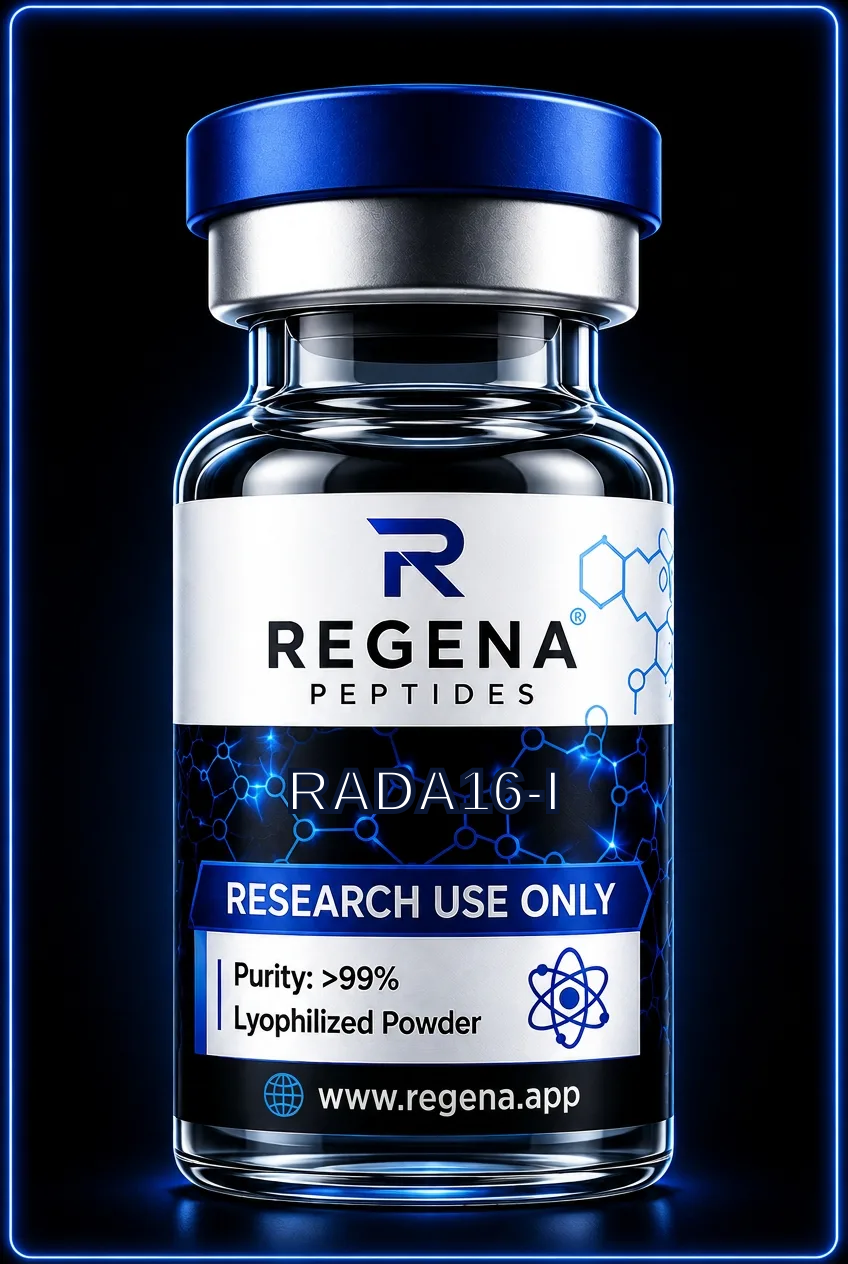
Other · Ionic-complementary self-assembling peptide
RADA16-I
Also known as RADA16; RAD16-I
An ionic-complementary 16-residue peptide that forms β-sheet nanofibres and hydrated scaffolds for biomaterials research.
- Length
- 16 amino acids
- Half-life
- Not well characterised
- Mechanism
- RADA16-I self-assembles into β-sheet-rich nanofibres through backbone hydrogen bonding, hydrophobic association and ionic complementarity. It has no established specific receptor target; its principal experimental function is to form a hydrated three-dimensional scaffold.
- Studied in
- Three-dimensional cell cultures, scaffold characterisation experiments and animal biomaterial models examine its nanofibre assembly, matrix mechanics and interactions with cells.
About RADA16-I
RADA16-I is commonly prepared as Ac-RADARADARADARADA-NH2, with an acetylated N-terminus and amidated C-terminus. Four repeats of arginine–alanine–aspartate–alanine create alternating charged and hydrophobic positions. It belongs to the ionic-complementary peptide family developed from early observations that designed peptide sequences can assemble into stable β-sheet materials. The designation I refers to its charge-pattern class, not a receptor subtype or a particular stage of biological activity in experimental models.
In aqueous systems, RADA16-I can organise into nanofibres that associate into hydrated networks, with assembly strongly influenced by ionic conditions, pH and peptide content. Researchers characterise these materials using microscopy, spectroscopy and rheology before assessing cell behaviour in three-dimensional culture. The unmodified sequence lacks a dedicated adhesion motif such as RGD. Consequently, matrix mechanics, adsorbed proteins and cell-derived extracellular matrix can all influence apparent cellular compatibility and attachment.
Laboratory notes
- Record terminal modifications, counterion, pH and ionic composition because these variables affect self-assembly and batch comparability.
- Standardise mixing, equilibration and shear history before rheological measurements; verify nanofibre formation with complementary structural methods.
- Check endotoxin, sterility and medium compatibility for cell-culture experiments, and distinguish unmodified RADA16-I from motif-functionalised derivatives.
Storage and reconstitution basics: storage guide.
Questions about RADA16-I
Does RADA16-I activate a specific receptor?
No specific receptor agonism is established. Its primary research role is structural, providing a self-assembled nanofibrous environment.
Why is a single biological half-life difficult to specify?
Degradation depends on assembly state, protease exposure and the surrounding matrix. Scaffold persistence and soluble-peptide degradation are different measurements.
Is RADA16-I equivalent to an RGD-functionalised scaffold?
No. The unmodified sequence contains no RGD motif; functionalised research-use variants introduce additional recognition sequences and require separate characterisation.
Is RADA16-I for human use?
No. It is supplied strictly for in-vitro laboratory research and is not for human or animal consumption.
Related research peptides
All products are sold for laboratory research use only. Not for human consumption, not a medicine, not for diagnosing, treating or preventing any condition.