
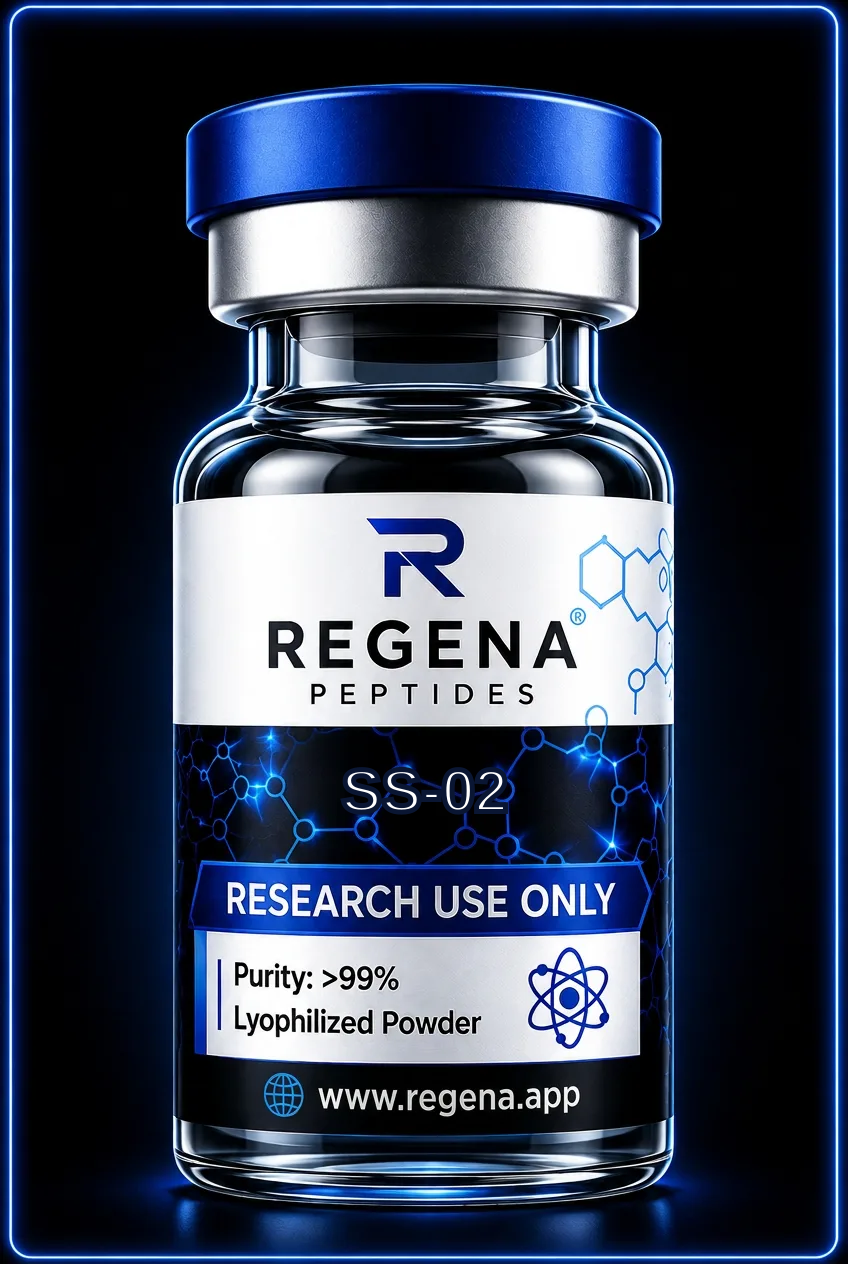
Other · Aromatic–cationic mitochondrial-associated tetrapeptide
SS-02
Also known as SS02
An aromatic–cationic tetrapeptide containing dimethyltyrosine, studied for mitochondrial interactions, redox chemistry and opioid activity.
- Length
- 4 amino acids
- Half-life
- Not well characterised
- Mechanism
- SS-02 associates with mitochondria through its aromatic–cationic architecture, while its dimethyltyrosine residue supports radical-scavenging chemistry. It also has reported μ-opioid receptor activity, so experimental effects cannot automatically be assigned solely to mitochondrial interactions.
- Studied in
- SS-02 is studied in isolated mitochondrial preparations, oxidative-stress cell assays and experimental opioid receptor pharmacology.
About SS-02
SS-02 has the sequence Dmt–D-Arg–Phe–Lys–NH₂, where Dmt denotes 2′,6′-dimethyltyrosine and the terminal amide distinguishes it from a free-carboxyl analogue. It belongs to the Szeto–Schiller aromatic–cationic peptide family, developed through work linking short opioid-related peptide structures with mitochondrial localisation. Alternating aromatic and basic residues define its architecture. Its D-arginine residue and amidated terminus also matter when assessing identity, enzymatic susceptibility and comparisons with related tetrapeptides in biochemical experiments.
The phenolic group of Dmt contributes to SS-02’s radical-scavenging behaviour in experimental systems. Mitochondrial studies examine oxidative damage, membrane function and bioenergetic readouts, but these endpoints do not identify a unique protein receptor. Unlike a purely mitochondria-focused probe, SS-02 also has μ-opioid receptor activity. Appropriate receptor controls are therefore important in receptor-expressing cells or tissues, especially when interpreting downstream signalling changes that could arise through more than one molecular pathway.
Laboratory notes
- Confirm Dmt identity, D-arginine stereochemistry and C-terminal amidation; mass alone does not establish stereochemical identity.
- Include cell-free interference controls when using fluorescent oxidant probes, because redox-active compounds can alter probe chemistry.
- Assess opioid receptor expression and use appropriate pharmacological controls when separating receptor-dependent effects from mitochondrial endpoints.
Storage and reconstitution basics: storage guide.
Questions about SS-02
What does Dmt mean in the SS-02 sequence?
Dmt is 2′,6′-dimethyltyrosine, an aromatic amino-acid derivative containing a phenolic group relevant to its redox chemistry.
Is SS-02 equivalent to SS-20?
No. SS-20 contains phenylalanine in place of the N-terminal Dmt of SS-02, changing both phenolic chemistry and pharmacological properties.
Is SS-02 a mitochondria-specific receptor probe?
No. Its mitochondrial association does not establish a unique receptor, and its reported μ-opioid receptor activity creates an additional mechanistic consideration. Research use only.
Is SS-02 for human use?
No. It is supplied strictly for in-vitro laboratory research and is not for human or animal consumption.
Related research peptides
All products are sold for laboratory research use only. Not for human consumption, not a medicine, not for diagnosing, treating or preventing any condition.