
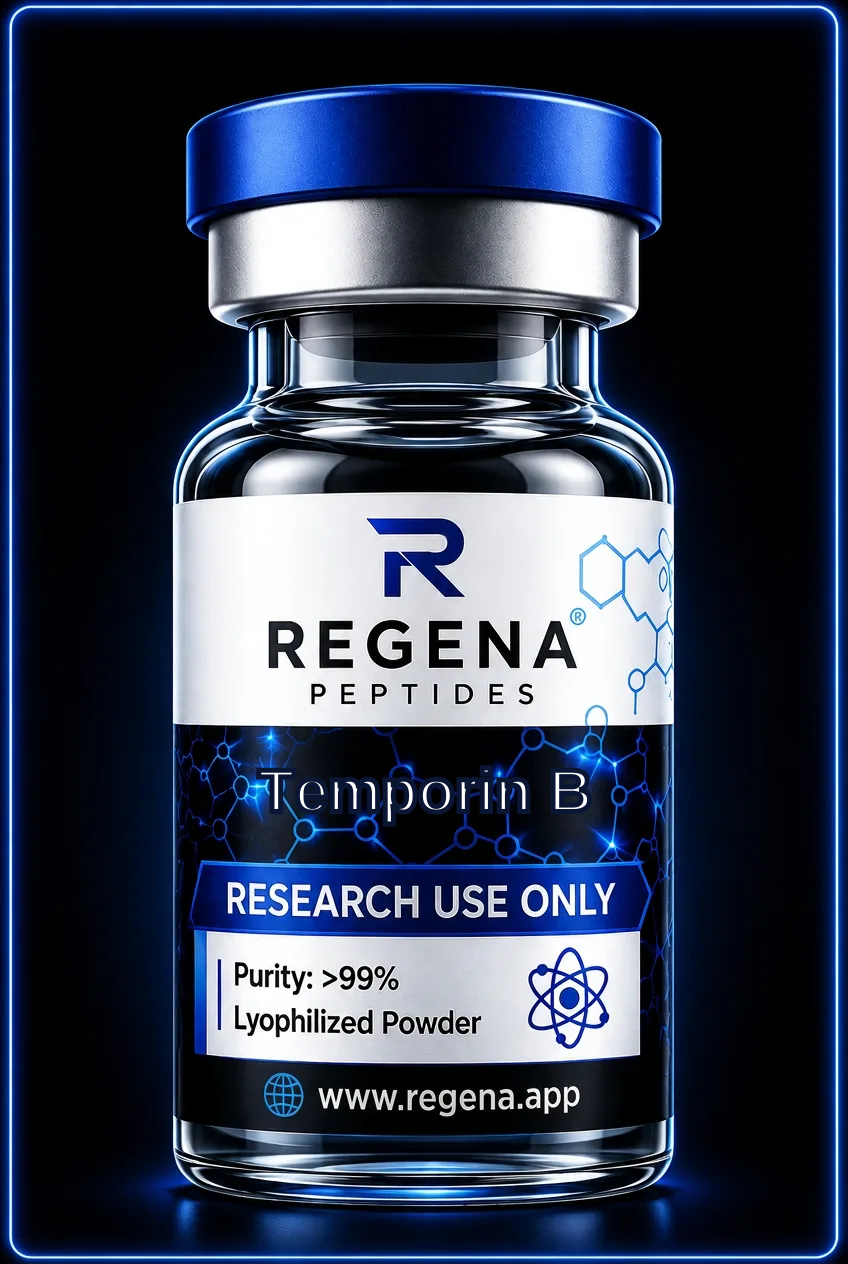
Antimicrobial · Short, hydrophobic, C-terminally amidated antimicrobial peptide
Temporin B
Also known as TB
A short frog-skin peptide used to examine how hydrophobicity, aggregation and lipopolysaccharide shape membrane activity.
- Length
- 13 amino acids
- Half-life
- Not well characterised
- Mechanism
- Temporin B interacts with lipid membranes, where membrane-associated folding and peptide aggregation influence permeabilisation. Lipopolysaccharide can affect its self-association and access to bacterial membranes; no specific protein receptor is established for its principal activity.
- Studied in
- Bacterial cultures, lipopolysaccharide-containing systems and model lipid bilayers are used to examine membrane disruption, aggregation and interactions with Temporin L.
About Temporin B
Temporin B is one of the short antimicrobial peptides identified from skin secretions of the European common frog, Rana temporaria, in work reported in 1996. Its sequence is LLPIVGNLLKSLL-NH₂, giving a 13-residue peptide with an amidated C-terminus. The molecule is rich in leucine and other hydrophobic residues, contains one lysine and has no cysteine. Its N-terminal-region proline distinguishes its structural possibilities from those of a uniformly helical peptide sequence.
Studies of Temporin B explore how a short, relatively weakly cationic sequence interacts with complex bacterial envelopes. Its activity often differs between Gram-positive and Gram-negative test organisms, with the outer membrane and lipopolysaccharide providing important experimental variables. Lipopolysaccharide-associated aggregation can restrict productive membrane interactions. Research combining Temporin B with Temporin L examines whether changes in peptide self-association help explain cooperative effects, while vesicle assays separate direct lipid permeabilisation from whole-cell envelope processes.
Laboratory notes
- For research use only; confirm the amidated C-terminus and distinguish native Temporin B from sequence-modified analogues.
- Assess stock clarity and peptide recovery because this hydrophobic sequence can aggregate or adsorb to vessel surfaces.
- Document bacterial strain, growth medium and lipopolysaccharide source when comparing activity across experimental systems.
Storage and reconstitution basics: storage guide.
Questions about Temporin B
What is the native Temporin B sequence?
The mature sequence is LLPIVGNLLKSLL-NH₂. The terminal amide is a structural feature, not an additional amino acid.
Why is lipopolysaccharide important in Temporin B experiments?
It forms a major component of the Gram-negative outer membrane and can influence peptide binding and aggregation, affecting access to underlying membranes.
Is Temporin B activity explained by a protein receptor?
No specific protein receptor is established for its principal antimicrobial mechanism. Membrane interactions and peptide self-association are the main experimental focus.
Is Temporin B for human use?
No. It is supplied strictly for in-vitro laboratory research and is not for human or animal consumption.
Related research peptides
All products are sold for laboratory research use only. Not for human consumption, not a medicine, not for diagnosing, treating or preventing any condition.