
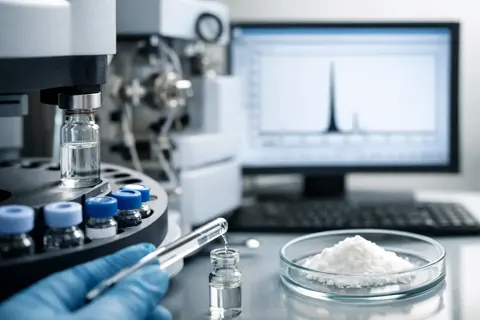
A purity result is only as informative as the measurement it describes. On a peptide certificate, an HPLC percentage usually expresses the share of integrated detector signal attributed to the principal peak. It is not a blanket statement about everything in the sample.
HPLC can provide strong evidence of chromatographic purity when the method separates relevant components and the resulting data are interpreted appropriately. The important distinction is between confirming a result under defined analytical conditions and establishing the complete identity, composition and suitability of a research material.
Start with the question the test answers
High-performance liquid chromatography separates sample components as they pass through a column in a controlled solvent system. Differences in their interactions with the column cause them to emerge at different times. A detector records those emerging components, producing the peaks seen on a chromatogram.
For a peptide sample, one peak will often dominate. Other signals may arise from truncated sequences, incomplete synthesis products, modified peptides, residual reagents or degradation products. The method must be capable of separating and detecting these components before their relative contributions can be assessed.
An area-percentage calculation compares the area of the principal peak with the total area of the peaks included in the integration. This is the basis of many reported HPLC purity values. It is a relative measurement of detected signal, rather than an automatic measurement of chemical purity by weight.
The useful question is therefore: does this sample contain predominantly one chromatographically resolved component under the stated conditions? A suitable HPLC method can answer that well. Whether that component is definitely the intended peptide, and whether other types of contamination are absent, requires additional evidence.
Why a clean trace needs a suitable method
Peptide sequences differ in length, charge, hydrophobicity and susceptibility to chemical modification. Consequently, conditions that separate one peptide from its likely impurities may work poorly for another. A visually simple chromatogram does not demonstrate that the method could have revealed every relevant impurity.
Reversed-phase HPLC with UV detection is widely used in peptide analysis. Its performance depends on the column, mobile phases, solvent gradient, temperature and detection wavelength. These choices affect retention, resolution and detector response, all of which influence the reported result.
Co-elution is a particularly important limitation. An impurity that emerges at the same time as the intended peptide can contribute to the main peak without appearing separately. Substances with weak detector responses may also be underestimated, while components outside the method’s scope may not be represented at all.
A high area percentage is therefore meaningful within an analytical boundary. It should not be expanded into a claim that the sample is free of every possible non-target substance.
Validation provides context for confidence
Method validation examines whether an analytical procedure performs adequately for its intended purpose. Depending on the objective, this may involve specificity, precision, linearity, accuracy, sensitivity and system-suitability assessments. These are not interchangeable checks: each addresses a different source of uncertainty.
Specificity concerns the ability to distinguish the intended material from relevant impurities. For synthetic peptides, these can include deletion sequences, failed-coupling products, deprotection-related by-products and oxidised species. Closely related variants can be challenging because they may behave similarly on the column.
Precision asks whether repeated measurements, including repeat preparations where relevant, produce comparable results. Linearity examines the relationship between detector response and concentration over the range being used. System suitability checks whether the instrument and chromatographic conditions are performing acceptably during the analysis.
Research-use certificates do not always include a full validation report. Its absence from a short certificate does not by itself settle the quality question. Nevertheless, a percentage without identifiable method information gives researchers little basis for judging what the analysis could reliably establish.
Read the chromatogram, not just the headline
Begin by connecting the trace to the material. The product description, batch reference and analysis date should align with the certificate and sample under review. A generic chromatogram cannot establish the properties of an unrelated batch.
Retention time is a useful consistency measure when comparing results obtained with the same method. It is not independent proof of identity: different substances can elute in similar regions, and changes in analytical conditions can shift retention.
Peak shape offers further clues. Shoulders, splitting or broadening may reflect unresolved components, but can also arise from sample overload, column interactions, instability or unsuitable conditions. Such features warrant investigation rather than an immediate judgement about material quality.
The integration settings deserve equal attention. Software assigns peak boundaries and calculates areas using selected baseline and detection parameters. How small peaks are included, or how adjacent peaks are divided, can change the final area percentage. A readable chromatogram and documented integration approach provide context that a lone figure cannot.
Identity and purity are different measurements
Mass spectrometry is commonly used alongside HPLC because it addresses a different analytical question. An observed molecular mass consistent with the expected peptide supports identity, whereas HPLC describes the relative signals of chromatographically separated components.
Neither result should be stretched beyond its scope. Expected mass alone does not necessarily resolve every sequence or structural ambiguity. Likewise, a dominant chromatographic peak cannot establish the intended sequence merely because it appears at a plausible retention time.
Together, these methods provide a more informative evidence set. Researchers can assess whether material consistent with the expected peptide is present and whether the sample contains detectable, separable related impurities. Interpretation still depends on suitable methods and clear linkage between the tests and the batch.
Peptide content and stability require separate consideration
Chromatographic purity is not the same as peptide content by weight. Water, salts, counter-ions and other components may contribute to sample mass without being represented proportionately in a UV chromatogram. A high area percentage therefore cannot be read directly as the amount of peptide in a vial.
Depending on the research question, additional analyses may include water content, residual solvents, counter-ion determination or elemental impurities. Microbiological controls may also be relevant to a particular material format or laboratory application. The appropriate panel follows from the experiment, rather than from a universal purity threshold.
An HPLC result also describes a sample at a particular point in time. It does not establish long-term stability or prove that transport and subsequent handling have left the material unchanged. Temperature variation, light exposure and repeated handling can affect peptide integrity, so analytical records must be considered alongside the material’s history.
Purity alone does not establish experimental relevance either. Sequence identity, salt form, handling procedures and study design can all influence whether a material is suitable for a specific non-clinical investigation.
A documentation review that supports research decisions
A practical review can be organised around four questions:
- Does the batch reference match the material being evaluated?
- Is the reported value clearly described as chromatographic area percentage?
- Are the chromatogram, method information and testing date available?
- What separate evidence addresses identity and any experiment-specific contaminants?
The testing laboratory’s identity and the relationship between documents are also useful. A coherent record makes it possible to distinguish demonstrated findings from assumptions. Third-party testing can add context, but its usefulness still depends on the sample, method and traceability of the report.
For a compound-specific starting point, see the CJC-1295 without DAC profile and assess the documentation available for the relevant batch. Researchers arranging delivery to Atlanta should allow 5–18 business days from tracking, with dispatch from Germany, the USA or China; the destination page does not indicate local premises.
The independent analytical results offer a further point of reference when reviewing the available evidence.
HPLC is best treated as a precise answer to a bounded question. Confidence comes from a suitable method, traceable data and complementary tests—not simply from a high percentage. All material discussed here is for research use only and not for human consumption.
Share Regena with a research colleague. They get trusted peptides; you earn 3–30% affiliate commission based on your monthly referred sales.
More research reading
Not sure which peptide fits your research question?
Take the 60-second Find Your Peptides quiz — it points you to the most relevant reference compounds for your area of investigation.
Start the quiz