
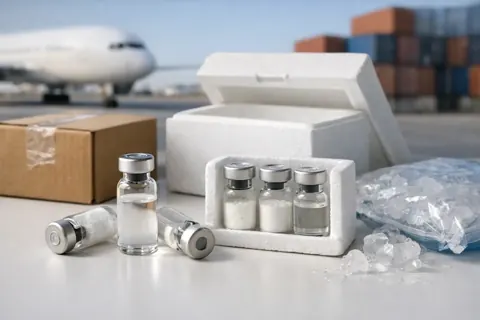
Transport creates a gap between a peptide’s analytical test and its arrival at a laboratory. During that interval, the material may encounter changing temperatures, humidity, light, physical handling and delays. Whether those exposures matter depends on the particular peptide, its formulation and the protection provided throughout the journey.
Peptides can degrade during shipping, but neither a warm parcel nor a delayed delivery proves that degradation has occurred. Equally, an undamaged vial does not establish that its contents remain analytically unchanged. A useful assessment brings together compound-specific stability information, transport conditions and the limitations of the available evidence.
This discussion concerns research-use materials only, not products for human consumption. Shipping requirements should be assessed against documented material specifications rather than general advice applied to every peptide.
Begin with the material, not the weather forecast
The same route can present different risks to different materials. Amino-acid sequence, molecular structure, formulation and physical state all influence how a peptide responds to its environment. Some correctly packaged materials tolerate short periods of ordinary transport conditions; others require more closely controlled conditions.
Lyophilised peptides have undergone freeze-drying to remove water. Reducing water availability generally limits opportunities for water-driven reactions, which can make transport more manageable than for an equivalent material in solution. It does not make a peptide immune to environmental stress.
Dry material may still be affected by heat, oxygen, light or moisture entering through a compromised closure. Sequence-specific susceptibility also remains relevant: certain amino-acid residues are more vulnerable to oxidation or other chemical changes.
Solutions introduce additional variables. Solvent composition, pH, concentration, container material and previous storage conditions may influence stability. Requirements for unopened lyophilised material therefore cannot simply be transferred to material in solution. The relevant documentation needs to describe the actual format being shipped.
Changes may be invisible
A peptide does not have to change colour or appearance to undergo degradation. Depending on its chemistry and environment, possible changes include hydrolysis, oxidation, deamidation and aggregation. These processes may affect the analytical profile or consistency of the material used in an experiment.
Visual inspection remains useful for identifying obvious problems, but it cannot measure molecular integrity. A normal-looking vial may warrant further investigation after a significant transport excursion, while an unusual-looking parcel does not by itself demonstrate a chemical change in the contents.
This distinction matters when interpreting a certificate of analysis. A batch report records findings from a tested sample at a particular time. It does not retrospectively measure everything that happened to a shipment after that analysis.
How transport stresses combine
Heat receives considerable attention because increasing temperature can accelerate chemical reactions. Duration matters alongside intensity: a brief exposure and a prolonged stay in a hot depot are not equivalent events. The significance of either still depends on the material’s documented stability.
Temperature cycling adds a separate concern. Moving between cold and warm environments can create condensation, particularly in humid conditions. Supplier guidance may call for sealed packaging to equilibrate before opening; any such procedure should remain consistent with the material’s specific handling requirements.
Other stresses deserve equal consideration:
- Moisture can enter through damaged or inadequate closures and affect dry material.
- Light can promote photochemical changes in susceptible compounds.
- Oxygen exposure may contribute to oxidation where the sequence is vulnerable.
- Impact or compression can crack a vial, disturb a stopper or compromise a seal.
These factors often interact. A delay increases the time available for exposure, while a damaged closure may make surrounding humidity more consequential. Assessing each variable in isolation can miss the practical significance of the whole journey.
Packaging should address identified risks
Appropriate protection starts with the material’s transport requirements. Insulation, temperature-control components, opaque packaging and secure vial containment may all have a role, but they are not interchangeable measures. Each should address an identifiable risk rather than simply create an impression of careful handling.
The primary vial provides containment. A protective secondary enclosure helps shield it from environmental exposure and breakage, while the outer carton must withstand routine parcel handling. Moisture protection and physical cushioning remain relevant even where temperature control is unnecessary.
A realistic logistics plan also considers customs processing, weekends, public holidays and unsuccessful delivery attempts. For time-sensitive materials, a dispatch schedule based only on the fastest possible route may overlook foreseeable interruptions.
Tracking is valuable for locating delays and arranging receipt. It is not temperature monitoring. A tracking history describes movements and scans, not the conditions inside the parcel. Where controlled transport is required, researchers should ask what evidence supports those conditions rather than treating tracking updates as a substitute.
What batch documentation contributes
Analytical records and shipping controls answer different questions. A certificate of analysis may identify the batch, methods, test date and reported results. HPLC data can describe a chromatographic purity profile under the conditions used for the analysis.
Those records support traceability, but they do not establish that a later delivery remained within its transport specification. Conversely, evidence of careful packaging does not establish identity or purity. A thorough review needs both analytical information and a proportionate account of handling.
Before relying on a shipment, useful questions include whether the supplied format matches the documentation, what transport conditions are required, and how significant delays or excursions are assessed. Where information is missing, the appropriate response is clarification rather than an assumption that all peptides behave alike.
A measured receiving procedure
Inspect the parcel before discarding packaging. Crushing, punctures, water damage or evidence that it was left in an unsuitable location should be recorded. Check the product and batch labels against the expected shipment, and review the accompanying storage information.
If coolant was included, note its condition without treating it as a stability test. A melted pack does not automatically mean the peptide has degraded. An apparently intact pack likewise cannot establish the parcel’s complete temperature history.
When there is a concern, retain relevant packaging, document observations promptly and request written guidance from the supplier. A damaged closure, unexpected moisture or discolouration deserves review, but none of these observations quantifies purity.
Some research protocols require additional analytical verification or a documented chain of custody. In those cases, arrival photographs and supplier correspondence can complement the laboratory record, but cannot replace the specified testing.
Seasonal delivery needs compound-specific planning
Summer transport across southern Spain, including the Costa del Sol, can involve warm vehicles, depots and unattended delivery points. Comparable conditions may occur during hot periods in the UK or elsewhere in Europe. Arranging for prompt receipt reduces avoidable exposure, although it cannot establish what happened earlier in transit.
Winter introduces different considerations. Freezing may be relevant to some formulations, particularly solutions, and movement into heated buildings can create condensation risks. Neither season justifies a universal temperature rule for every peptide.
For a listing-level review, examine the available information for Tesamorelin research material against these questions. Researchers arranging delivery to Vancouver should account for international transport: Regena deliveries originate in Germany, the USA or China, with a delivery window of 5–18 business days from tracking, not dispatch from local premises.
Judge the evidence across the whole journey
The strongest assessment connects the peptide’s form and documented requirements with its packaging, route and observed condition on receipt. No single purity figure, coolant pack or photograph can answer every stability question.
Keep batch records alongside receiving observations so that unexpected experimental findings can be reviewed in context. For help distinguishing analytical evidence from broader assumptions about material quality, read the guide to interpreting a certificate of analysis.
Shipping risk cannot be reduced to a simple yes-or-no judgement about heat or delay. The practical task is to identify relevant exposures, establish what is known and avoid claiming certainty where the transport record does not provide it.
Peptides in this article
Add a solvent
- Bacteriostatic Water
Kit of 10 × 10 ml vials · Standard solvent for most peptides
€149.00 - Acetic Acid Kit
Kit of 10 × 3 ml vials (liquid) · For peptides that stay cloudy in BAC water
€149.00
Share Regena with a research colleague. They get trusted peptides; you earn 3–30% affiliate commission based on your monthly referred sales.
More research reading
Not sure which peptide fits your research question?
Take the 60-second Find Your Peptides quiz — it points you to the most relevant reference compounds for your area of investigation.
Start the quiz