
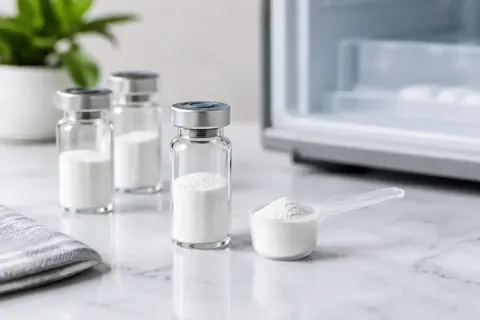
An older vial of peptide powder presents an evidence problem, not simply a calendar problem. Its label may carry a date and its contents may look unchanged, but neither observation establishes the condition of the molecules inside. A meaningful assessment connects the material’s identity with its batch records, packaging and documented storage history.
There is no universal answer to how long peptide powders last. Sequence, formulation, residual moisture and exposure all influence stability. For research-use materials, the aim is to establish whether the available evidence is adequate for the planned experiment—not to infer a usable period from appearance or generic advice. These materials are for research use only, not human consumption.
Begin with the meaning of the batch date
Expiry and retest dates answer different questions. An expiry date describes the end of a period during which defined specifications are expected to be met under stated conditions. A retest date marks a point when further assessment is needed before continued use. Suppliers may use these terms differently, so the accompanying explanation matters as much as the date itself.
Neither date stands apart from the conditions on which it was based. Packaging assumptions, temperature requirements and supporting stability information give the date its meaning. An undocumented period in a warm environment introduces uncertainty that an otherwise in-date label cannot resolve.
When reviewing a vial, first match its lot number to the relevant documentation. Then establish whether the date refers to expiry or reassessment, and whether the stated conditions describe the material’s actual history. General information about dry peptides cannot replace batch-specific evidence.
Why removing water changes stability
Lyophilisation uses freezing and vacuum drying to remove most of the water from a preparation. With less water available, some degradation processes, including hydrolysis, can proceed more slowly. This helps explain why a dry peptide preparation may be comparatively more stable than the same compound in solution.
Dry does not mean chemically inactive. Residual water can remain after processing, and moisture may enter through a compromised closure or during repeated opening. Susceptible amino acid residues can undergo oxidation. Temperature can accelerate molecular changes, while light exposure is relevant to compounds whose documentation specifies light protection.
The peptide sequence is only part of the picture. Excipients, molecular structure, vial headspace and the quality of the closure can also affect stability. Two powders with similar appearances therefore need not behave alike, even when both are described as lyophilised.
A normal-looking powder is not analytical evidence
Colour and texture are useful observations, but poor substitutes for chemical testing. A white, dry cake can contain changes that are not visible. Equally, a small difference in cake shape does not establish that degradation has occurred.
Inspection is best treated as a way to identify questions requiring investigation. A cracked vial, damaged seal, illegible label, unexpected discolouration or visible dampness should interrupt routine acceptance. These findings do not identify the underlying chemistry, but they can show that the material no longer matches the assumptions in its records.
Unknown history deserves similar attention. A parcel with an unexplained delay or possible heat exposure may require review even when its packaging looks intact. Document the concern rather than trying to settle it by looking at the powder.
Storage records provide the missing context
The relevant storage conditions are those specified for the particular material. Selecting a temperature from a general online rule can introduce variables not covered by the supplier’s evidence. Consistency and traceability matter more than an unsupported claim that one storage method suits every peptide.
Original packaging is also part of the assessment. Transferring material, repeatedly opening a vial or compromising its closure changes the exposure conditions. Temperature cycling can introduce condensation risks, particularly when opening and environmental moisture interact. Such events should be considered within a controlled laboratory procedure rather than assumed to be harmless.
A useful material record captures:
- The receipt date, lot number and designated storage location.
- The stated temperature requirements and any recorded excursions.
- Whether the original closure and protective packaging remain intact.
- Opening, transfer or other handling events relevant to the study.
- Observations about labels, container damage or unexpected appearance.
These records do not extend a validated period. They make it possible to judge whether the conditions behind the batch documentation still apply.
What a certificate of analysis contributes
A certificate of analysis, or COA, may report the lot number, test date, analytical methods, chromatographic purity and molecular mass. High-performance liquid chromatography, commonly abbreviated to HPLC, separates detectable sample components and provides information about their relative profile. Mass spectrometry can support identity assessment by comparing observed and expected molecular mass.
The important limitation is timing. A COA describes the sample examined when the analysis was performed. It cannot establish that every vial has remained unchanged during subsequent transport, storage and handling.
Read the certificate alongside the batch date, packaging information and storage record. A well-matched report provides a useful baseline; an unrelated or generic certificate does not establish the condition of the vial under review.
For research that depends on consistency over time, repeat analysis or retained samples may be appropriate. A later result offers more direct evidence of current condition only when the tested sample is representative of the material being used and the methods are suitable for the question.
Solutions require a separate assessment
Evidence concerning a dry powder should not be carried across unchanged to a reconstituted sample. Dissolution alters the chemical environment: pH, dissolved oxygen, molecular mobility and contact with container surfaces can all become relevant.
Hydrolysis, oxidation, aggregation and adsorption may affect the resulting preparation. Their importance depends on the peptide, solvent system, concentration, container and research procedure. The dry vial’s date does not establish an appropriate holding period for that solution.
Where an experiment requires material to remain analytically consistent over time, a written study protocol and suitable checks are more informative than a general storage estimate. The assessment must address the actual preparation being studied.
Investigating an excursion or an older vial
A temperature excursion does not automatically demonstrate complete degradation. Its significance depends on the compound, the duration and extent of exposure, and whether the container remained sealed. Equally, the absence of visible damage does not establish that the event was inconsequential.
A structured review begins by setting aside material with unresolved history from routine stock. Reconcile the label and COA, establish the meaning of the date, and gather the available transport and storage records. Record any gaps explicitly rather than treating missing information as evidence of acceptable conditions.
The next question is whether supplier stability information can resolve the discrepancy. If not, consider whether analytical verification can answer the questions relevant to the experiment. Sensitive comparisons may require stronger evidence than exploratory work, but neither benefits from an undocumented assumption.
Research references and ordering context
For a compound-specific documentation enquiry, the GHRP-2 research listing is a starting point for requesting the relevant batch report. Researchers can also review delivery information for Bangkok. Parcels ship from Germany, the USA or China, with delivery taking 5–18 business days from tracking; this is an international delivery service, not a local premises claim.
The guide to storage and reconstitution records provides related research context. It should be read alongside the material’s own documentation, not as a replacement for it.
The useful conclusion is not a single number of months or years. It is a documented judgement about whether identity, analytical condition and handling history are sufficiently understood for the work planned. When those elements cannot be established, a tidy-looking vial is not enough to close the gap.
Peptides in this article
Add a solvent
- Bacteriostatic Water
Kit of 10 × 10 ml vials · Standard solvent for most peptides
€149.00 - Acetic Acid Kit
Kit of 10 × 3 ml vials (liquid) · For peptides that stay cloudy in BAC water
€149.00
Share Regena with a research colleague. They get trusted peptides; you earn 3–30% affiliate commission based on your monthly referred sales.
More research reading
Not sure which peptide fits your research question?
Take the 60-second Find Your Peptides quiz — it points you to the most relevant reference compounds for your area of investigation.
Start the quiz