
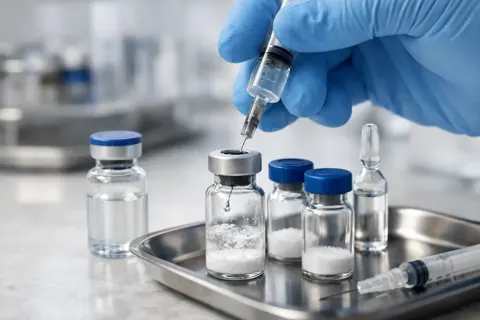
Reconstitution changes more than the physical appearance of a peptide sample. Once a lyophilised material becomes a solution, solvent compatibility, concentration, handling and storage all become part of its research history. A preparation error can therefore introduce uncertainty even when the original batch has useful analytical documentation.
The appropriate approach is compound-specific and governed by a laboratory procedure. This overview explains the decisions and records that support controlled preparation; it is not a universal vial-mixing protocol. Peptide materials discussed here are for research use only, not human consumption, and the guidance does not cover administration.
Establish what is in the vial
Lyophilisation removes water to produce a dried material, often supplied in this form to support stability during transport and storage. Reconstitution means introducing a compatible solvent to return that material to solution for laboratory work.
Before preparing it, confirm the compound name, batch identifier and stated amount. Similar-looking cakes can contain different quantities, so appearance is not a reliable measure of peptide content.
Also distinguish nominal vial quantity from analytically established peptide content where that difference matters to the experiment. A high HPLC area-purity result describes chromatographic response; it does not, on its own, determine the net peptide mass available for a quantitative preparation.
The label, certificate and laboratory plan should agree about the material being used. If they do not, resolve the discrepancy before introducing solvent. Once preparation begins, it becomes harder to separate an original documentation problem from a handling error.
Define the research requirement before choosing a volume
The starting question is not simply how much liquid a vial can hold. It is what solution the laboratory method requires, and whether that solution can be prepared and measured reliably.
Concentration relates the amount of material to the final solution volume. Changing the volume changes the concentration, not the starting quantity of peptide. The planned value must therefore be consistent with the documented material amount and the measurement approach used by the laboratory.
Keep mass and volume units distinct. Milligrams and millilitres describe different quantities, and confusing them can produce an incorrect record even if the physical preparation appears uneventful.
A more dilute solution may be easier to measure accurately in some workflows, but it can require more storage space or additional handling. A more concentrated preparation may reduce volume while creating other practical constraints. Neither choice is automatically better: the validated research method should determine the requirement.
Record the intended concentration and the basis for it before preparation. Where a calculation is uncertain, obtain an independent check rather than trying to resolve it after the vial has been mixed.
Select the solvent from compound-specific information
Solvent selection cannot safely be generalised across peptides. Compatibility depends on the material and the intended laboratory application, as well as the conditions under which the solution will be handled.
Sterile water and bacteriostatic water are sometimes discussed as though they were interchangeable. They are not universally equivalent, and neither should be selected solely because it appears in generic online advice. The relevant product documentation and laboratory procedure should establish what is appropriate.
Check whether the handling information describes the specific peptide form and preparation being used. Instructions for a different compound, concentration or research context may not transfer to the current material.
If the documentation does not identify a compatible solvent or leaves conflicting advice, pause and seek technical clarification. Choosing a solvent by trial and error can make subsequent observations difficult to interpret.
Control the preparation environment
A defined procedure should cover the working area, suitable equipment, contamination controls and the sequence of preparation. Planning these elements in advance reduces interruptions and helps prevent mix-ups between vials.
Cleanliness and aseptic handling, where required by the laboratory method, are distinct from proof of sterility. Careful technique can reduce opportunities for contamination; it cannot establish that an untested starting material is sterile.
Repeated access to a container also creates further opportunities for contamination or recording errors. Organising the work to avoid unnecessary handling is therefore part of sample control, not merely a matter of convenience.
Use the laboratory's approved equipment and procedure rather than adapting instructions intended for a different use. The preparation record should make clear which batch was handled and which solvent and process were used.
Treat mixing and appearance as process observations
Mixing behaviour varies between peptides. Some materials dissolve readily, while others require more time or different conditions specified in the relevant method. A universal expectation of immediate dissolution can encourage unnecessary intervention.
Excessive agitation may produce foaming or bubbles and can be unsuitable for some compounds. Follow the validated mixing approach rather than assuming that more vigorous handling will resolve incomplete dissolution.
Visual inspection is useful for identifying unexpected particles, clumps or cloudiness, but appearance has limits. A clear solution is not proof of chemical integrity, correct concentration or sterility. Likewise, an unusual appearance should be assessed against the compound-specific documentation before assigning a cause.
If the material behaves differently from the documented expectation, stop and review the identity, solvent, planned concentration and handling record. Do not assume that an unexpected appearance can be corrected without affecting the preparation's suitability for research.
Create a record that remains useful later
Labelling should connect the prepared solution to its original batch and its preparation history. Without that connection, even a correctly made solution can become difficult to interpret when several compounds or vials are stored together.
A useful preparation record includes:
- Compound identity and original batch number.
- Preparation date.
- Solvent identity and recorded volume information.
- Calculated concentration and the basis for that calculation.
- Relevant observations or departures from the approved procedure.
Labels and supporting records should be consistent. A concentration written on a vial without its underlying calculation or batch reference leaves avoidable uncertainty for anyone reviewing the work later.
This becomes particularly important when comparing multiple preparations or carrying out research over an extended period. Traceability allows differences in handling to be considered alongside differences in analytical results.
Base storage decisions on evidence
Do not assume that every peptide solution has the same storage requirements. Relevant conditions depend on the compound, solvent and preparation. Temperature, light, moisture exposure and time can all affect the material, but their importance is not identical in every case.
Use compound-specific, supported storage information rather than a generic refrigeration rule or an unsupported shelf-life estimate. A certificate for the original batch does not establish how long a newly prepared solution remains unchanged.
Repeated temperature changes and freeze–thaw cycles should also be considered within the laboratory's stability guidance. Aliquoting may reduce repeated access in some workflows, but it introduces its own preparation and labelling steps and should not be treated as universally appropriate.
Ambient conditions deserve attention during handling, including in warmer regions such as southern Spain. The relevant issue is the material's actual exposure and documented requirements, not an assumption based solely on delivery destination.
Resolve uncertainty before continuing
Seek clarification when the solvent choice is unclear, the concentration record cannot be reconciled or dissolution differs from expectations. Supplier technical information can help explain the material, while the laboratory remains responsible for deciding whether its preparation method is appropriate.
Review independent testing documentation as evidence about the tested batch, not as assurance that later handling cannot change it. Analytical records and preparation controls serve related but separate purposes.
For compound-specific ordering context, consult the SS-31 research material page and request the relevant batch documentation. The Alhaurin El Grande delivery guide describes shipping to the area. Orders originate in Germany, the USA or China, with delivery typically taking 5–18 business days from tracking being issued; there are no local premises implied by the destination page.
Preserve the link between material and method
Reliable reconstitution is a documented laboratory process, not simply the disappearance of powder into liquid. Confirm the starting material, establish the required solution, follow a compound-appropriate procedure and retain a clear preparation record.
Those controls do not guarantee an unchanged or suitable sample. They make the process reviewable, help identify sources of uncertainty and give subsequent research results a more interpretable preparation history.
Peptides in this article
Add a solvent
- Bacteriostatic Water
Kit of 10 × 10 ml vials · Standard solvent for most peptides
€149.00 - Acetic Acid Kit
Kit of 10 × 3 ml vials (liquid) · For peptides that stay cloudy in BAC water
€149.00
Share Regena with a research colleague. They get trusted peptides; you earn 3–30% affiliate commission based on your monthly referred sales.
More research reading
Not sure which peptide fits your research question?
Take the 60-second Find Your Peptides quiz — it points you to the most relevant reference compounds for your area of investigation.
Start the quiz