
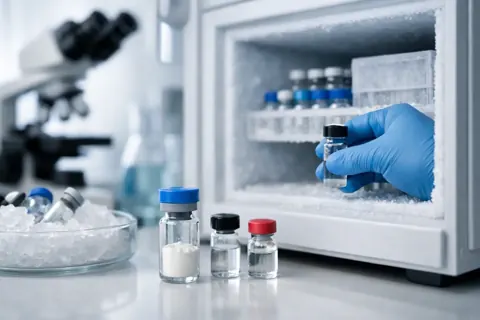
Moving a peptide from a dry state into solution changes the storage questions a laboratory must answer. Conditions appropriate for an unopened lyophilised vial may not be suitable for the same compound after reconstitution. A dependable workflow recognises that transition rather than treating refrigeration as a complete solution.
Storage belongs within the research method because handling can influence later observations. The appropriate controls depend on the peptide, formulation, solvent system and pattern of access. These materials are for research use only and are not for human consumption.
Define requirements before choosing a storage location
Review the compound-specific documentation first. Identify the supplied form, stated environmental conditions and any handling information relevant to the planned laboratory work. General advice can help identify questions, but it should not override information about the actual material.
Batch reports provide a separate starting reference. A certificate of analysis and HPLC data describe testing performed on a sample under defined conditions. They do not establish continuing stability through every subsequent transfer, opening or preparation event.
This distinction matters when interpreting experiments. If the storage history changes between sessions, a difference in observations may reflect handling as well as the research question. Keeping these variables visible supports reproducibility without implying that storage records alone prove suitability.
Protect dry material from environmental exposure
Lyophilised peptides contain much less water than their corresponding aqueous preparations, but they are not unaffected by their surroundings. Moisture exposure can change the material's physical characteristics and stability, while heat may accelerate degradation. Some sequences are also sensitive to light.
Use the temperature conditions specified for the compound rather than selecting refrigeration or freezing by habit. No single temperature approach or retention period applies to all peptides. Keep any stated requirements accessible at the storage location and in the sample record.
Avoid unnecessary opening of dry vials. Ambient humidity can introduce moisture, particularly when containers are repeatedly exposed to room air. Condensation is another consideration when cold material is brought into a warmer working environment; manage that transition under the relevant laboratory procedure.
Where protection from light is required, preserve the supplied protective packaging or use suitable secondary containment. The absence of a visible change does not demonstrate that exposure has had no effect.
Reassess the plan when material enters solution
Reconstitution creates a different storage context. Peptides in solution are often less stable than in lyophilised form, but the extent depends on the compound and solvent system. Information established for dry material should not be used as evidence for a prepared solution's stability.
The research protocol should define preparation and storage conditions using the relevant documentation. Do not assign a generic shelf life or assume that cold storage makes any solution suitable for later work.
Repeated freeze–thaw cycles can place stress on material. Where the protocol supports divided samples, traceable aliquots can reduce repeated thawing and access to a single container. Freezing itself should not be assumed appropriate without compound-specific support.
Planning preparation around the experiment can also limit unnecessary handling. The aim is to avoid creating material with an uncertain subsequent history, not to prescribe a universal preparation volume or schedule.
Consider the container as part of the system
Storage conditions are only useful if the container remains suitable. An intact original vial may serve for initial storage, but transfers and aliquoting introduce further choices about compatibility, closures and contamination control.
Chemically compatible containers and appropriate laboratory cleanliness help manage these risks. Where the protocol requires sterile containers, that requirement should be explicit; sterility of a container does not establish sterility of its contents. Container choice may also matter where adsorption to surfaces affects the sample.
Each opening creates an opportunity for moisture, particulates or microbial contamination to enter. Reducing unnecessary access can therefore complement environmental control. Smaller portions may be useful where supported by the research method, but every new container must retain its connection to the original batch.
Check seals, caps and labels during routine handling. A loose closure or unreadable identifier can undermine an otherwise carefully controlled storage plan.
Make bench handling consistent with storage control
A sample can be held at the specified temperature yet still experience inconsistent conditions during use. Time outside storage, repeated transfers and exposure to condensation all belong in the wider handling assessment.
Give each sample a defined location and a legible identifier. Record the compound name, batch reference, receipt date and, where applicable, preparation date and solvent information. Aliquot labels should connect to the parent sample rather than become independent, unexplained identifiers.
Temperature monitoring should reflect the storage environment, not merely the appliance setting. Frequently opened domestic units can introduce variability; an appropriately controlled laboratory environment is preferable. Even within a laboratory, organisation matters because prolonged searching and repeated box opening can disturb unrelated samples.
Recognise common failures before they become routine
Several avoidable habits weaken storage control:
- applying one peptide's requirements to all compounds;
- assuming dry and reconstituted material behave alike;
- repeatedly accessing a master container without reviewing alternatives;
- transferring material without preserving batch and solvent records;
- treating a COA as a guarantee of future stability.
These errors are connected. Poor planning can increase handling, while weak labels make the resulting history difficult to reconstruct. A useful workflow addresses both the physical controls and the information that explains them.
When a closure fails, an excursion occurs or provenance becomes unclear, review the sample before incorporating it into planned research. Appearance alone cannot establish identity, purity or the consequences of an exposure.
Connect practical guidance with the actual material
The LL-37 research page is one starting point for a compound-specific documentation review. Request the relevant batch information and assess handling requirements before making a storage decision.
Ordering logistics are separate from evidence of stability. The Madrid delivery details describe delivery from Germany, the USA or China, taking 5–18 business days from tracking; they do not indicate local premises. Further educational context is available in the peptide storage and reconstitution guide.
A robust storage method follows the material through each change of state and container. Use documented conditions, limit avoidable exposure and preserve the batch connection throughout. This makes handling a visible part of the experiment rather than an unexplained variable discovered afterwards.
Peptides in this article
Add a solvent
- Bacteriostatic Water
Kit of 10 × 10 ml vials · Standard solvent for most peptides
€149.00 - Acetic Acid Kit
Kit of 10 × 3 ml vials (liquid) · For peptides that stay cloudy in BAC water
€149.00
Share Regena with a research colleague. They get trusted peptides; you earn 3–30% affiliate commission based on your monthly referred sales.
More research reading
Not sure which peptide fits your research question?
Take the 60-second Find Your Peptides quiz — it points you to the most relevant reference compounds for your area of investigation.
Start the quiz