
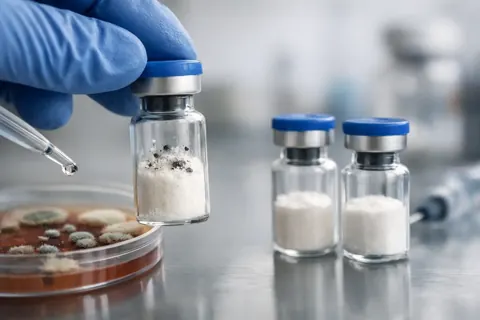
When a peptide vial looks different from expected, the first task is to preserve the evidence—not to explain the change immediately. Visible debris, a damaged closure or an unexpected colour can justify withholding a sample from research, but none identifies the underlying cause by itself.
The reverse is equally important: an apparently normal vial may contain an unseen contaminant or be incorrectly labelled. Assessment therefore requires more than a visual pass or fail. Observation, handling history, batch records and appropriately selected laboratory tests each contribute different information. The guidance here applies only to research materials, not to human consumption.
Separate the possible problems
Several distinct issues are often described as contamination. Particulate contamination involves foreign matter such as fibres, dust, stopper fragments or glass. Chemical contamination may involve residual solvents, cleaning substances, carryover or an unintended component introduced during processing. Microbial contamination requires a different assessment again.
A sample mix-up can compromise identity without introducing foreign material into the vial. Degradation can alter composition without being contamination in the strict sense. Temperature, light, moisture and repeated handling may contribute to changes in a peptide's condition.
These distinctions determine the investigation. A collapsed lyophilised cake, for example, is an observation about physical appearance. It does not independently demonstrate microbial growth, chemical carryover or foreign particles. Recording the observation accurately keeps competing explanations open until evidence supports one of them.
Inspect before altering the sample
Begin with a non-destructive receiving check under good lighting. Examine the outer packaging, vial, label and closure before opening anything. Record the arrival date, batch number and package condition, and take photographs where appropriate to the laboratory's record system.
Look for cracks, chips, loose seals, punctures or signs that the closure has been disturbed. A damaged container is a reason for review even if its contents appear unchanged. Check that the label is readable and agrees with the accompanying documentation; a mismatch is a traceability problem that should be resolved before experimental use.
For dry material, note unexpected moisture, discolouration, visible debris or changes in the cake or powder. For material already in solution, record cloudiness, sediment, floating matter, films or unexpected colour changes. Describe what is visible without converting it into a diagnosis.
Some of these features can have explanations other than contamination. Precipitation, temperature-related changes or formulation properties may affect appearance. Conversely, many chemical contaminants are colourless or occur at concentrations too low to see. Neither visual clarity nor an unusual appearance settles the question.
Quarantine preserves both evidence and control
A questionable vial should be clearly marked as not for use and separated from accepted research stock. This prevents accidental inclusion in an experiment while the concern is assessed. Record who handled it, when the issue was first noticed and any known transit or storage events.
Avoid attempts to make the contents appear normal before review. Filtering, vigorous shaking or transferring the material can remove or redistribute evidence and introduce new variables. Retaining the original vial and closure helps preserve the context of the observation.
The response should be proportionate. A cosmetic defect on an external label may need a documentation query. Internal particles, a broken closure or unresolved lot identification generally warrant a more formal investigation. In either case, record the reason for the decision rather than relying on an informal verbal judgement.
Reconstruct the material's history
Receiving records are most useful when connected to the sample's subsequent handling. Establish where the vial was kept, who accessed it and whether any departures from stated conditions were recorded. Keep known events separate from suspected explanations.
A temperature excursion, for example, may help interpret a physical or analytical change, but it does not prove contamination. Similarly, transit delay is relevant context rather than a diagnosis. The purpose of the history is to identify plausible contributors and gaps in knowledge.
Keep the vial, its label and associated paperwork linked throughout the review. Once identifiers and records become separated, even a detailed analytical result may be difficult to connect to the correct material. Chain-of-custody information supports interpretation as much as the final test report does.
What batch documentation can establish
A batch-specific certificate of analysis can show which tests were reported for the supplied lot. Review the compound name, batch identifier, sample description, analysis date and results against the material in hand. A generic purity statement without a lot reference provides limited evidence for a particular vial.
HPLC is commonly used to assess chromatographic purity. It can describe the relative signals from the principal peak and detectable secondary components under the stated conditions. It does not identify every possible contaminant or establish microbiological quality.
Mass spectrometry can provide supporting molecular-mass evidence relevant to identity. Other questions may require residual-solvent analysis, elemental analysis, particulate characterisation or tests for bioburden and endotoxin. These parameters should not be inferred from a high HPLC percentage.
Documentation also has a time and sampling context. A batch report is part of the evidence trail, not a substitute for examining the vial's subsequent condition and handling history. Its findings should be read alongside the current observation rather than used to dismiss it automatically.
Select tests around a defined question
Before commissioning laboratory work, state what needs to be resolved. Investigating visible matter is different from confirming peptide identity, comparing impurity profiles or assessing a suspected microbial issue. An unfocused request for a general quality check may leave the central concern unanswered.
A suitably qualified laboratory can help match methods to the suspected problem. Chromatographic comparison may be useful for changes in detectable components. Mass-based analysis can support identity assessment, while microscopy or particulate analysis may help characterise visible matter.
Microbiological investigation requires controlled laboratory procedures and qualified interpretation. It cannot be replaced by informal observations or by waiting to see whether the vial changes appearance. Likewise, an analytical method should not be assumed to exclude substances outside its detection scope.
Testing can consume limited material and involve substantial cost. The decision should reflect the significance of the planned experiment, the strength of the concern, available batch records and access to verified comparison material. Document sample handling, methods and acceptance criteria so that the resulting report can support a clear research decision.
Compound references and international delivery
The KPV research listing offers a starting point for compound-specific review; establish which documentation is available for the relevant batch rather than assuming that general listing information resolves a vial concern.
For destination information, consult the Rio de Janeiro delivery guide. Orders are dispatched from Germany, the USA or China, not local premises, with delivery in 5–18 business days from tracking being issued. Record actual arrival and packaging condition as part of receiving checks.
Reduce ambiguity in later investigations
A consistent receiving routine makes future discrepancies easier to assess. Inspect arrivals, verify lot numbers, record damage and keep batches distinguishable. Maintain storage records and use controlled laboratory practices appropriate to the work. Avoid pooling material from different vials unless the research protocol specifically calls for it.
The independent testing results resource provides additional context for reviewing analytical evidence. Any report still needs to be connected to its tested sample and interpreted within its stated scope.
A defensible contamination assessment ends with a documented conclusion—or a clearly recorded uncertainty. Preserve the original observation, investigate the relevant possibilities and avoid allowing reassuring appearance or a general certificate to answer questions they cannot resolve.
Peptides in this article
Add a solvent
- Bacteriostatic Water
Kit of 10 × 10 ml vials · Standard solvent for most peptides
€149.00 - Acetic Acid Kit
Kit of 10 × 3 ml vials (liquid) · For peptides that stay cloudy in BAC water
€149.00
Share Regena with a research colleague. They get trusted peptides; you earn 3–30% affiliate commission based on your monthly referred sales.
More research reading
Not sure which peptide fits your research question?
Take the 60-second Find Your Peptides quiz — it points you to the most relevant reference compounds for your area of investigation.
Start the quiz