
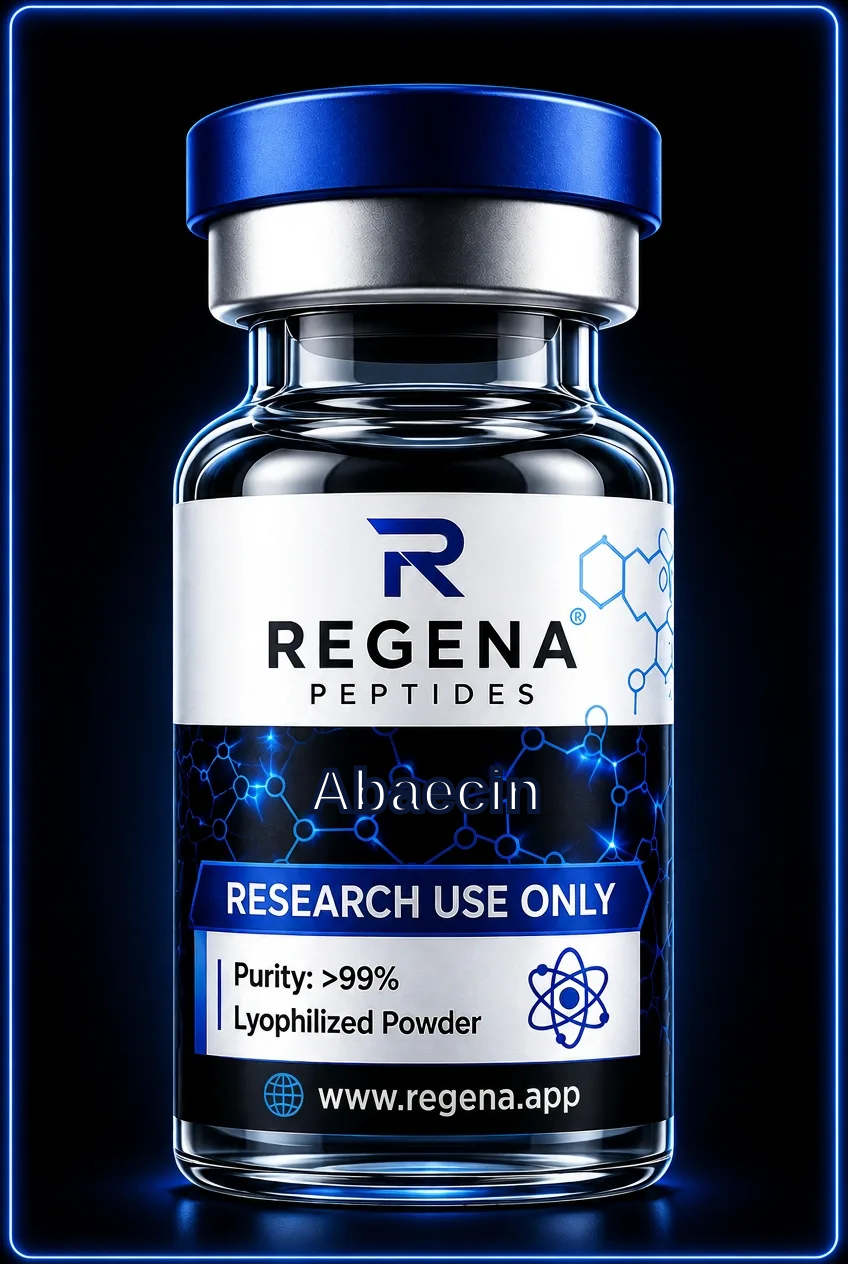
Antimicrobial · Proline-rich insect antimicrobial peptide
Abaecin
Also known as —
A proline-rich bee peptide studied for bacterial interactions and cooperation with other components of insect innate immunity.
- Length
- 34 amino acids
- Half-life
- Not well characterised
- Mechanism
- Abaecin is a proline-rich antimicrobial peptide whose activity depends on bacterial envelope access and intracellular interactions rather than a defined receptor. Studies of bumblebee abaecin support interaction with the bacterial chaperone DnaK and cooperation with membrane-active peptides; these findings should not be assumed to apply identically to every species variant.
- Studied in
- Bacterial growth assays, membrane-permeability measurements and protein-binding experiments investigate abaecin variants and their interactions with other insect antimicrobial peptides.
About Abaecin
Abaecin was originally isolated from the haemolymph of immune-challenged honeybees, Apis mellifera, and described in 1990. The mature honeybee peptide contains 34 amino acids and is unusually rich in proline. It lacks the cysteine-stabilised framework found in insect defensins and belongs to a structurally distinct group of antimicrobial peptides. Related abaecin sequences occur in other bees, so species identity is an important part of any reagent specification.
Mechanistic work places abaecin within the coordinated antimicrobial response of insects rather than identifying a single universal mode of action. Experiments with a bumblebee variant showed interactions with DnaK and enhanced bacterial inhibition when paired with the membrane-active peptide hymenoptaecin. Such observations support models in which envelope access influences intracellular activity. Laboratory interpretation should distinguish direct evidence for the supplied sequence from findings obtained with homologues, particularly when comparing bacterial strains or peptide combinations.
Laboratory notes
- Confirm the species-specific sequence, terminal chemistry and molecular mass before comparing results with published abaecin studies.
- Use low-binding labware and validate stock recovery, as adsorption can alter the effective peptide concentration in small-volume assays.
- For combination experiments, include each peptide separately and monitor both bacterial growth and membrane permeability.
Storage and reconstitution basics: storage guide.
Questions about Abaecin
Does abaecin have a defined receptor?
No universal receptor has been established. DnaK is an experimentally investigated intracellular interaction partner for a bumblebee variant, not a demonstrated receptor shared across all abaecins.
Are honeybee and bumblebee abaecin interchangeable?
No. They are related peptides, but sequence differences can influence bacterial interactions and assay behaviour. Report the exact sequence and source species.
Why investigate abaecin alongside hymenoptaecin?
Bumblebee peptide studies suggest that membrane disruption by hymenoptaecin can facilitate abaecin activity, making the pair useful for examining cooperative insect defence mechanisms. These reagents are for research use only.
Is Abaecin for human use?
No. It is supplied strictly for in-vitro laboratory research and is not for human or animal consumption.
Related research peptides
All products are sold for laboratory research use only. Not for human consumption, not a medicine, not for diagnosing, treating or preventing any condition.