
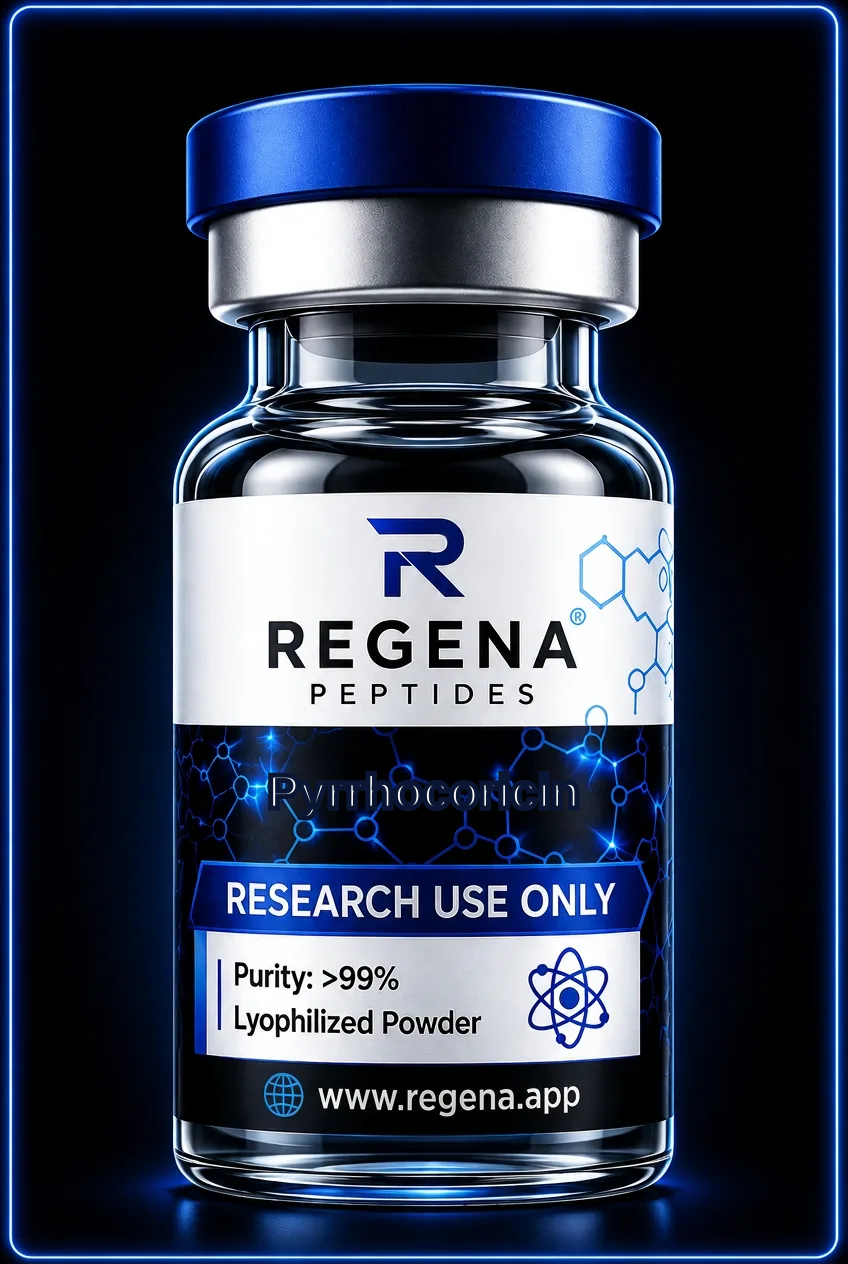
Antimicrobial · Insect proline-rich antimicrobial glycopeptide
Pyrrhocoricin
Also known as —
A firebug-derived, 20-residue glycopeptide used to examine bacterial translation inhibition, transport and DnaK interactions.
- Length
- 20 amino acids
- Half-life
- Not well characterised
- Mechanism
- Pyrrhocoricin interacts with the bacterial ribosomal exit tunnel and inhibits productive translation. Earlier biochemical work also identified interactions with the bacterial chaperone DnaK, but these should not be treated as establishing DnaK as its sole intracellular target.
- Studied in
- Bacterial translation assays, DnaK biochemical systems and transporter-mutant strains are used to separate target binding from uptake-dependent activity.
About Pyrrhocoricin
Pyrrhocoricin was discovered in the firebug, Pyrrhocoris apterus, as part of investigations into insect antimicrobial defence. Its mature backbone contains 20 amino acids and is rich in proline, with native O-linked glycosylation at threonine 11. Both glycosylated material and synthetic unglycosylated analogues appear in the research literature. These preparations should be identified separately because carbohydrate content, terminal chemistry and sequence substitutions can alter their interactions with bacterial components and their behaviour in comparative assays.
Early mechanistic studies emphasised pyrrhocoricin binding to DnaK, a bacterial Hsp70-family chaperone involved in protein folding. Subsequent work on proline-rich antimicrobial peptides established the bacterial ribosome as another important target, with exit-tunnel interactions providing a basis for translation inhibition. Whole-cell experiments also depend on intracellular access, including SbmA-associated uptake in suitable bacterial models. A useful experimental design therefore evaluates transport, ribosomal effects and chaperone interactions independently rather than assuming that one binding assay explains every observation.
Laboratory notes
- Record whether the reagent is glycosylated at threonine 11 and verify the stated terminal modifications.
- For DnaK experiments, define nucleotide conditions and substrate controls because chaperone interactions depend on the biochemical state.
- Use orthogonal translation and membrane-integrity readouts alongside uptake controls when interpreting whole-cell results.
Storage and reconstitution basics: storage guide.
Questions about Pyrrhocoricin
Is DnaK the only proposed target of pyrrhocoricin?
No. DnaK interactions were prominent in early studies, while ribosome-focused research supports translation inhibition through exit-tunnel binding.
What distinguishes native pyrrhocoricin from some synthetic preparations?
Native pyrrhocoricin is O-glycosylated at threonine 11. Some synthetic preparations contain only the 20-residue peptide backbone or additional sequence modifications.
What does an uptake-mutant comparison establish?
It tests whether a particular transporter contributes to whole-cell activity in that strain. It does not, by itself, identify the intracellular molecular target.
Is Pyrrhocoricin for human use?
No. It is supplied strictly for in-vitro laboratory research and is not for human or animal consumption.
Related research peptides
All products are sold for laboratory research use only. Not for human consumption, not a medicine, not for diagnosing, treating or preventing any condition.