
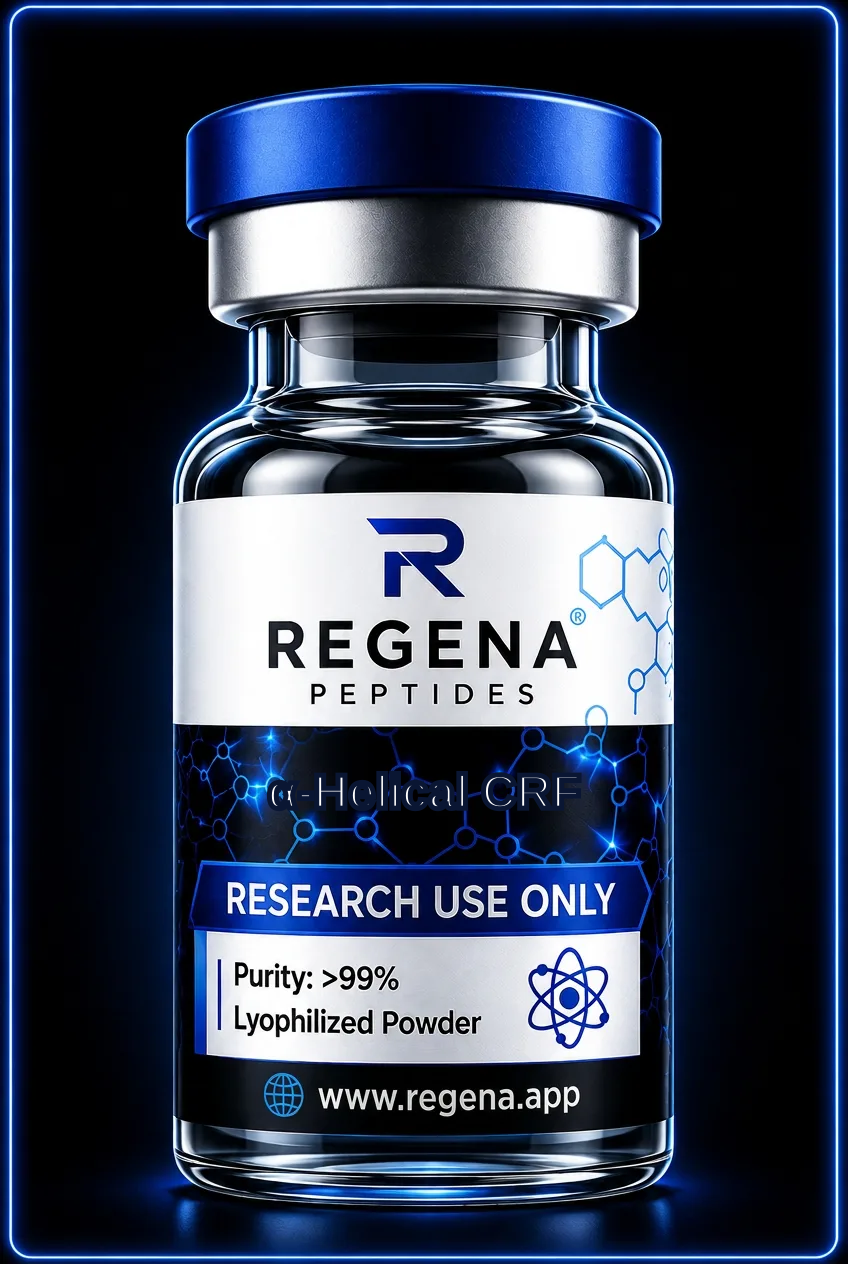
Other · Modified CRF fragment; competitive CRF receptor antagonist
α-Helical CRF (9-41)
Also known as α-Helical CRF(9–41); α-helical CRH(9–41)
A helix-favouring CRF fragment used as an early antagonist probe of CRF1- and CRF2-mediated signalling.
- Length
- 33 amino acids
- Half-life
- Not well characterised
- Mechanism
- α-Helical CRF(9–41) competes with corticotropin-releasing factor family agonists at CRF1 and CRF2 receptors, reducing agonist-driven signalling. It is not reliably subtype-selective and can display residual agonist activity in some assay systems.
- Studied in
- Pituitary cell cultures, recombinant CRF receptor assays and rodent neuroendocrine models use this analogue to investigate CRF-dependent signalling.
About α-Helical CRF (9-41)
Developed during early structure–activity studies of corticotropin-releasing factor, α-helical CRF(9–41) is a synthetic 33-residue analogue of the peptide’s C-terminal region. The conventional analogue incorporates substitutions that favour an amphipathic helical conformation rather than simply reproducing an unmodified CRF fragment. Its design preserved receptor-binding features while removing the N-terminal segment important for efficient activation, establishing an early approach to peptide antagonism within the CRF receptor family.
Both CRF1 and CRF2 are class B G protein-coupled receptors, commonly studied through cyclic AMP accumulation. α-Helical CRF(9–41) helped establish receptor-dependent components of CRF responses in pituitary and neural preparations. However, its pharmacological behaviour is less clean than a simple antagonist label suggests. Partial agonism and assay-dependent differences in apparent antagonism make peptide-alone controls and receptor-subtype comparisons particularly important when interpreting functional data from different experimental systems.
Laboratory notes
- Check the complete analogue sequence rather than relying on the 9–41 designation; the conventional α-helical analogue contains substitutions.
- Run antagonist-alone controls across the assay range to identify any intrinsic signalling activity.
- Compare CRF1 and CRF2 in matched cellular backgrounds before making receptor-subtype assignments.
Storage and reconstitution basics: storage guide.
Questions about α-Helical CRF (9-41)
Does 'α-helical' mean the peptide has a fixed structure in solution?
No. The name refers to the analogue’s design and conformational propensity. Its actual secondary structure depends on solvent, concentration and receptor interactions.
Can it distinguish CRF1 from CRF2?
Not reliably on its own. It interacts with both receptor subtypes, so subtype-specific controls or complementary probes are needed.
Why test the peptide without a CRF agonist?
Residual agonist activity has been observed in some systems. Peptide-alone measurements help distinguish that activity from straightforward competitive antagonism.
Is α-Helical CRF (9-41) for human use?
No. It is supplied strictly for in-vitro laboratory research and is not for human or animal consumption.
Related research peptides
All products are sold for laboratory research use only. Not for human consumption, not a medicine, not for diagnosing, treating or preventing any condition.