
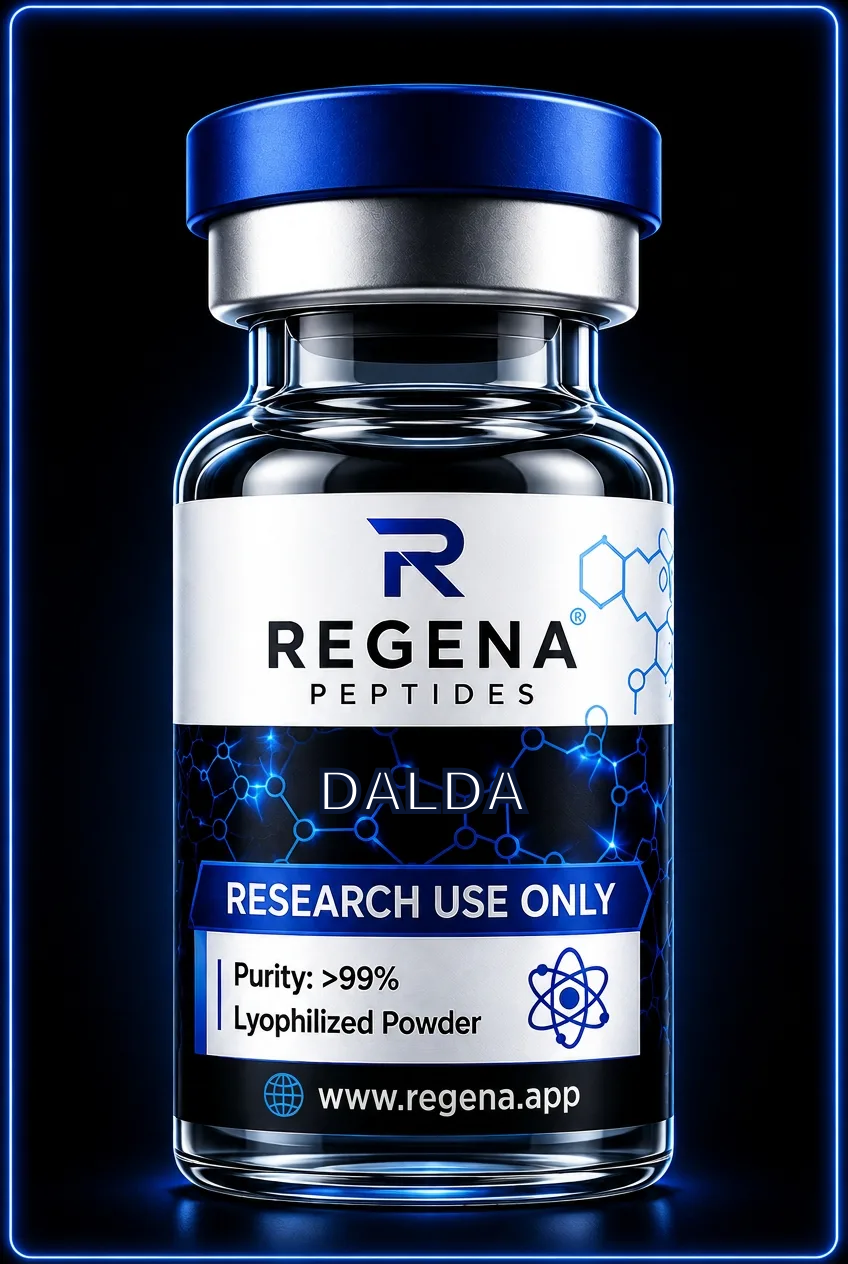
Other · Dermorphin-derived tetrapeptide; μ-opioid receptor agonist
DALDA
Also known as H-Tyr-D-Arg-Phe-Lys-NH₂
A highly cationic, dermorphin-derived tetrapeptide used as a μ-opioid receptor agonist in laboratory assays.
- Length
- 4 amino acids
- Half-life
- Not well characterised
- Mechanism
- DALDA preferentially activates μ-opioid receptors, engaging Gi/o-dependent signalling that can inhibit adenylyl cyclase and alter ion-channel activity. Its cationic residues and amidated C terminus distinguish it from enkephalin-derived opioid probes.
- Studied in
- Receptor-binding assays, isolated tissue preparations and receptor-expressing cells examine DALDA's μ-opioid selectivity, functional activity and structure–activity relationships.
About DALDA
DALDA is the synthetic tetrapeptide Tyr–D-Arg–Phe–Lys–NH₂, developed from the N-terminal opioid pharmacophore of dermorphin, a peptide originally identified in amphibian skin. Its design retains an N-terminal tyrosine and an aromatic residue at position three while introducing basic side chains at positions two and four. The D configuration of arginine at position two and the amidated C terminus are defining structural features, not optional sequence annotations.
At approximately neutral pH, DALDA is strongly cationic because its N-terminal amino group, arginine side chain and lysine side chain are generally protonated. It is studied primarily as a μ-opioid receptor agonist, with selectivity and apparent potency assessed in receptor-binding and functional systems. Comparisons with [Dmt1]DALDA isolate the influence of N-terminal aromatic substitution. As with other peptide agonists, receptor expression, assay endpoint and peptide degradation can affect the observed pharmacological profile.
Laboratory notes
- Verify D-Arg at position two and C-terminal amidation against the analytical specification.
- Record counterion identity and peptide content when calculating assay concentrations from weighed material.
- Assess stability in the actual assay buffer or biological matrix rather than assuming a universal half-life.
Storage and reconstitution basics: storage guide.
Questions about DALDA
What is the sequence of DALDA?
Its sequence is H-Tyr-D-Arg-Phe-Lys-NH₂, with a free N terminus and an amidated C terminus.
How does DALDA differ from [Dmt1]DALDA?
DALDA contains tyrosine at position one; [Dmt1]DALDA replaces that residue with 2′,6′-dimethyltyrosine.
Why is DALDA described as highly cationic?
Its free N terminus and the basic side chains of arginine and lysine generally carry positive charges near neutral pH, while amidation removes the terminal carboxylate.
Is DALDA for human use?
No. It is supplied strictly for in-vitro laboratory research and is not for human or animal consumption.
Related research peptides
All products are sold for laboratory research use only. Not for human consumption, not a medicine, not for diagnosing, treating or preventing any condition.