
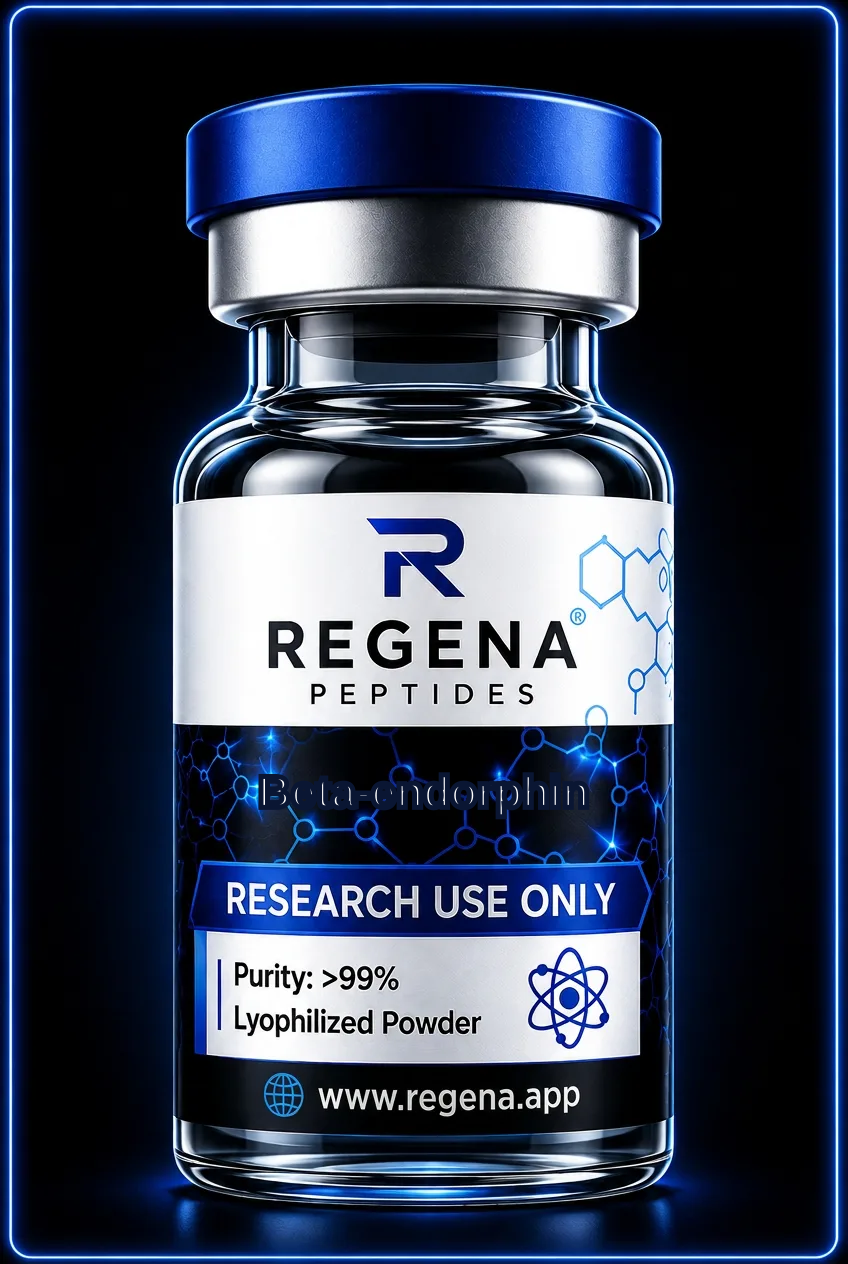
Other · Endogenous opioid peptide; proopiomelanocortin-derived peptide
Beta-endorphin
Also known as β-Endorphin; β-EP
A 31-residue POMC-derived opioid peptide used to examine μ- and δ-opioid receptor signalling and endogenous peptide processing.
- Length
- 31 amino acids
- Half-life
- Not well characterised
- Mechanism
- Beta-endorphin activates μ- and δ-opioid receptors, with receptor preference influenced by the experimental system. These Gi/o-coupled receptors inhibit adenylyl cyclase and modulate ion channels, including inhibition of voltage-gated calcium channels and activation of inwardly rectifying potassium channels.
- Studied in
- Recombinant receptor assays, neuronal cultures and rodent models use beta-endorphin to investigate opioid signalling, nociceptive processing and neuroendocrine regulation.
About Beta-endorphin
Beta-endorphin is a 31-residue peptide generated through tissue-dependent processing of proopiomelanocortin, or POMC. Its sequence occupies the C-terminal region of beta-lipotropin, another product of the same precursor. The N-terminal Tyr-Gly-Gly-Phe-Met sequence is identical to methionine-enkephalin, although the additional residues substantially influence receptor interactions and enzymatic processing. Beta-endorphin was identified during biochemical investigations of pituitary opioid activity and remains a reference ligand for studying endogenous opioid systems in laboratory settings.
At the receptor level, beta-endorphin principally engages μ- and δ-opioid receptors, rather than functioning as a strictly subtype-selective probe. Researchers measure ligand binding, cyclic AMP inhibition, G-protein activation and downstream neuronal responses to distinguish affinity from functional efficacy. Proteolytic truncation and N-terminal acetylation can change its activity substantially, so the exact molecular form matters. Studies of POMC-expressing cells also examine how precursor cleavage, intracellular storage and regulated release shape peptide availability.
Laboratory notes
- Confirm species sequence and terminal modifications on the certificate of analysis; POMC-derived forms are not interchangeable.
- Monitor methionine oxidation and peptide cleavage by LC–MS when working with aged stocks or biological matrices.
- Use receptor-selective antagonists or receptor-defined cell lines to distinguish μ- from δ-mediated responses.
Storage and reconstitution basics: storage guide.
Questions about Beta-endorphin
Is beta-endorphin selective for the μ-opioid receptor?
No. It can activate both μ- and δ-opioid receptors, and their relative contributions depend on receptor expression and assay conditions.
Why does N-terminal acetylation matter?
The free N-terminal tyrosine is central to classical opioid receptor recognition. N-terminal acetylation markedly reduces classical opioid activity.
Does its methionine-enkephalin sequence make it equivalent to that pentapeptide?
No. The shared first five residues form an opioid recognition motif, but the remaining sequence changes receptor interactions, degradation and assay behaviour.
Is Beta-endorphin for human use?
No. It is supplied strictly for in-vitro laboratory research and is not for human or animal consumption.
Related research peptides
All products are sold for laboratory research use only. Not for human consumption, not a medicine, not for diagnosing, treating or preventing any condition.