
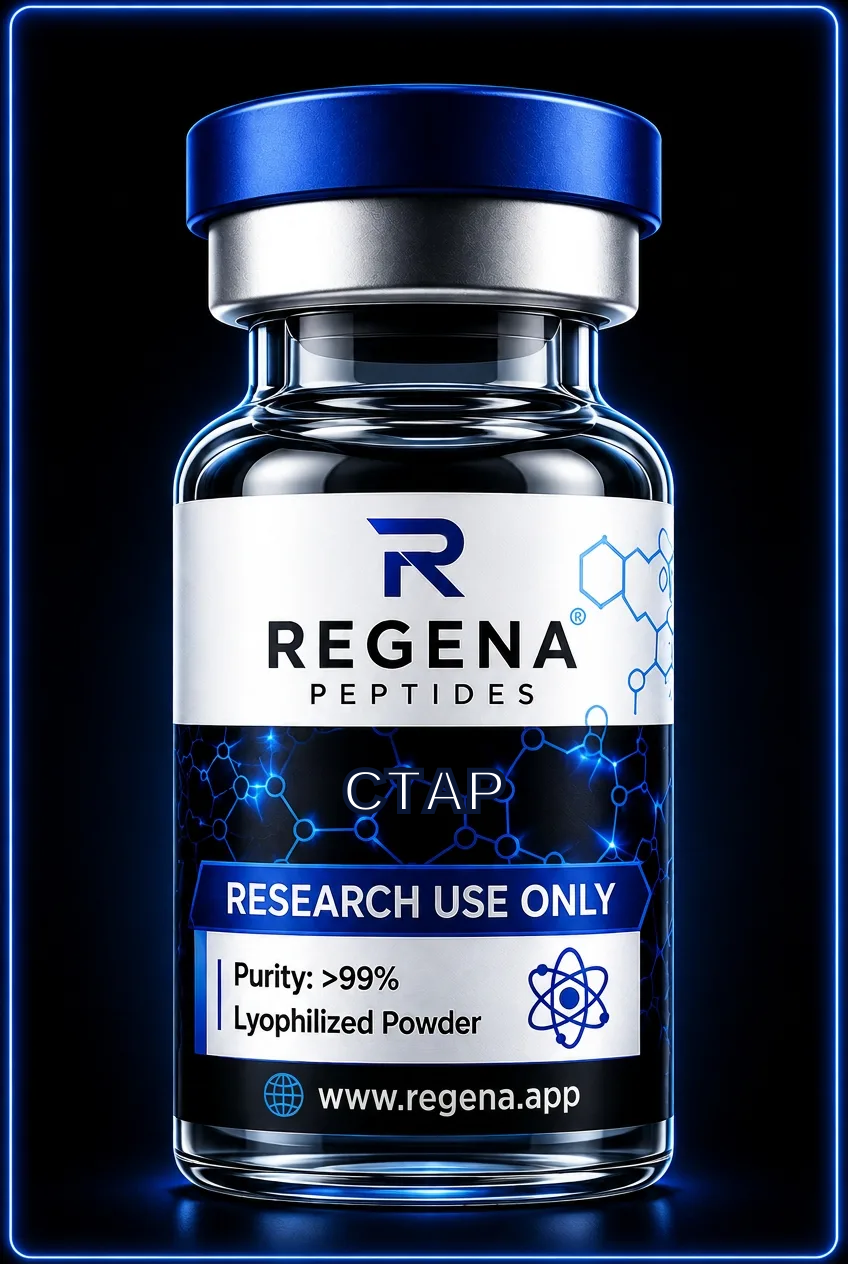
Other · Disulphide-cyclised octapeptide; μ-opioid receptor antagonist
CTAP
Also known as D-Phe-Cys-Tyr-D-Trp-Arg-Thr-Pen-Thr-NH₂
An arginine-containing cyclic octapeptide used as a selective antagonist probe in μ-opioid receptor experiments.
- Length
- 8 amino acids
- Half-life
- Not well characterised
- Mechanism
- CTAP preferentially antagonises μ-opioid receptors through competitive receptor occupancy in standard pharmacological assays. It is used to separate μ-dependent agonist signalling from responses mediated by other receptors or pathways.
- Studied in
- Cell-based signalling assays, isolated tissue preparations, brain slices and rodent models use CTAP to investigate μ-opioid receptor pharmacology and neuronal signalling.
About CTAP
CTAP has the sequence D-Phe–Cys–Tyr–D-Trp–Arg–Thr–Pen–Thr–NH₂ and contains a disulphide bridge between Cys² and Pen⁷. Like CTOP, it belongs to a family of conformationally restricted opioid antagonists derived from work on somatostatin-related peptide scaffolds. Its distinguishing residue is arginine at position five, replacing the ornithine found in CTOP. The C-terminal threonine is amidated, while the N-terminal D-phenylalanine lies outside the disulphide-constrained portion of the sequence.
CTAP is widely employed as a μ-opioid antagonist probe in binding and functional experiments. Its arginine guanidinium group differs from the primary amino side chain of ornithine, altering local charge distribution and hydrogen-bonding possibilities. Studies can assess competitive antagonism by measuring agonist concentration–response relationships under controlled conditions. Neither receptor selectivity nor antagonist behaviour should be assumed identical across every preparation; receptor density, equilibration, peptide integrity and the chosen endpoint all influence interpretation.
Laboratory notes
- Preserve the disulphide-constrained structure by checking assay reagents for reducing activity.
- Verify sequence identity rather than relying on the closely related CTAP and CTOP abbreviations.
- For quantitative antagonism studies, establish equilibration and test multiple antagonist concentrations with matched controls.
Storage and reconstitution basics: storage guide.
Questions about CTAP
Which residue distinguishes CTAP from CTOP?
CTAP has Arg⁵, while CTOP has Orn⁵; the remaining stated sequence and disulphide connectivity are shared.
Why is penicillamine included in CTAP?
Its thiol forms the disulphide bridge with cysteine, and its β-carbon methyl groups contribute to the steric constraints of the cyclic scaffold.
How can competitive antagonism be assessed experimentally?
Agonist concentration–response curves measured across antagonist concentrations can support quantitative analysis, provided equilibrium and other model assumptions are satisfied.
Is CTAP for human use?
No. It is supplied strictly for in-vitro laboratory research and is not for human or animal consumption.
Related research peptides
All products are sold for laboratory research use only. Not for human consumption, not a medicine, not for diagnosing, treating or preventing any condition.