
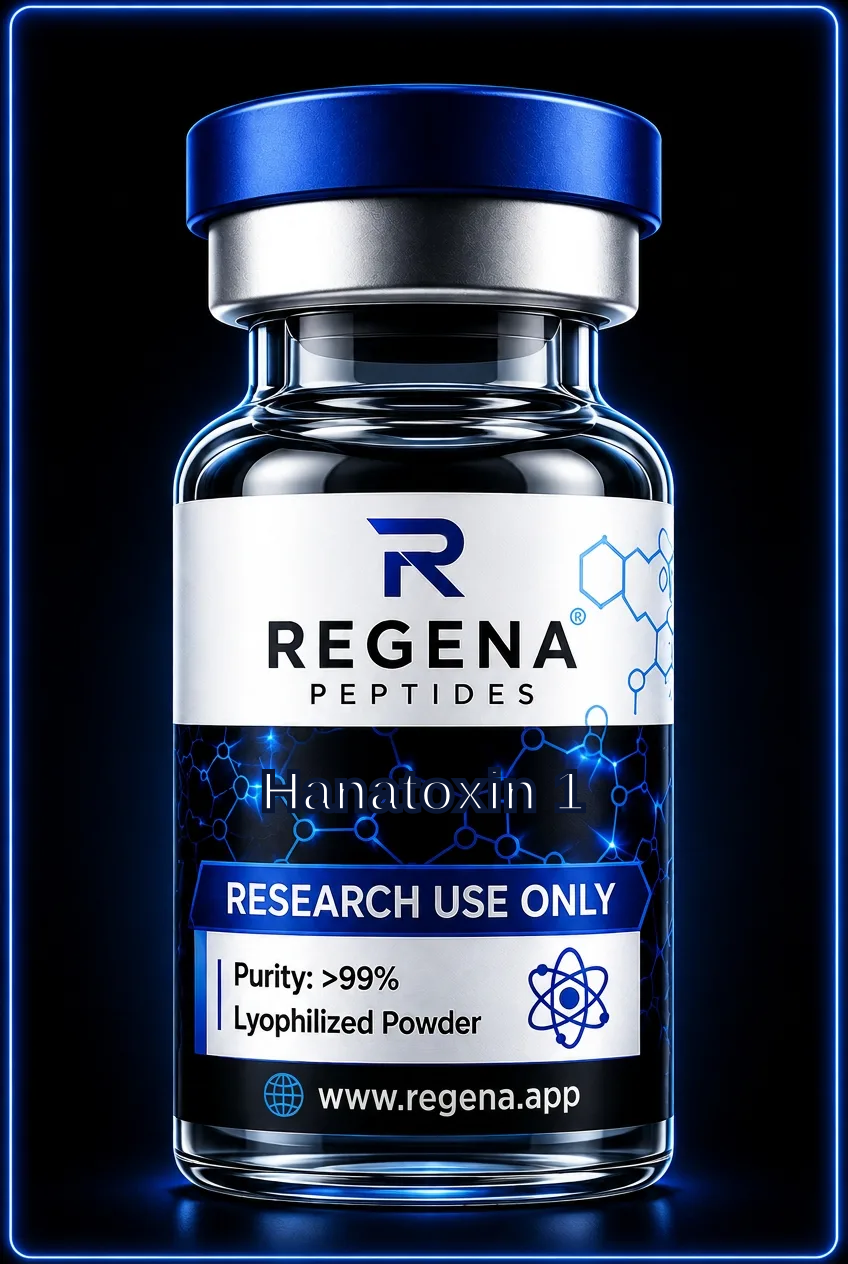
Other · Inhibitor cystine-knot voltage-sensor toxin
Hanatoxin 1
Also known as HaTx1; Hanatoxin-1
A tarantula peptide that modifies Kv-channel voltage sensing, widely studied through Kv2.1 gating and membrane interactions.
- Length
- 35 amino acids
- Half-life
- Not well characterised
- Mechanism
- Hanatoxin 1 interacts with the voltage-sensing domain of susceptible voltage-gated potassium channels, particularly Kv2.1, and stabilises resting voltage-sensor conformations. It shifts activation towards more positive potentials rather than acting as a conventional pore plug.
- Studied in
- Voltage-clamp experiments, channel mutagenesis and membrane-binding assays use hanatoxin 1 to study Kv-channel voltage sensing and toxin–lipid–channel interactions.
About Hanatoxin 1
Hanatoxin 1 is a 35-residue venom peptide originally isolated from a tarantula historically described as Grammostola spatulata. It was characterised alongside a closely related hanatoxin isoform during investigations of potassium-channel inhibition. Three disulphide bonds support an inhibitor cystine-knot scaffold, while an exposed hydrophobic surface contributes to membrane association. Its discovery helped establish that peptide toxins can inhibit voltage-gated channels by altering their gating machinery rather than physically obstructing the ion-conduction pathway.
Kv2.1 is the best-established experimental target, with toxin sensitivity strongly influenced by residues in the extracellular S3–S4 voltage-sensor region. Hanatoxin 1 favours resting sensor states, so sufficiently strong depolarisation can overcome much of the apparent inhibition. This voltage dependence distinguishes its behaviour from simple pore occlusion. Recombinant channels, voltage-sensor substitutions and lipid bilayer experiments are used to examine how membrane partitioning and protein contacts jointly determine the observed gating effect.
Laboratory notes
- Document holding potential, conditioning pulses and test-voltage range because voltage-sensor state strongly affects apparent inhibition.
- Account for membrane partitioning and equilibration time when comparing recordings across cell systems.
- Verify isoform identity and native folding; hanatoxin variants should not be assumed to have identical assay behaviour.
Storage and reconstitution basics: storage guide.
Questions about Hanatoxin 1
Does hanatoxin 1 block the potassium-channel pore?
Its canonical mechanism is voltage-sensor modulation rather than direct pore occlusion, making inhibition dependent on the voltage protocol.
Why is Kv2.1 commonly used in hanatoxin experiments?
Kv2.1 has well-characterised hanatoxin sensitivity and provides a tractable system for mapping toxin contacts and voltage-sensor conformational changes.
Can lipid composition affect the result?
Yes. Membrane association contributes to toxin action, so differences in lipid composition can alter apparent affinity and gating effects.
Is Hanatoxin 1 for human use?
No. It is supplied strictly for in-vitro laboratory research and is not for human or animal consumption.
Related research peptides
All products are sold for laboratory research use only. Not for human consumption, not a medicine, not for diagnosing, treating or preventing any condition.