
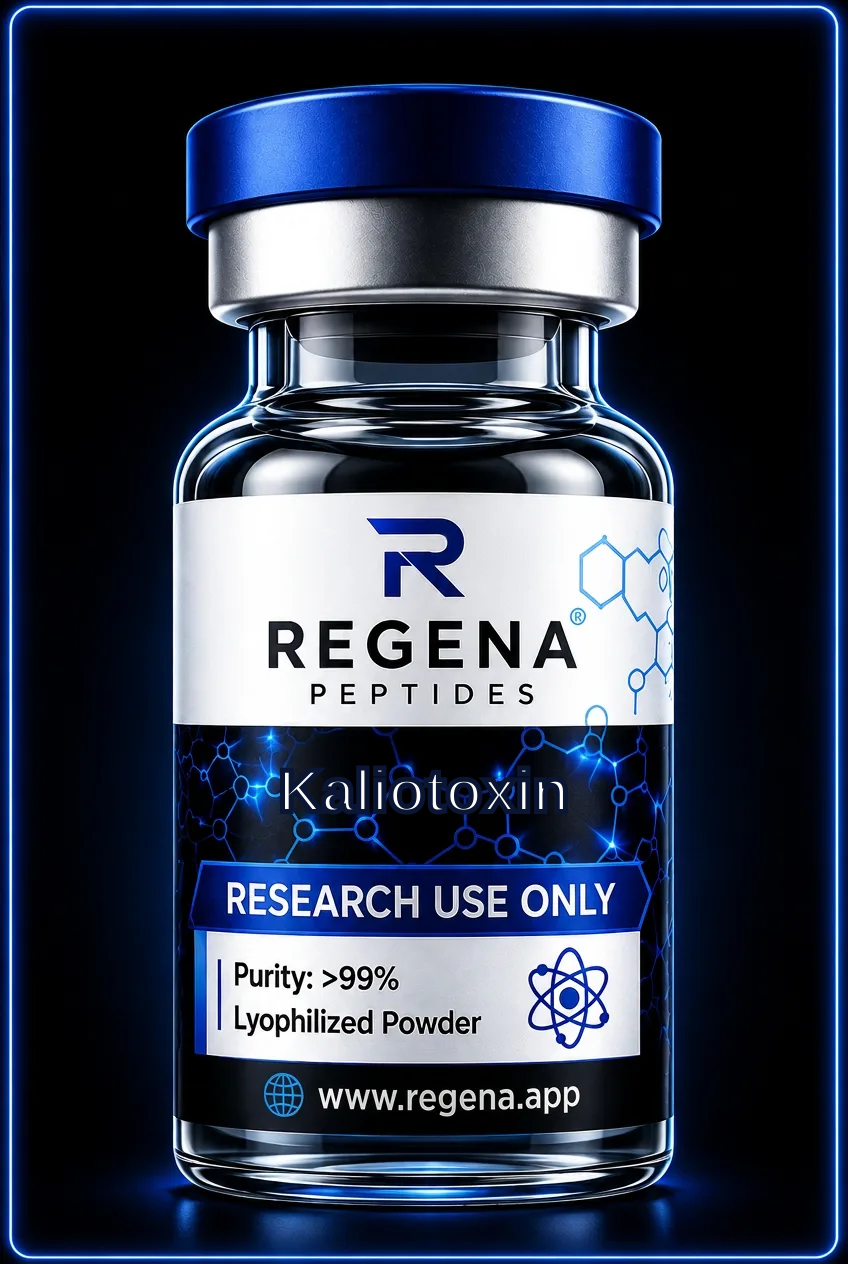
Other · Scorpion α-KTx voltage-gated potassium-channel blocker
Kaliotoxin
Also known as KTX; KTX1; α-KTx 3.1
A 38-residue scorpion potassium-channel blocker used in Kv1.1/Kv1.3 electrophysiology and structural studies of pore recognition.
- Length
- 38 amino acids
- Half-life
- Not well characterised
- Mechanism
- Kaliotoxin binds the extracellular pore region of susceptible potassium channels, prominently Kv1.1 and Kv1.3, and obstructs ion conduction. Its disulphide-constrained binding surface includes a conserved lysine that contributes to interaction with the selectivity-filter region.
- Studied in
- Recombinant Kv1 assays, neuronal preparations and toxin–channel structural models use kaliotoxin to study pore recognition, channel selectivity and potassium-current contributions.
About Kaliotoxin
Kaliotoxin was isolated from the venom of Androctonus mauretanicus mauretanicus and characterised in the early 1990s. The canonical peptide contains 38 amino acids connected by three disulphide bonds, producing the cysteine-stabilised α/β fold characteristic of many scorpion potassium-channel toxins. It is classified as α-KTx 3.1 and is closely related structurally to the agitoxin family. Related kaliotoxin variants occur in the literature, making precise sequence identity important when selecting or comparing research materials.
Kv1.1 and Kv1.3 are prominent targets in modern kaliotoxin research, although its discovery involved calcium-activated potassium-current experiments in molluscan neurons. That historical context should not be interpreted as universal selectivity for mammalian calcium-activated channels. Structural and electrophysiological investigations instead examine how its exposed binding residues recognise particular extracellular pore architectures. Experiments using engineered channel complexes have also explored toxin-associated changes around the selectivity filter, complementing functional measurements obtained with native or recombinant potassium channels.
Laboratory notes
- Specify canonical kaliotoxin versus related variants; the abbreviated name KTX alone may not fully identify the material.
- Pair intact-mass analysis with a folding-sensitive method or functional assay, since disulphide isomers can share the same mass.
- For research use only. Document the channel construct and ionic conditions, and follow the product-specific toxin safety guidance.
Storage and reconstitution basics: storage guide.
Questions about Kaliotoxin
Does kaliotoxin exclusively block calcium-activated potassium channels?
No. Its historical discovery context involved such currents, but Kv1.1 and Kv1.3 are major established targets in subsequent research.
Can kaliotoxin distinguish Kv1.1 from Kv1.3 on its own?
No. Both are susceptible, so subtype attribution requires additional pharmacological, molecular or genetic evidence.
Why are engineered channel complexes used in kaliotoxin structural studies?
They can provide experimentally tractable systems for examining toxin–pore contacts. Findings must still be checked against the sequence and function of the channel of interest.
Is Kaliotoxin for human use?
No. It is supplied strictly for in-vitro laboratory research and is not for human or animal consumption.
Related research peptides
All products are sold for laboratory research use only. Not for human consumption, not a medicine, not for diagnosing, treating or preventing any condition.