
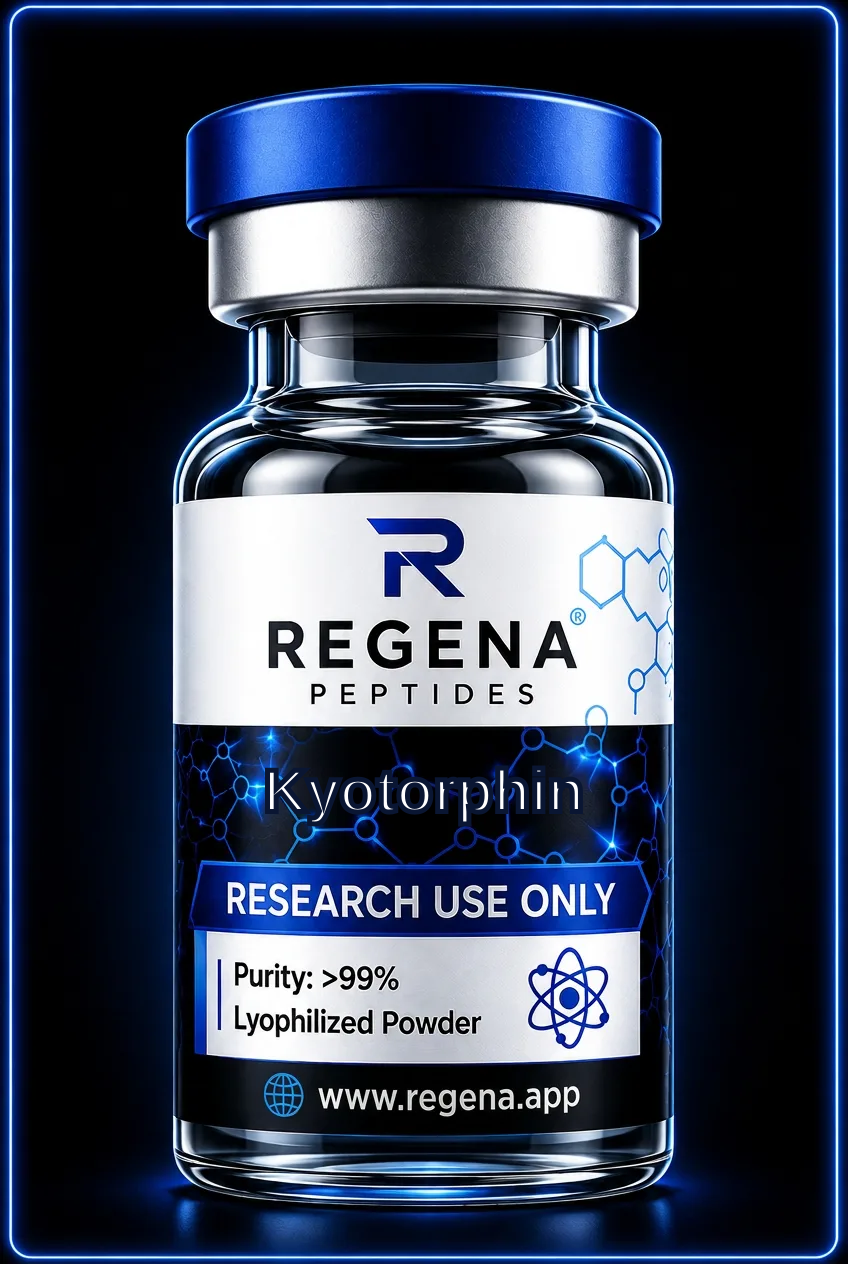
Other · Neuroactive dipeptide
Kyotorphin
Also known as KTP; L-tyrosyl-L-arginine
Tyr–Arg dipeptide studied for enkephalin release and a proposed signalling system distinct from classical opioid receptors.
- Length
- 2 amino acids
- Half-life
- Not well characterised
- Mechanism
- Kyotorphin can promote Met-enkephalin release in neural preparations, providing an indirect link to opioid signalling rather than established direct opioid receptor agonism. A distinct Gi/o-linked recognition mechanism has been proposed, but its molecular receptor identity remains unresolved.
- Studied in
- Brain slices, synaptosomal preparations, membrane-signalling assays and rodent models are used to study enkephalin release, peptide metabolism and neuronal responses.
About Kyotorphin
Kyotorphin is L-tyrosyl-L-arginine, a dipeptide first isolated from bovine brain and described in 1979. Unlike the endomorphins, its native structure has a free C-terminal carboxyl group rather than an amide. Its connection to opioid biology arises largely from experiments linking it to enkephalin release and opioid-sensitive responses, not from a well-established capacity to bind and directly activate the classical opioid receptor subtypes.
Mechanistic work has examined kyotorphin recognition sites, G-protein coupling and calcium-dependent events in neural membrane and cellular preparations. Although a dedicated receptor has been proposed, a definitive molecular assignment is lacking. This uncertainty makes release assays and receptor-blocking controls especially important. Researchers also investigate its formation and hydrolysis in brain material, separating intact-dipeptide effects from those of its constituent amino acids or other metabolites.
Laboratory notes
- Confirm L-Tyr–L-Arg stereochemistry; analogues containing D-arginine should not be treated as interchangeable with native kyotorphin.
- In release experiments, distinguish extracellular Met-enkephalin accumulation from changes in its enzymatic degradation.
- Use a validated LC–MS method to track intact kyotorphin and include tyrosine and arginine controls where metabolite effects are plausible.
Storage and reconstitution basics: storage guide.
Questions about Kyotorphin
Is kyotorphin a direct μ-opioid receptor agonist?
It is not established as a direct classical opioid receptor agonist. Its opioid-related activity is commonly investigated through enkephalin release and downstream opioid receptor involvement.
Has a kyotorphin receptor been molecularly identified?
A distinct recognition and signalling system has been proposed, but its receptor identity has not been conclusively established.
Is kyotorphin amidated?
Native kyotorphin is Tyr–Arg with a free C-terminal carboxyl group. Amidated or stereochemically modified derivatives are separate research compounds.
Is Kyotorphin for human use?
No. It is supplied strictly for in-vitro laboratory research and is not for human or animal consumption.
Related research peptides
All products are sold for laboratory research use only. Not for human consumption, not a medicine, not for diagnosing, treating or preventing any condition.