
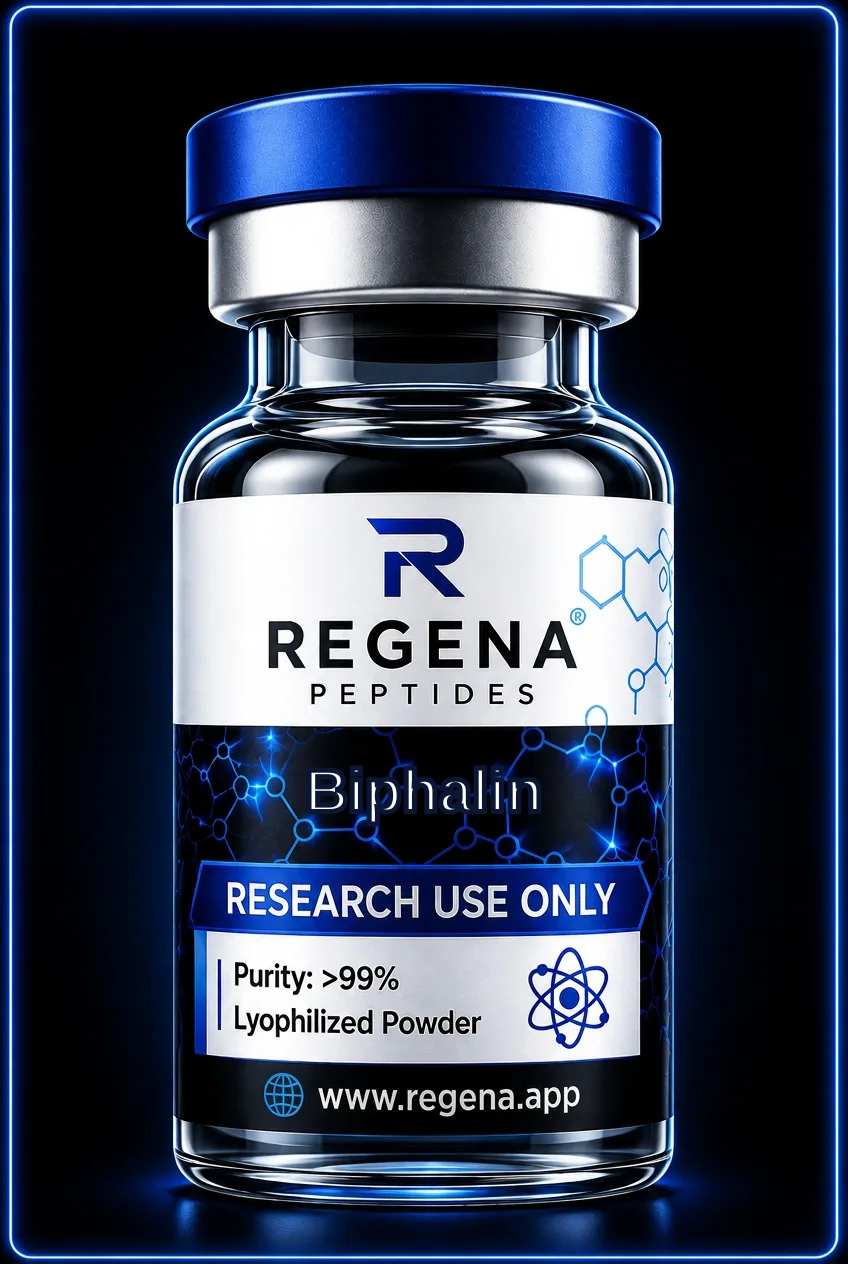
Other · Dimeric enkephalin analogue; opioid receptor agonist
Biphalin
Also known as —
A hydrazine-linked enkephalin dimer used to examine μ- and δ-opioid receptor activation and multivalent peptide design.
- Length
- 8 amino acids across two tetrapeptide arms
- Half-life
- Not well characterised
- Mechanism
- Biphalin activates μ- and δ-opioid receptors, which couple predominantly to Gi/o proteins and regulate adenylyl cyclase, ion channels and downstream signalling. Relative activity at other opioid receptors depends on the assay system.
- Studied in
- Receptor-expressing cell lines, isolated tissues and rodent models are used to investigate opioid receptor signalling, peptide stability and nociceptive processing.
About Biphalin
Biphalin is a synthetic, symmetrical opioid peptide first described in the early 1980s during work on dimeric enkephalin analogues. It contains two Tyr–D-Ala–Gly–Phe arms whose C-terminal carbonyl groups are joined through a hydrazine bridge. Both N-terminal tyrosines remain free, preserving a key recognition feature of many opioid peptides. The resulting molecule contains eight amino acid residues, but it is not a conventional linear octapeptide.
Its pharmacology is characterised principally by agonism at μ- and δ-opioid receptors rather than strict selectivity for either subtype. Laboratory studies use binding competition, second-messenger measurements and isolated tissue assays to compare receptor affinity with functional activity. The paired peptide arms also make biphalin useful in structure–activity studies of linker geometry and opioid recognition. A dimeric structure alone does not establish simultaneous engagement of two receptors; that requires separate experimental evidence.
Laboratory notes
- Confirm the hydrazine-linked dimer and D-Ala-containing structure by appropriate identity testing; molecular mass alone does not establish stereochemistry.
- Use low-binding vessels and assess recovery when preparing dilute solutions for receptor assays.
- Include subtype-selective antagonists or receptor-defined cell lines to distinguish μ- from δ-mediated responses.
Storage and reconstitution basics: storage guide.
Questions about Biphalin
Is biphalin a linear eight-residue peptide?
No. It consists of two tetrapeptide arms connected at their C termini through a hydrazine bridge.
Is biphalin selective for the μ-opioid receptor?
It has substantial activity at both μ- and δ-opioid receptors, so it should not be treated as a strictly μ-selective probe.
Does its dimeric architecture prove receptor cross-linking?
No. Receptor cross-linking or simultaneous binding requires direct evidence beyond the presence of two opioid peptide arms.
Is Biphalin for human use?
No. It is supplied strictly for in-vitro laboratory research and is not for human or animal consumption.
Related research peptides
All products are sold for laboratory research use only. Not for human consumption, not a medicine, not for diagnosing, treating or preventing any condition.