
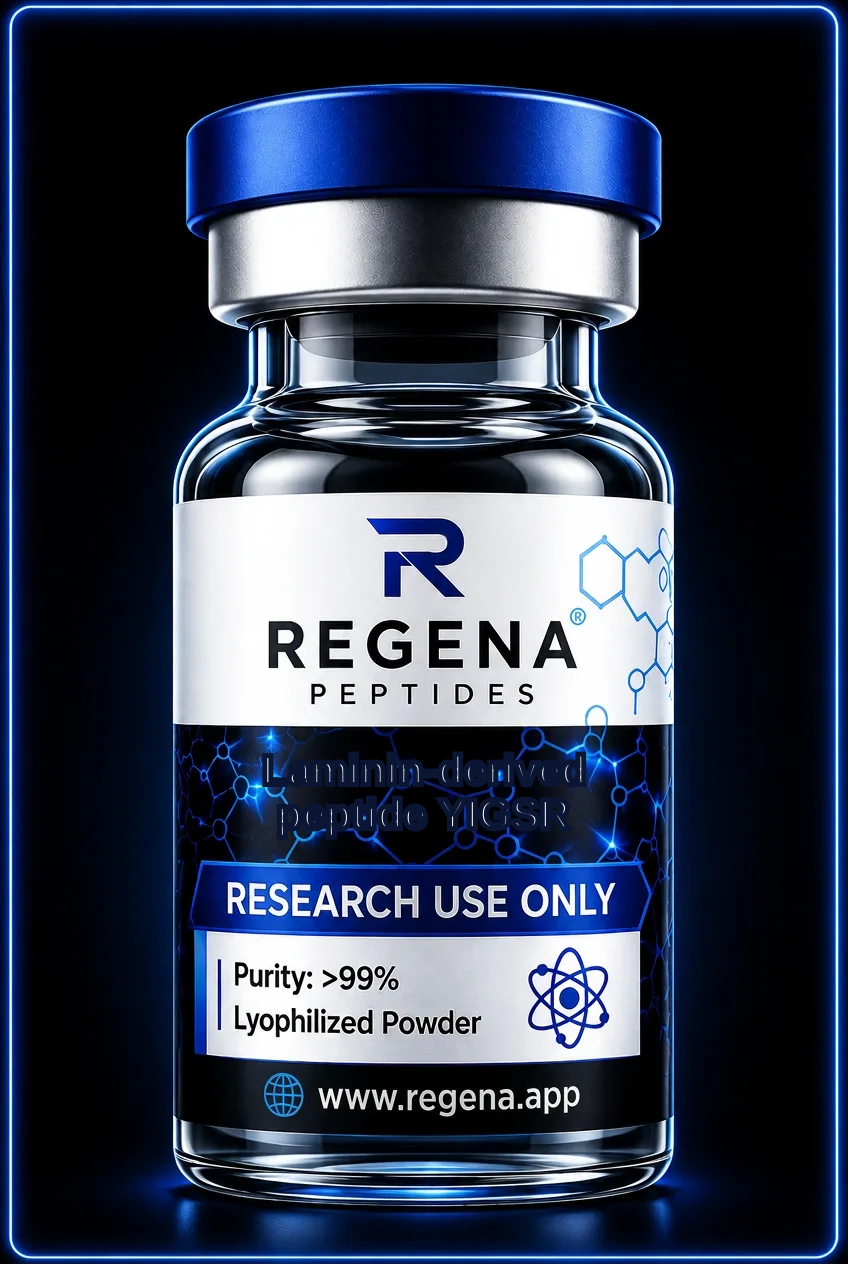
Regenerative · Extracellular matrix-derived adhesion pentapeptide
Laminin-derived peptide YIGSR
Also known as Tyr–Ile–Gly–Ser–Arg; YIGSR
A laminin β1-chain pentapeptide used to examine matrix recognition, cell adhesion and peptide-functionalised surfaces.
- Length
- 5 amino acids
- Half-life
- Not well characterised
- Mechanism
- YIGSR reproduces a laminin β1-chain recognition motif associated with cell adhesion and interactions involving the 67-kDa laminin receptor, linked to RPSA. Its effects depend on presentation, and activity should not be assumed to reflect exclusive engagement of one receptor.
- Studied in
- Cell-attachment assays, migration systems, functionalised biomaterials and animal tumour dissemination models have been used to investigate YIGSR-dependent matrix interactions.
About Laminin-derived peptide YIGSR
YIGSR is the sequence Tyr–Ile–Gly–Ser–Arg, identified within the β1 chain of laminin, historically termed the laminin B1 chain. Work mapping cell-binding regions of laminin in the 1980s established this short sequence as a useful experimental adhesion motif. It is commonly studied as a synthetic pentapeptide rather than as intact laminin. The isolated sequence lacks the larger protein's multidomain architecture, so it represents only a restricted component of laminin-dependent matrix recognition.
The motif is frequently associated with the 67-kDa laminin receptor, whose relationship to the RPSA-encoded 37-kDa protein underlies the common 37/67-kDa receptor terminology. Nevertheless, receptor attribution requires experimental controls rather than reliance on the motif alone. Soluble YIGSR can compete with matrix interactions, whereas surface-presented YIGSR may support attachment in suitable systems. Ligand density, orientation, linker chemistry and cell type therefore materially influence results in adhesion assays and engineered extracellular-matrix substrates.
Laboratory notes
- Specify terminal chemistry: free-acid, amidated and linker-bearing variants are not chemically interchangeable.
- For surface assays, characterise coupling efficiency and ligand accessibility rather than reporting starting peptide quantity alone.
- Use scrambled-sequence controls and receptor-perturbation experiments to distinguish sequence-dependent attachment from non-specific adsorption.
Storage and reconstitution basics: storage guide.
Questions about Laminin-derived peptide YIGSR
Which laminin chain contains YIGSR?
The motif derives from the laminin β1 chain, called the B1 chain in older literature.
Why can soluble and immobilised YIGSR behave differently?
Soluble peptide can compete for recognition sites, while immobilisation presents an attachment substrate whose activity depends on density and orientation.
Does YIGSR reproduce all functions of laminin?
No. It is a short recognition motif and does not reproduce laminin's complete structure, receptor repertoire or matrix-assembly properties.
Is Laminin-derived peptide YIGSR for human use?
No. It is supplied strictly for in-vitro laboratory research and is not for human or animal consumption.
Related research peptides
All products are sold for laboratory research use only. Not for human consumption, not a medicine, not for diagnosing, treating or preventing any condition.