
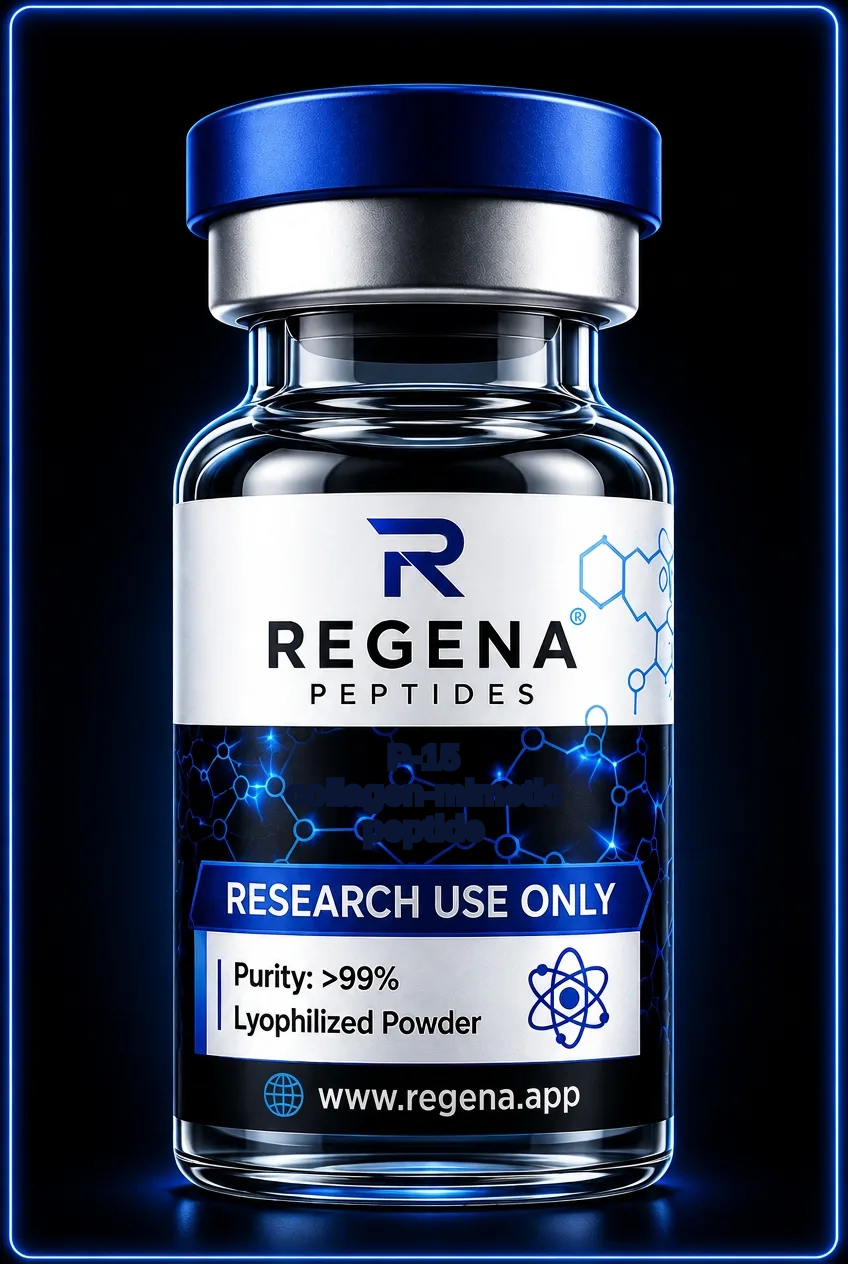
Regenerative · Type I collagen-derived cell-binding peptide
P-15 collagen-mimetic peptide
Also known as P-15; P15
A 15-residue collagen-derived motif used to investigate cell adhesion and the biological properties of engineered surfaces.
- Length
- 15 amino acids
- Half-life
- Not well characterised
- Mechanism
- P-15 reproduces a cell-binding region of type I collagen and can support cell attachment when presented on a suitable substrate. Integrin-associated adhesion signalling is implicated, but a single, universally established receptor assignment should not be assumed.
- Studied in
- Laboratory studies use P-15-functionalised substrates in osteoblast and mesenchymal stromal cell cultures, alongside animal bone–material interface models.
About P-15 collagen-mimetic peptide
P-15 is a synthetic peptide with the sequence GTPGPQGIAGQRGVV, corresponding to a region of the α1 chain of type I collagen. It was developed through research seeking short collagen sequences that retain cell-binding activity outside the intact extracellular matrix protein. Unlike native collagen, this short fragment does not reproduce the full triple-helical scaffold. Its experimental behaviour therefore depends strongly on how the sequence is displayed, particularly when adsorbed or immobilised on mineral or polymer surfaces.
Research commonly examines initial cell attachment, spreading, focal adhesion formation and expression of osteogenic markers on P-15-bearing materials. These experiments address matrix recognition rather than a conventional soluble ligand–receptor interaction. Integrins and downstream adhesion pathways may contribute, but results depend on substrate chemistry, peptide accessibility and the surrounding protein layer. Appropriate comparisons include the unmodified substrate and a sequence control, because changes in surface charge, wettability or protein adsorption can also alter cellular responses.
Laboratory notes
- Confirm sequence, purity and terminal chemistry by the batch certificate and mass spectrometry; terminal modifications can affect surface coupling.
- Quantify peptide loading and retention on functionalised materials rather than assuming that the starting solution reflects surface presentation.
- Include substrate-only and sequence-control surfaces, and distinguish attachment from proliferation when interpreting cell counts.
Storage and reconstitution basics: storage guide.
Questions about P-15 collagen-mimetic peptide
Does P-15 form a collagen triple helix?
P-15 is a short linear collagen-derived motif, not an intact collagen molecule or a conventional triple-helix-forming collagen model peptide.
Is P-15 a selective agonist for one integrin?
A single selective integrin target is not firmly established across experimental settings. Receptor involvement requires direct binding, blocking or genetic experiments.
Why does surface presentation matter?
Immobilisation changes motif accessibility, local density and orientation, all of which can influence cell attachment independently of the peptide sequence.
Is P-15 collagen-mimetic peptide for human use?
No. It is supplied strictly for in-vitro laboratory research and is not for human or animal consumption.
Related research peptides
All products are sold for laboratory research use only. Not for human consumption, not a medicine, not for diagnosing, treating or preventing any condition.