
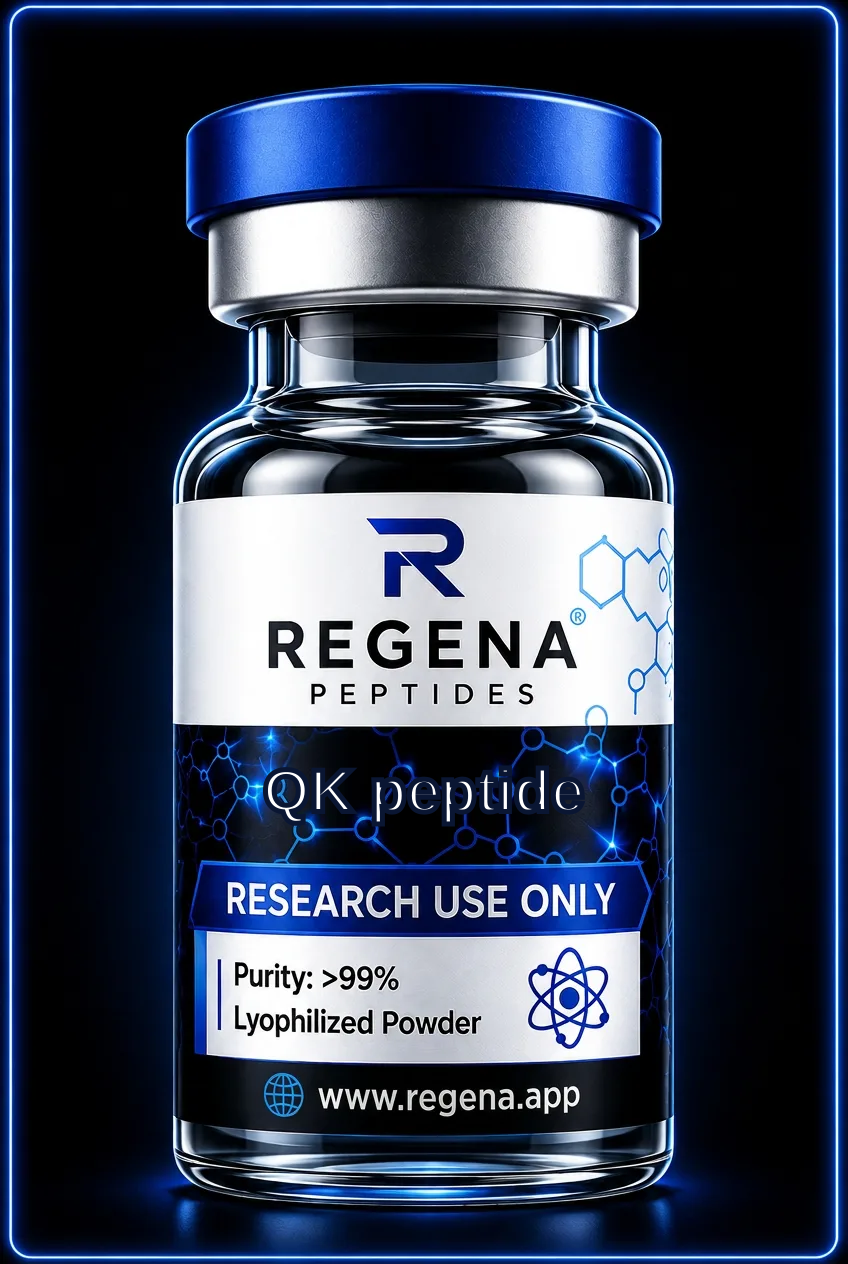
Regenerative · Designed α-helical VEGF-mimetic peptide
QK peptide
Also known as QK; VEGF-mimetic QK; KLTWQELYQLKYKGI
A designed 15-residue VEGF mimetic whose helical structure supports studies of endothelial receptor signalling and vessel-like organisation.
- Length
- 15 amino acids
- Half-life
- Not well characterised
- Mechanism
- QK mimics the receptor-binding α-helical region of VEGF-A and has been reported to engage VEGF receptors, including VEGFR1 and VEGFR2. Experimental responses include VEGFR-associated phosphorylation and downstream endothelial signalling, with activity dependent on peptide conformation and presentation.
- Studied in
- Endothelial cell cultures, vessel-sprouting assays and experimental biomaterial systems use QK to investigate VEGF-like signalling and angiogenic organisation.
About QK peptide
QK is a designed peptide with the sequence KLTWQELYQLKYKGI, developed to reproduce structural features of the receptor-binding α-helix of vascular endothelial growth factor A. Published in 2005, the original design used substitutions and flanking residues to stabilise a helical arrangement rather than simply copying an unmodified protein fragment. The commonly studied form is N-terminally acetylated and C-terminally amidated, so terminal chemistry is essential when identifying the material used in a particular experiment.
Researchers use QK to probe how a compact VEGF-like structural motif influences endothelial receptor signalling and organisation. Reported interactions involve VEGFR1 and VEGFR2, while functional assays often assess receptor phosphorylation, migration, sprouting or network formation. Soluble peptide and scaffold-bound QK are not interchangeable experimental formats: immobilisation changes accessibility, local density and molecular orientation. Structural measurements and receptor-dependence controls are therefore useful alongside microscopy-based readouts, which alone cannot establish a specific VEGF-receptor mechanism.
Laboratory notes
- Record terminal acetylation and amidation explicitly; uncapped analogues should not automatically be treated as equivalent to the original design.
- Use circular dichroism under relevant buffer conditions when helical conformation is central to the experimental question.
- For scaffold-bound material, quantify peptide loading and coupling chemistry, and include an otherwise identical peptide-free scaffold.
Storage and reconstitution basics: storage guide.
Questions about QK peptide
Is QK an exact fragment of VEGF-A?
No. It is a designed mimetic incorporating sequence changes and flanking residues intended to reproduce a receptor-binding helical structure.
Which receptors are relevant to QK experiments?
VEGFR1 and VEGFR2 are reported targets. Receptor expression, phosphorylation and blocking experiments should be assessed in the chosen model rather than inferred from network formation alone.
Why can immobilised QK behave differently from soluble QK?
Surface attachment changes peptide orientation, accessibility and local density, and can alter receptor engagement independently of the total peptide content.
Is QK peptide for human use?
No. It is supplied strictly for in-vitro laboratory research and is not for human or animal consumption.
Related research peptides
All products are sold for laboratory research use only. Not for human consumption, not a medicine, not for diagnosing, treating or preventing any condition.