
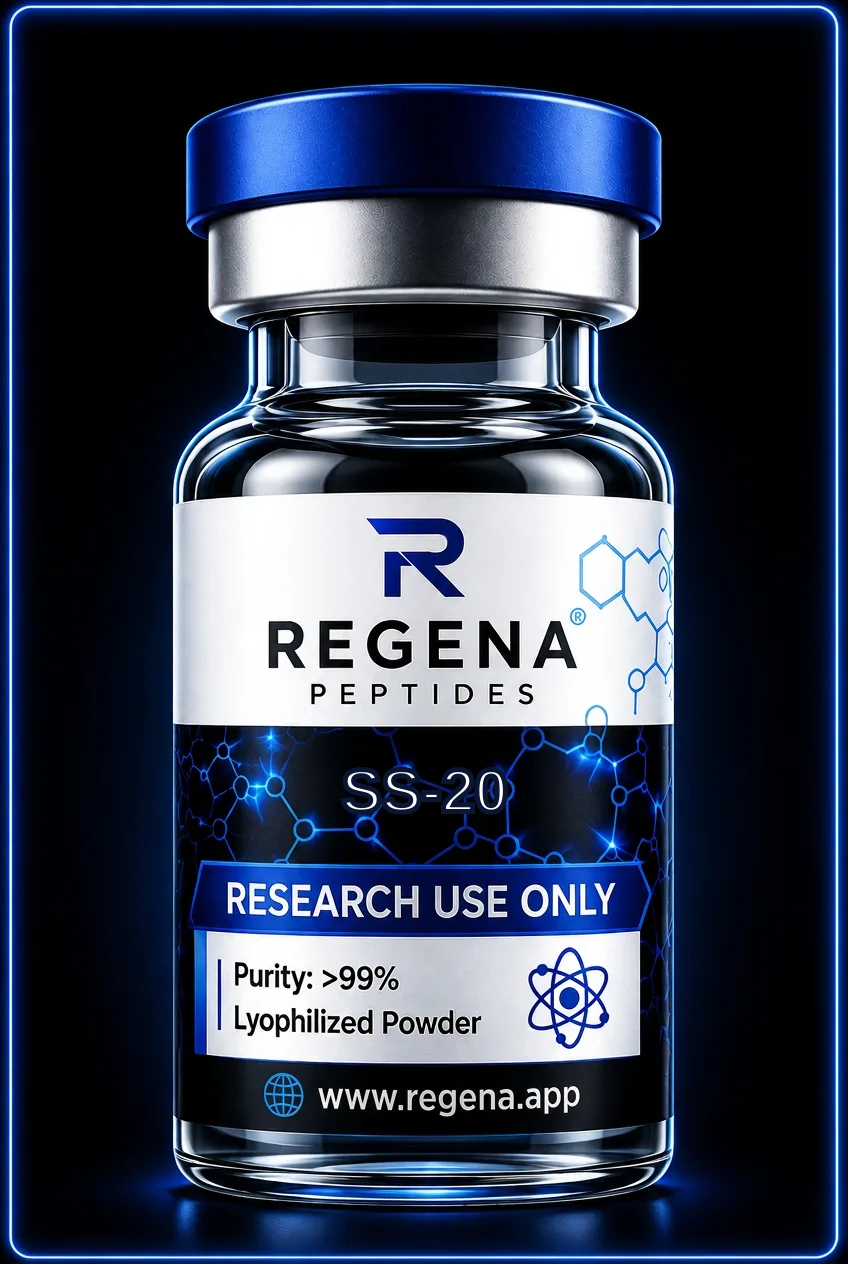
Other · Aromatic–cationic mitochondrial-associated tetrapeptide
SS-20
Also known as SS20
A phenylalanine-containing aromatic–cationic tetrapeptide used to investigate mitochondrial function without a phenolic scavenging group.
- Length
- 4 amino acids
- Half-life
- Not well characterised
- Mechanism
- SS-20 associates with mitochondrial membranes and is investigated for effects on mitochondrial bioenergetics and membrane-associated processes. Unlike Dmt-containing analogues, it lacks a phenolic radical-scavenging group; no single protein receptor is established as its defining target.
- Studied in
- Isolated mitochondria, cultured cells and animal models of mitochondrial stress are used to examine SS-20 through respiration, ATP and membrane-function measurements.
About SS-20
SS-20 is the amidated tetrapeptide Phe–D-Arg–Phe–Lys–NH₂, a member of the Szeto–Schiller family of aromatic–cationic peptides. Its structure alternates aromatic residues with basic residues and includes D-arginine at the second position. Relative to SS-02, its N-terminal phenylalanine replaces dimethyltyrosine. This substitution removes the phenolic hydroxyl group, making SS-20 a useful comparator when investigating which experimental properties depend on phenolic radical-scavenging chemistry rather than the broader peptide architecture in mitochondrial assay systems.
Research on SS-20 examines mitochondrial respiration, ATP generation and responses to experimentally imposed mitochondrial stress. Its lack of a phenolic group distinguishes it from related peptides with direct radical-scavenging chemistry, but does not preclude downstream changes in oxidant production. Such changes can follow altered electron transport or membrane behaviour. Mechanistic interpretation should therefore separate chemical scavenging from bioenergetic effects and avoid assigning a specific receptor or lipid-binding mechanism without direct supporting measurements.
Laboratory notes
- Verify D-arginine stereochemistry and C-terminal amidation when comparing material from different batches or sources.
- Normalise mitochondrial respiration results to a suitable measure of mitochondrial content and record substrate and coupling conditions.
- Use separate assays for direct radical scavenging and mitochondrial oxidant generation; these measure different processes.
Storage and reconstitution basics: storage guide.
Questions about SS-20
Why is SS-20 useful as a comparator for SS-02?
It retains a related aromatic–cationic framework but lacks SS-02’s dimethyltyrosine phenolic group, helping investigate the contribution of that chemical feature.
Does SS-20 lack all effects on oxidant measurements?
Not necessarily. An indirect change in mitochondrial oxidant generation is distinct from direct chemical scavenging of radicals.
Which receptor should be used to define SS-20 activity?
No single protein receptor is established as its defining target. Research-use-only studies generally examine mitochondrial function alongside direct interaction assays where appropriate.
Is SS-20 for human use?
No. It is supplied strictly for in-vitro laboratory research and is not for human or animal consumption.
Related research peptides
All products are sold for laboratory research use only. Not for human consumption, not a medicine, not for diagnosing, treating or preventing any condition.