
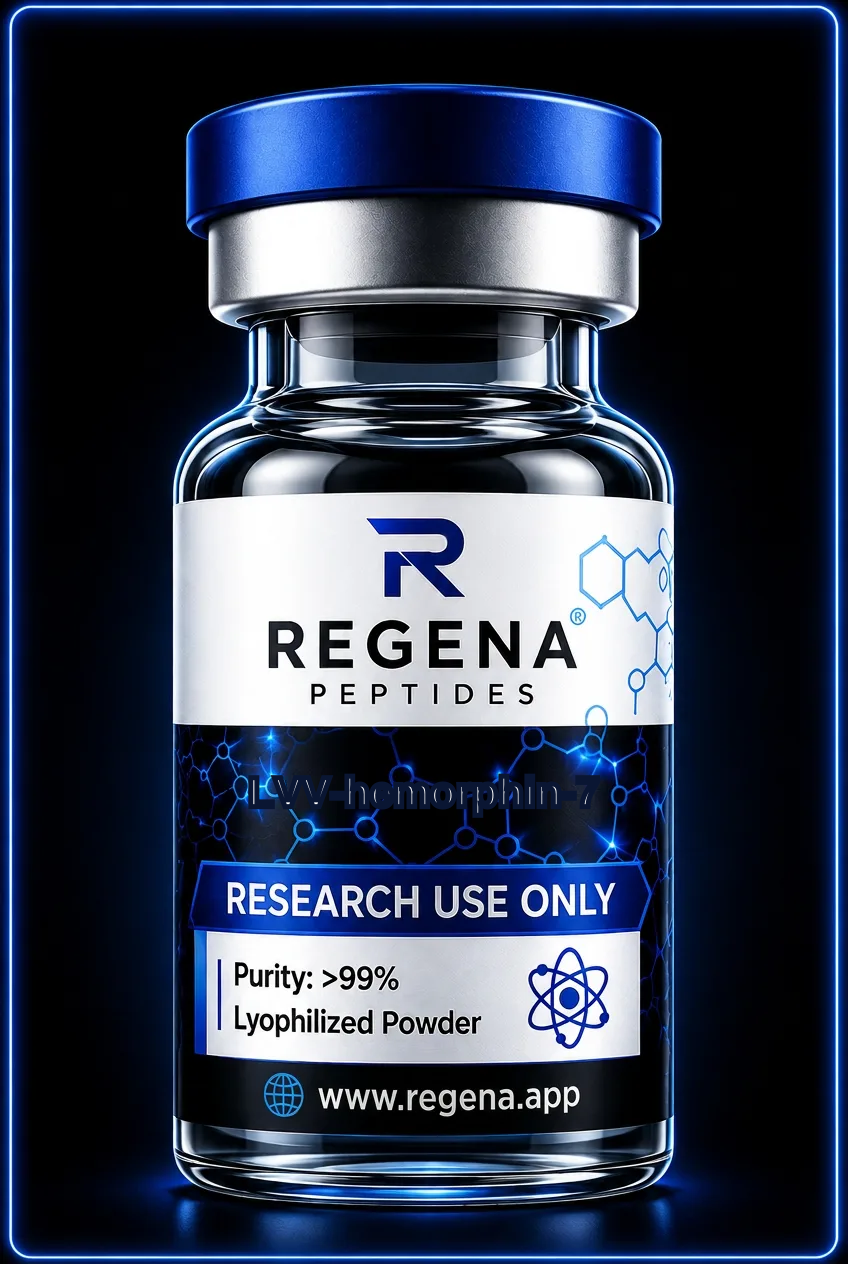
Other · Haemoglobin-derived peptide; opioid ligand and IRAP inhibitor
LVV-hemorphin-7
Also known as LVV-H7; LVVYPWTQRF
A ten-residue haemoglobin fragment investigated for IRAP inhibition, opioid interactions and angiotensin receptor modulation.
- Length
- 10 amino acids
- Half-life
- Not well characterised
- Mechanism
- LVV-hemorphin-7 interacts with opioid receptor systems and inhibits insulin-regulated aminopeptidase (IRAP), the protein associated with the AT4 binding site. It has also been reported to modulate angiotensin II type 1 receptor signalling in cell-based studies, a mechanism distinct from IRAP inhibition.
- Studied in
- Recombinant IRAP assays, opioid receptor systems, angiotensin receptor-expressing cells and rodent learning paradigms investigate its multiple molecular interactions.
About LVV-hemorphin-7
LVV-hemorphin-7 consists of Leu-Val-Val-Tyr-Pro-Trp-Thr-Gln-Arg-Phe, abbreviated LVVYPWTQRF. Although its name ends in seven, the complete peptide contains ten amino acids: the seven-residue haemorphin core plus an N-terminal Leu-Val-Val extension. It belongs to the family of bioactive fragments identified through haemoglobin proteolysis and tissue peptide characterisation. The extension preserves additional beta-chain sequence and places tyrosine internally rather than at the free N-terminus, changing the structural context of the haemorphin motif.
Beyond opioid-related assays, LVV-hemorphin-7 is a well-established research ligand for the AT4-associated protein insulin-regulated aminopeptidase. IRAP is an enzyme, not an angiotensin G-protein-coupled receptor, and its catalytic inhibition must be distinguished from receptor signalling. Separate cell studies have described modulation of angiotensin II type 1 receptor responses. These different experimental contexts make target-specific controls essential, particularly when interpreting findings from tissue preparations or animal models in which multiple pathways may contribute.
Laboratory notes
- Specify whether an experiment measures IRAP catalytic inhibition, AT4-site ligand binding or angiotensin receptor signalling; these are distinct endpoints.
- Use peptidase profiling or LC–MS time courses to check for removal of the N-terminal leucine and subsequent sequence processing.
- Include parental-cell controls and pathway-specific comparators when assessing angiotensin receptor signalling.
Storage and reconstitution basics: storage guide.
Questions about LVV-hemorphin-7
Why does LVV-hemorphin-7 contain ten residues?
The seven refers to the YPWTQRF haemorphin core. Adding the LVV prefix produces the ten-residue sequence LVVYPWTQRF.
Are IRAP and the angiotensin II type 1 receptor the same target?
No. IRAP is a membrane aminopeptidase associated with AT4 ligand binding, whereas the angiotensin II type 1 receptor is a G-protein-coupled receptor.
Can an IRAP inhibition result explain every tissue response?
No. Opioid interactions, peptide processing and other pathway effects may contribute. Target-specific experiments are needed to attribute a response to IRAP.
Is LVV-hemorphin-7 for human use?
No. It is supplied strictly for in-vitro laboratory research and is not for human or animal consumption.
Related research peptides
All products are sold for laboratory research use only. Not for human consumption, not a medicine, not for diagnosing, treating or preventing any condition.