
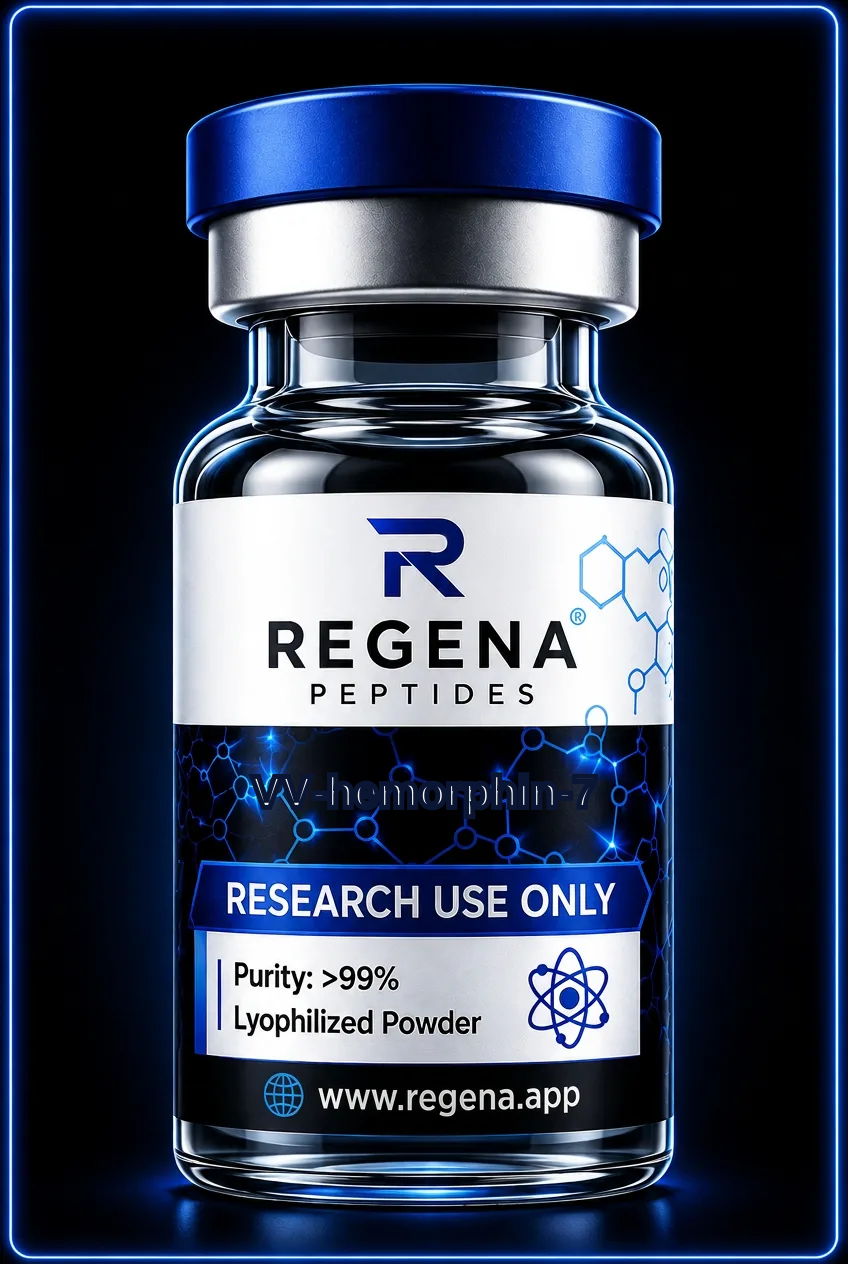
Other · Haemoglobin-derived opioid peptide
VV-hemorphin-7
Also known as VV-H7; VVYPWTQRF
A nine-residue haemorphin retaining an N-terminal Val-Val extension, used in comparative receptor and proteolysis research.
- Length
- 9 amino acids
- Half-life
- Not well characterised
- Mechanism
- VV-hemorphin-7 interacts with opioid receptor systems and has been investigated for binding at the AT4 site associated with insulin-regulated aminopeptidase (IRAP). Its N-terminal extension can influence target recognition and proteolytic processing, so findings for LVV-hemorphin-7 should not be assumed to apply unchanged.
- Studied in
- Opioid receptor assays, AT4-site binding preparations and haemoglobin digestion models study its target interactions and relationship to neighbouring haemorphin fragments.
About VV-hemorphin-7
VV-hemorphin-7 is the nonapeptide Val-Val-Tyr-Pro-Trp-Thr-Gln-Arg-Phe, written VVYPWTQRF. It comprises the seven-residue haemorphin core with two additional N-terminal valines from the haemoglobin beta-chain sequence. Characterisation of haemoglobin-derived peptides established that related fragments can differ by only one or a few terminal residues. VV-hemorphin-7 illustrates this relationship: it lacks the initial leucine of LVV-hemorphin-7 but retains the same remaining sequence, including the internal Tyr-Pro-Trp-Thr motif and C-terminal Gln-Arg-Phe segment.
Comparative studies use VV-hemorphin-7 to examine how an N-terminal valine pair affects opioid-system interactions and AT4-associated binding. Differences from LVV-hemorphin-7 can reflect altered target recognition, stability or processing rather than peptide length alone. Because IRAP constitutes the AT4-associated binding protein, binding experiments and aminopeptidase activity assays answer related but different questions. Biological extracts may contain several haemorphins simultaneously, so analytical separation is important before assigning a measured response to this specific sequence.
Laboratory notes
- Confirm the nine-residue sequence by mass spectrometry and check for LVV-hemorphin-7 or hemorphin-7 impurities.
- Use separate binding and catalytic assays when characterising AT4/IRAP interactions; displacement alone does not quantify enzyme inhibition.
- Monitor sequence stability in biological matrices and avoid repeated freeze–thaw cycles by preparing validated single-use aliquots.
Storage and reconstitution basics: storage guide.
Questions about VV-hemorphin-7
What distinguishes VV-hemorphin-7 from LVV-hemorphin-7?
VV-hemorphin-7 lacks the N-terminal leucine. Its sequence is VVYPWTQRF rather than LVVYPWTQRF.
Can VV-hemorphin-7 arise from processing of LVV-hemorphin-7?
Removal of the N-terminal leucine can generate this sequence. Whether it occurs in a particular preparation depends on the enzymes present and their substrate specificity.
Should receptor selectivity be inferred from the haemorphin name?
No. The name identifies a sequence family, not a fixed receptor-selectivity profile. Binding and functional activity require characterisation in the specific assay system.
Is VV-hemorphin-7 for human use?
No. It is supplied strictly for in-vitro laboratory research and is not for human or animal consumption.
Related research peptides
All products are sold for laboratory research use only. Not for human consumption, not a medicine, not for diagnosing, treating or preventing any condition.