
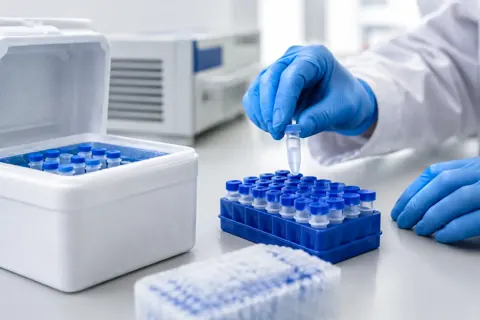
A storage location is only one part of a peptide sample's history. To assess material later, a researcher also needs to know what arrived, which conditions were specified, where it was held and whether anything unusual happened along the way. Without that record, even an apparently well-organised freezer can conceal important uncertainty.
The practical goal is to keep each sample identifiable and its handling history understandable. Peptides differ in their response to temperature, water, light and formulation, so generic advice cannot replace compound-specific documentation. All guidance here concerns laboratory research materials only, not human consumption.
Establish the starting record at receipt
Begin by checking the delivered material against the accompanying paperwork. The compound name, batch identifier and declared quantity should agree. Inspect the container for damaged closures, unexpected moisture and labels that are missing or difficult to read.
Save the matching certificate of analysis, or COA, with the receipt record. It may contain identity information, chromatographic results and methods such as HPLC. These describe the tested sample in a defined analytical context; they do not establish what will happen during subsequent storage.
A dated photograph of the vial and packaging can help preserve details that may later become obscured. If a temperature indicator or transport record is supplied, retain it too. Photographs and indicators supplement written records rather than replace them.
International transit can include customs processing and variable delivery conditions. Distance alone does not determine suitability. The relevant question is whether the available evidence allows the arrival condition to be assessed against the material's stated requirements.
Make the physical form part of the storage decision
Dry, lyophilised material and prepared solutions should not automatically share a storage plan. Lyophilisation removes much of the water and generally improves practical stability compared with an aqueous preparation. It does not eliminate sensitivity to heat, humidity or handling.
For unopened dry samples, follow the documented temperature, moisture and light requirements. Avoid assigning a storage condition simply because another peptide is kept there. Record the actual storage location so that its conditions can be checked later.
Condensation deserves particular attention when a cold vial is opened. Allowing a sealed container to reach the relevant working temperature before opening can limit moisture settling on the material. Keep closures secure and unnecessary exposure to humid air to a minimum, within the applicable laboratory procedure.
Solutions introduce different concerns. Depending on the peptide and solvent system, hydrolysis, oxidation, adsorption to container surfaces and microbial contamination may become more relevant. Information about a dry powder cannot establish stability after preparation.
Use the applicable compound information and validated research protocol to determine solution handling. Where documented smaller portions are appropriate, they can reduce repeated access to the same container. This is a sample-management choice, not a universal formula for peptide storage.
Control the environment rather than relying on a setting
A fridge or freezer display does not necessarily describe every sample's experience. Frequent door opening, transfers and differences within a storage unit can introduce variation. Monitoring is most useful when it represents the environment in which the samples are actually held.
Light and moisture need separate attention. Where light protection is specified, retain protective packaging or use suitable opaque secondary containment. An unchanged appearance is not evidence that prolonged exposure was acceptable.
For lyophilised samples, repeated opening can introduce water from ambient air. Secure closures, a clean and dry storage area, and limited unnecessary access help control that variable. Cold storage alone cannot compensate for poor moisture control.
Organise shared storage so that frequently accessed samples can be found without disturbing unrelated material. Clear positions and identifiers reduce time spent searching with boxes open and make transfers easier to document.
Build a register that works across a team
A useful register lets another researcher reconstruct the sample history without asking the person who originally received it. Connect the internal sample identifier to the original batch number and retain the source documentation.
Core fields include:
- compound name and batch or lot identifier;
- receipt date and declared physical form;
- specified storage conditions and actual location;
- the corresponding COA or report reference;
- significant transfers and preparation events;
- known or suspected temperature excursions.
Keep labels readable and consistent with the register. The vial or secondary container needs enough information to identify it reliably; more detailed records can sit in the linked register. An internal naming convention should not erase the original lot reference.
Record significant changes when they occur, rather than reconstructing them from memory. A move to another storage unit or an unexplained period outside controlled conditions may later be relevant when comparing experimental observations.
Use records to investigate uncertainty
Storage history is part of experimental control. If results differ between sessions or batches, handling may be one of the variables worth examining. A complete record cannot prove performance in a research model, but it can help distinguish documented conditions from unknown exposure.
This is particularly useful when several people handle a sample or a project continues over an extended period. Without consistent entries, a vial can retain its label while losing the information needed to assess its condition.
If there is credible concern about transit conditions, a compromised closure or conflicting paperwork, keep the material separate from planned research use while the issue is reviewed. A normal appearance cannot rule out unsuitable exposure, and a visible change does not identify its chemical cause.
Discolouration, residue or unexpected moisture may justify further investigation. Whether analytical reassessment is needed depends on the discrepancy and the research context. Do not infer identity or chromatographic purity from visual inspection.
Avoid shortcuts that break traceability
Unlabelled secondary containers separate samples from their identities. If additional containment is needed, repeat the key identifier and preserve access to the original label and documents. A tidy box is not useful if its contents cannot be traced.
Another shortcut is treating a release certificate as an assurance of continuing stability. Analytical data establish a starting reference, not a guarantee about later handling. Storage discipline cannot repair uncertain provenance, and strong starting documentation cannot compensate for an unknown storage history.
Likewise, do not apply one sample's conditions to an entire peptide collection. Sequence, formulation and physical state can all affect the appropriate controls. Resolve missing instructions rather than relying on the broad category name.
Keep ordering context separate from storage evidence
For a material-specific review, consult the CJC-1295 with DAC listing alongside the relevant batch and handling documents. The Sydney shipping information provides delivery context: parcels ship from Germany, the USA or China, with delivery taking 5–18 business days from tracking. This does not imply local premises or establish a sample's transport conditions.
You can also review Regena's supplier context, applying the same documentation checks used for any source.
A well-managed sample is more than a vial kept cold. Its identity, specified conditions and significant handling events remain connected, allowing the next researcher to make a reasoned decision rather than inherit an unexplained container.
Peptides in this article
Add a solvent
- Bacteriostatic Water
Kit of 10 × 10 ml vials · Standard solvent for most peptides
€149.00 - Acetic Acid Kit
Kit of 10 × 3 ml vials (liquid) · For peptides that stay cloudy in BAC water
€149.00
Share Regena with a research colleague. They get trusted peptides; you earn 3–30% affiliate commission based on your monthly referred sales.
More research reading
Not sure which peptide fits your research question?
Take the 60-second Find Your Peptides quiz — it points you to the most relevant reference compounds for your area of investigation.
Start the quiz