
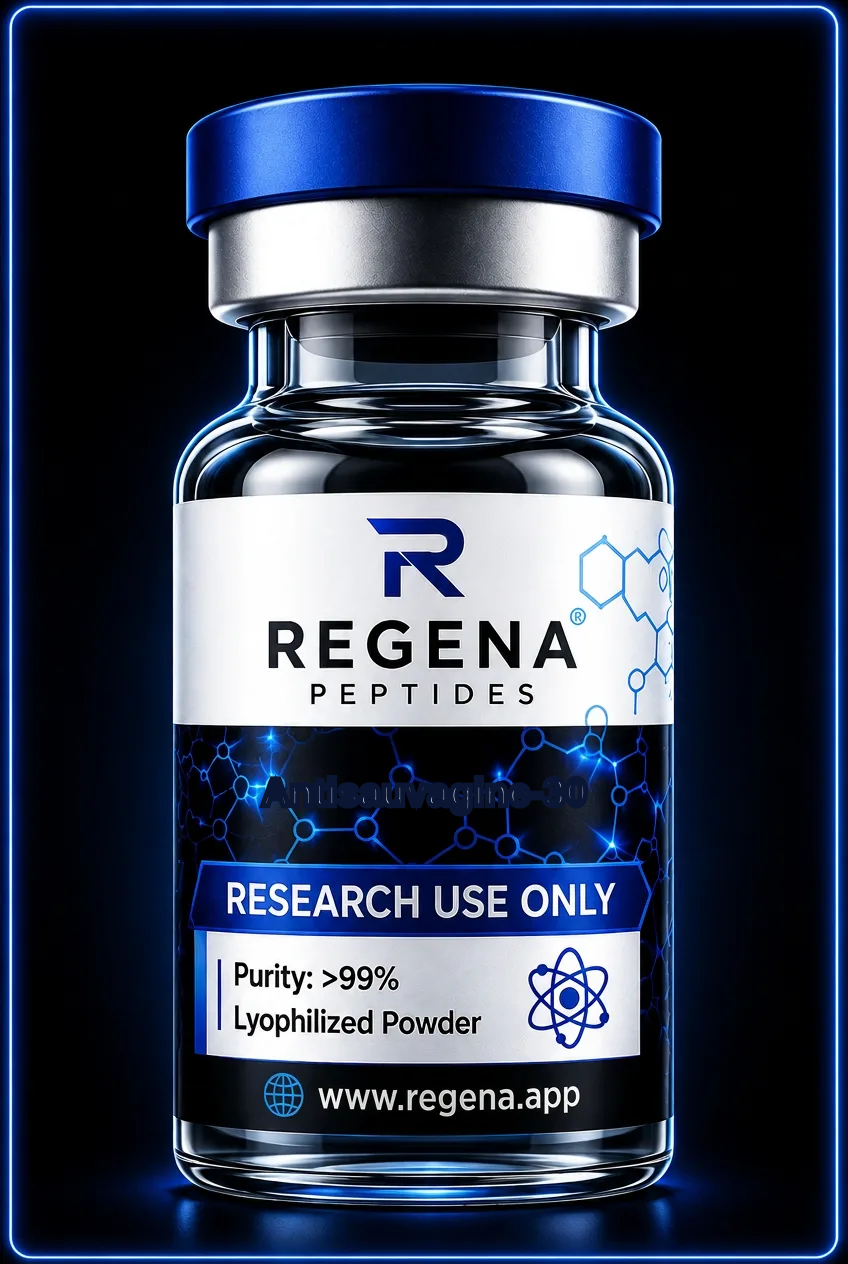
Other · Synthetic corticotrophin-releasing factor receptor antagonist
Antisauvagine-30
Also known as ASV-30; aSVG-30
Sauvagine-derived antagonist used to distinguish CRF2-dependent signalling in receptor assays and experimental models.
- Length
- 30 amino acids
- Half-life
- Not well characterised
- Mechanism
- Antisauvagine-30 antagonises corticotrophin-releasing factor receptor 2 (CRF2), with preferential activity over CRF1 in established binding and functional assays. Its selectivity is concentration- and assay-dependent, so inhibition alone does not establish exclusive CRF2 involvement.
- Studied in
- Receptor-expressing cell lines, isolated tissues and rodent models use Antisauvagine-30 to investigate CRF2-dependent signalling and stress-related neurobiology.
About Antisauvagine-30
Antisauvagine-30 is a synthetic antagonist derived from sauvagine, a 40-residue peptide originally isolated from the skin of the frog Phyllomedusa sauvagei. It corresponds to sauvagine residues 11–40, with D-phenylalanine at position 11 and histidine at position 12 in the parent numbering scheme. The conventional construct retains a C-terminal amide. These modifications produced a useful experimental antagonist for separating CRF2-mediated responses from signalling through the related CRF1 receptor.
CRF2 belongs to the class B family of G protein-coupled receptors and commonly couples to cyclic AMP production. Antisauvagine-30 is therefore studied using ligand-binding competition, cyclic AMP accumulation and tissue-response assays. Its apparent potency and selectivity vary with receptor species, splice variant, receptor abundance and agonist choice. Comparisons with CRF1-expressing controls and independent CRF2 perturbations are important because a pharmacological response to this peptide is not, by itself, definitive evidence of receptor specificity.
Laboratory notes
- Confirm the D-phenylalanine substitution, residue numbering and C-terminal amidation against the batch specification.
- Include matched CRF1 and CRF2 controls when interpreting receptor selectivity, particularly at higher assay concentrations.
- Use low-binding consumables and validated aliquot storage conditions to limit adsorption and repeated freeze–thaw exposure.
Storage and reconstitution basics: storage guide.
Questions about Antisauvagine-30
Does the name mean it contains 30 residues from the start of sauvagine?
No. The conventional construct is based on sauvagine residues 11–40 and includes two substitutions relative to that parent segment.
Is Antisauvagine-30 completely selective for CRF2?
No. It shows preferential CRF2 antagonism, but the degree of selectivity depends on concentration and the experimental system.
Which functional readout is commonly used?
Agonist-stimulated cyclic AMP accumulation in receptor-expressing cells is a common readout, usually supported by binding or receptor-control experiments.
Is Antisauvagine-30 for human use?
No. It is supplied strictly for in-vitro laboratory research and is not for human or animal consumption.
Related research peptides
All products are sold for laboratory research use only. Not for human consumption, not a medicine, not for diagnosing, treating or preventing any condition.