
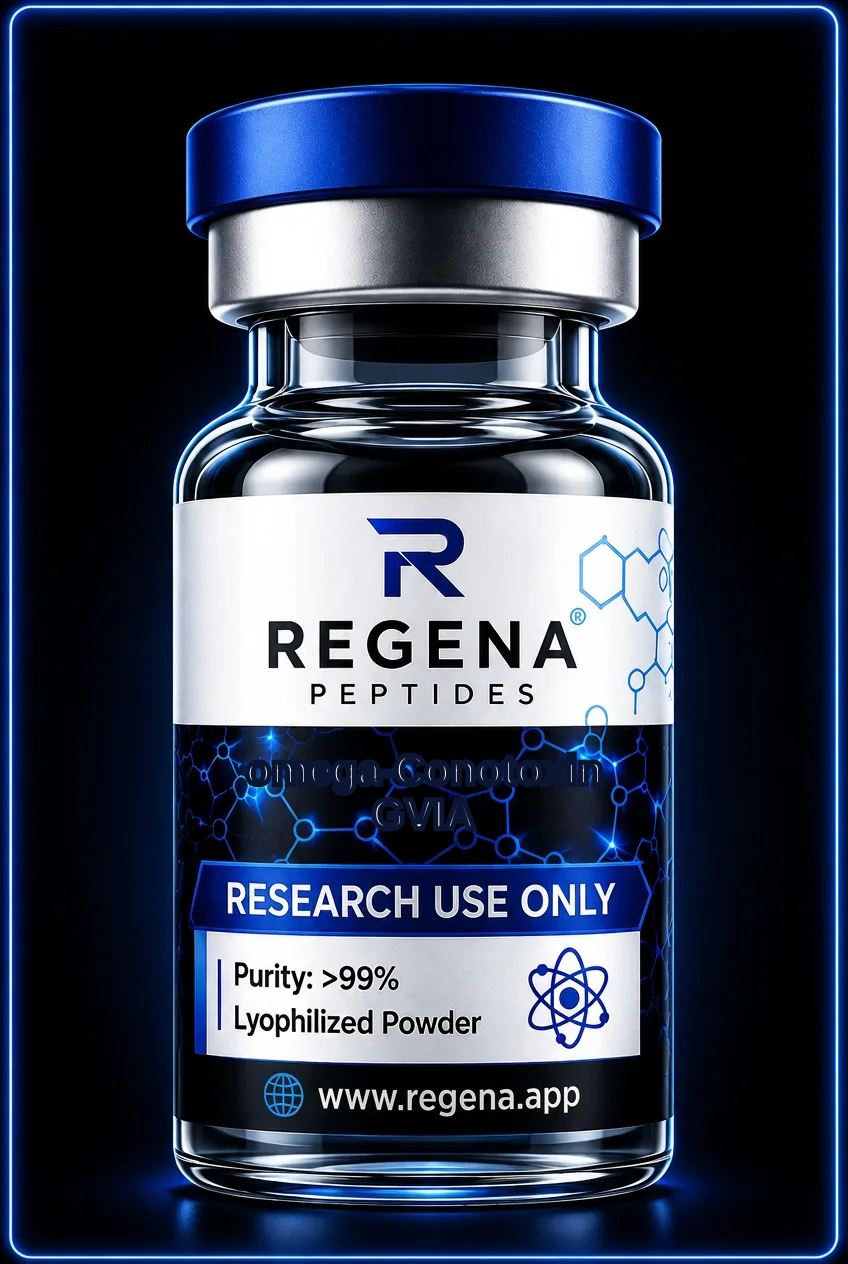
Other · O-superfamily conotoxin; voltage-gated calcium-channel pore blocker
omega-Conotoxin GVIA
Also known as ω-Conotoxin GVIA; ω-CTx-GVIA
A cone-snail peptide that blocks CaV2.2 channels, providing a reference probe for N-type calcium currents in neuronal assays.
- Length
- 27 amino acids
- Half-life
- Not well characterised
- Mechanism
- omega-Conotoxin GVIA binds at the extracellular pore region of CaV2.2 channels and inhibits N-type calcium current. Dissociation is often very slow under recording conditions, producing persistent inhibition after removal of free peptide.
- Studied in
- Recombinant CaV2.2 systems, sensory-neurone cultures, synaptosomes and isolated neuronal tissues use the peptide to examine N-type calcium entry and calcium-dependent transmitter release.
About omega-Conotoxin GVIA
omega-Conotoxin GVIA originates from venom of the marine cone snail Conus geographus. Its mature sequence contains 27 amino acids, three disulphide bonds, hydroxyproline residues and an amidated C-terminus. The disulphides form an inhibitor cystine-knot framework that stabilises the channel-binding surface. Historical fractionation and electrophysiological studies established GVIA as a defining probe for N-type calcium channels, helping distinguish this conductance from other calcium-current components in neuronal preparations and isolated tissue assays.
CaV2.2, encoded by CACNA1B, is the principal target. Binding near the extracellular pore suppresses calcium permeation rather than primarily shifting voltage-sensor activation, distinguishing GVIA from several spider-derived calcium-channel toxins. In many neuronal recordings, inhibition persists through prolonged washout because dissociation is slow; this persistence should not be interpreted as covalent binding. Recombinant expression systems and native neuronal models use GVIA-sensitive current fractions to investigate channel composition, calcium entry and coupling to transmitter-release machinery.
Laboratory notes
- Check that synthetic material reproduces the reference hydroxyproline pattern, C-terminal amidation and native disulphide connectivity.
- Plan recording sequences around potentially slow washout; confirm recovery experimentally rather than assuming rapid reversibility.
- Control for calcium-current rundown and extracellular divalent-ion composition when quantifying the GVIA-sensitive fraction.
Storage and reconstitution basics: storage guide.
Questions about omega-Conotoxin GVIA
Is GVIA inhibition chemically irreversible?
No covalent mechanism is implied. Inhibition often appears irreversible over an experiment because toxin dissociation is very slow and depends on recording conditions.
Which calcium-channel subtype does GVIA identify?
Its principal target is CaV2.2, the channel underlying N-type calcium current. Molecular or complementary pharmacological controls strengthen subtype assignment.
Why are post-translational modifications relevant to synthetic GVIA?
The natural peptide includes hydroxyproline residues and C-terminal amidation. Sequence-equivalent material lacking these features should not automatically be assumed to reproduce native properties.
Is omega-Conotoxin GVIA for human use?
No. It is supplied strictly for in-vitro laboratory research and is not for human or animal consumption.
Related research peptides
All products are sold for laboratory research use only. Not for human consumption, not a medicine, not for diagnosing, treating or preventing any condition.