
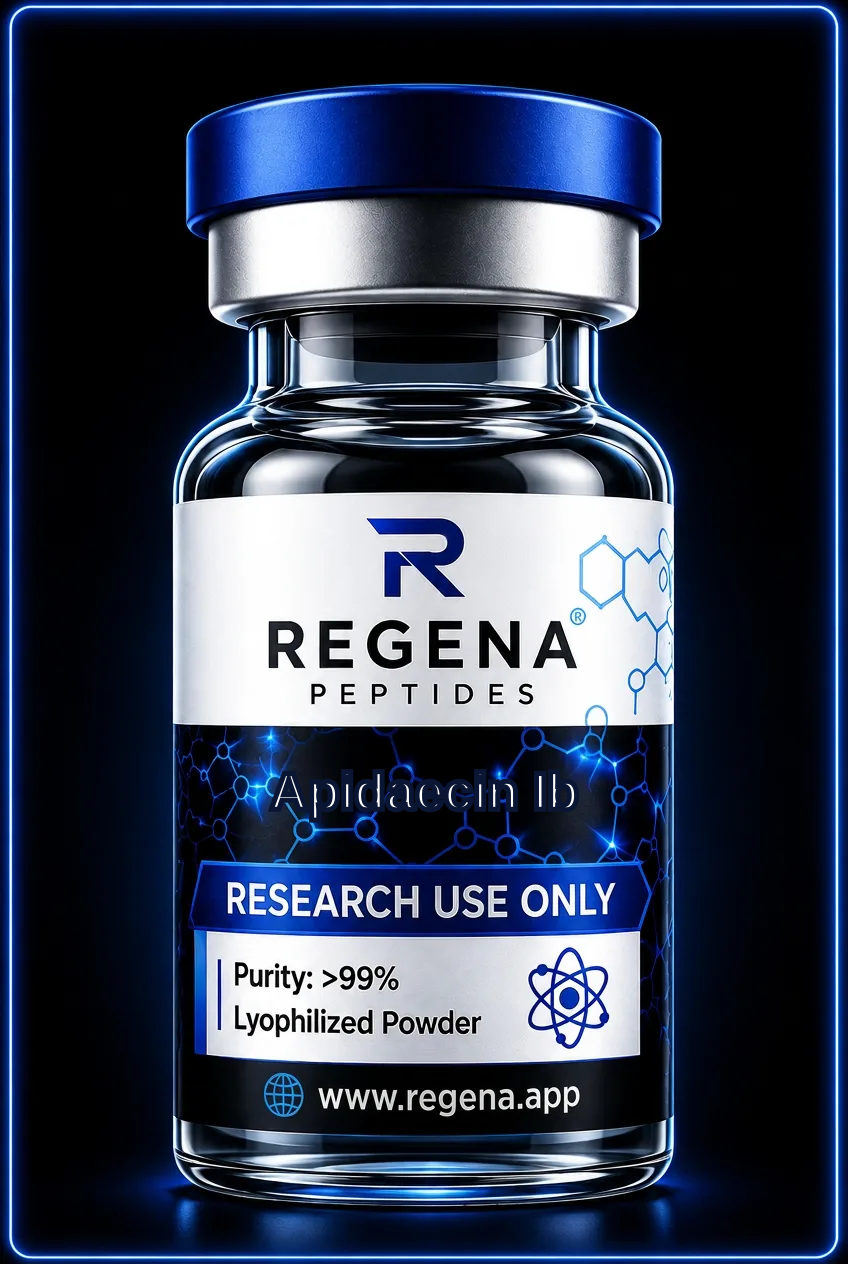
Antimicrobial · Insect proline-rich antimicrobial peptide
Apidaecin Ib
Also known as Apidaecin 1b; Api-Ib
An 18-residue honeybee peptide used to investigate bacterial translation termination and sequence-dependent ribosome interactions.
- Length
- 18 amino acids
- Half-life
- Not well characterised
- Mechanism
- Apidaecin-family peptides bind the bacterial ribosomal exit tunnel and interfere with translation termination. Release-factor trapping is particularly well characterised for engineered apidaecin derivatives, so derivative-specific findings should be distinguished from direct evidence for native Apidaecin Ib.
- Studied in
- Bacterial translation-termination assays, ribosome profiling and uptake-mutant studies examine apidaecin-family interactions with ribosomes and release factors.
About Apidaecin Ib
Apidaecin Ib is a naturally occurring member of the apidaecin family first identified in the honeybee, Apis mellifera. Its mature sequence contains 18 amino acids and is enriched in proline, without the disulphide framework characteristic of insect defensins. The Ib designation identifies a specific sequence variant rather than the entire family. Native Apidaecin Ib has a C-terminal leucine, making terminal sequence verification useful when distinguishing closely related apidaecins and synthetic analogues.
Apidaecins are studied as intracellular inhibitors of bacterial translation rather than solely as membrane-disrupting peptides. Work on the family, especially engineered derivatives, has revealed ribosomal exit-tunnel binding that can trap release factors after nascent-chain release and disrupt subsequent termination events. The C-terminal region is important for this interaction. Native sequence, terminal chemistry and bacterial uptake pathways therefore need to be specified, and mechanistic conclusions from optimised derivatives should not be presented as identical evidence for Apidaecin Ib.
Laboratory notes
- Verify the Ib sequence and C-terminal chemistry; closely related native variants and engineered derivatives are distinct reagents.
- Use termination-sensitive reporters or release-factor assays when investigating mechanism, rather than relying only on bulk translation readouts.
- Include bacterial uptake controls and distinguish native-peptide results from data obtained with engineered apidaecin analogues.
Storage and reconstitution basics: storage guide.
Questions about Apidaecin Ib
What does the Ib designation indicate?
It identifies a particular native apidaecin sequence variant. Apidaecin Ib is an 18-residue peptide with a C-terminal leucine.
Is Apidaecin Ib interchangeable with Api137?
No. Api137 is an engineered apidaecin derivative. Its structural and biochemical findings provide family-level context but do not make it chemically or experimentally identical to Apidaecin Ib.
Why study release factors alongside ribosomes?
Apidaecin-family inhibition involves translation termination, and release-factor trapping is a defining mechanism demonstrated for extensively studied derivatives.
Is Apidaecin Ib for human use?
No. It is supplied strictly for in-vitro laboratory research and is not for human or animal consumption.
Related research peptides
All products are sold for laboratory research use only. Not for human consumption, not a medicine, not for diagnosing, treating or preventing any condition.