
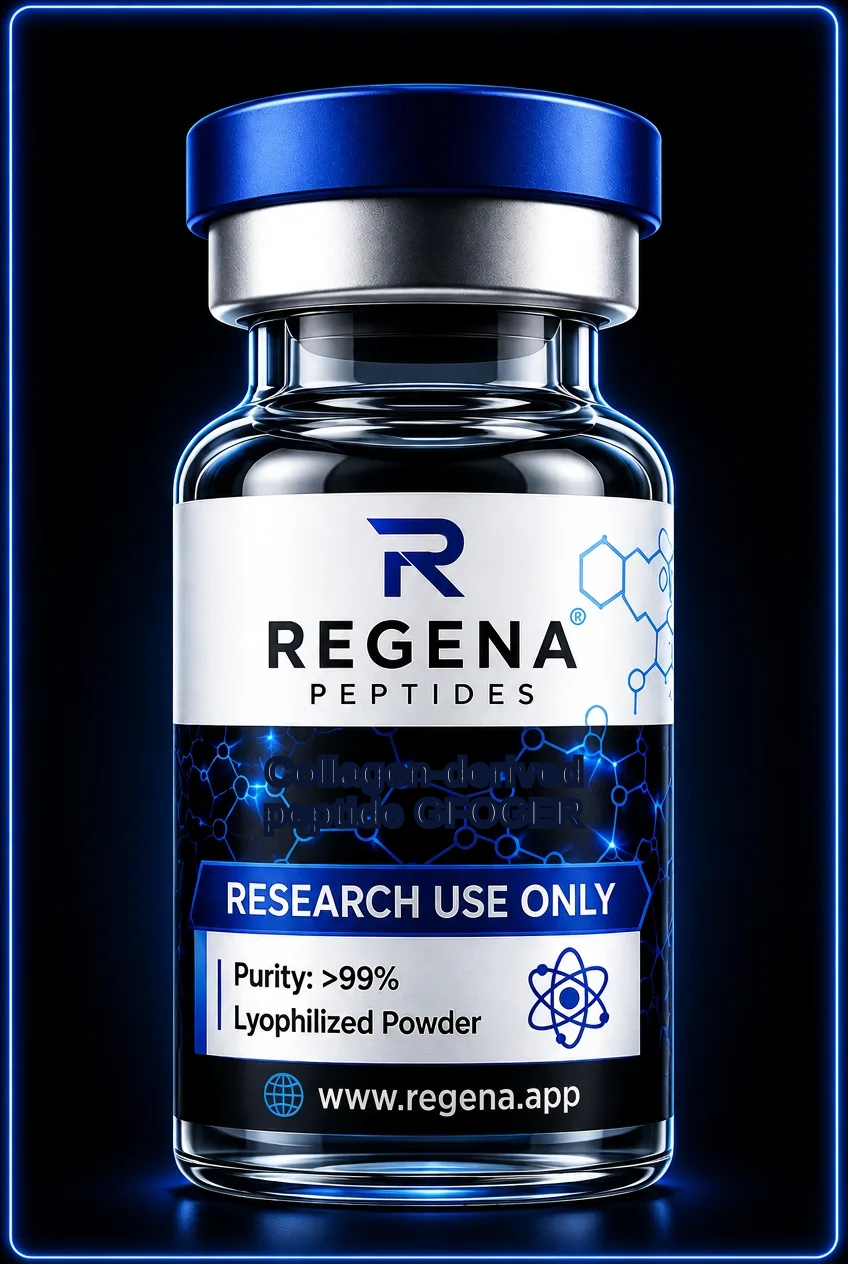
Regenerative · Collagen-derived integrin-binding motif
Collagen-derived peptide GFOGER
Also known as Gly-Phe-Hyp-Gly-Glu-Arg
A hydroxyproline-containing collagen motif whose established integrin recognition depends on triple-helical presentation.
- Length
- 6 amino acids
- Half-life
- Not well characterised
- Mechanism
- In an appropriate triple-helical collagen context, GFOGER binds collagen-recognising integrins, notably α2β1, through the α-subunit I domain. The glutamate side chain participates in metal-dependent recognition, while the isolated linear hexapeptide should not be assumed to reproduce this binding.
- Studied in
- Triple-helical peptide assays, recombinant integrin-binding experiments and cell-adhesion models use GFOGER-containing constructs to investigate collagen recognition.
About Collagen-derived peptide GFOGER
GFOGER denotes glycine–phenylalanine–hydroxyproline–glycine–glutamate–arginine, with O representing hydroxyproline rather than a standard single-letter amino acid code. The motif occurs in fibrillar collagen, including type I collagen, and was characterised through collagen-fragment mapping and synthetic triple-helical peptide studies. Its position within the repeating collagen architecture is central to its activity. A six-residue product labelled GFOGER is chemically distinct from a longer, triple-helix-forming construct that contains the same recognition sequence.
Structural studies show that collagen-binding integrin I domains recognise a three-dimensional surface assembled by the collagen triple helix. For α2β1, the motif's glutamate contributes to coordination at the metal-ion-dependent adhesion site. Other collagen-binding integrins can recognise GFOGER-containing constructs, with affinities influenced by receptor identity and peptide context. Laboratory studies therefore distinguish sequence recognition from helix stability, using direct binding measurements alongside adhesion assays and biophysical verification of the assembled peptide.
Laboratory notes
- Confirm whether the supplied material is the six-residue sequence or a longer triple-helical construct, and verify hydroxyproline stereochemistry in the specification.
- Use circular dichroism and thermal unfolding measurements when triple-helical structure is required; the name GFOGER alone does not establish folding.
- Control divalent-cation composition in integrin assays and include an appropriate chelation control to assess metal-dependent binding.
Storage and reconstitution basics: storage guide.
Questions about Collagen-derived peptide GFOGER
What does the O in GFOGER mean?
It denotes hydroxyproline, usually the collagen-associated 4-hydroxy-L-proline residue. The exact stereochemistry should be confirmed from the product documentation.
Will a linear GFOGER hexapeptide behave like collagen?
Not necessarily. Established collagen-like integrin recognition requires suitable triple-helical presentation, which a standalone six-residue sequence does not reliably provide.
Which receptor is most commonly examined with GFOGER?
The collagen-binding integrin α2β1 is a prominent target. Studies of other collagen-binding integrins require receptor-specific controls and a clearly defined peptide construct.
Is Collagen-derived peptide GFOGER for human use?
No. It is supplied strictly for in-vitro laboratory research and is not for human or animal consumption.
Related research peptides
All products are sold for laboratory research use only. Not for human consumption, not a medicine, not for diagnosing, treating or preventing any condition.