
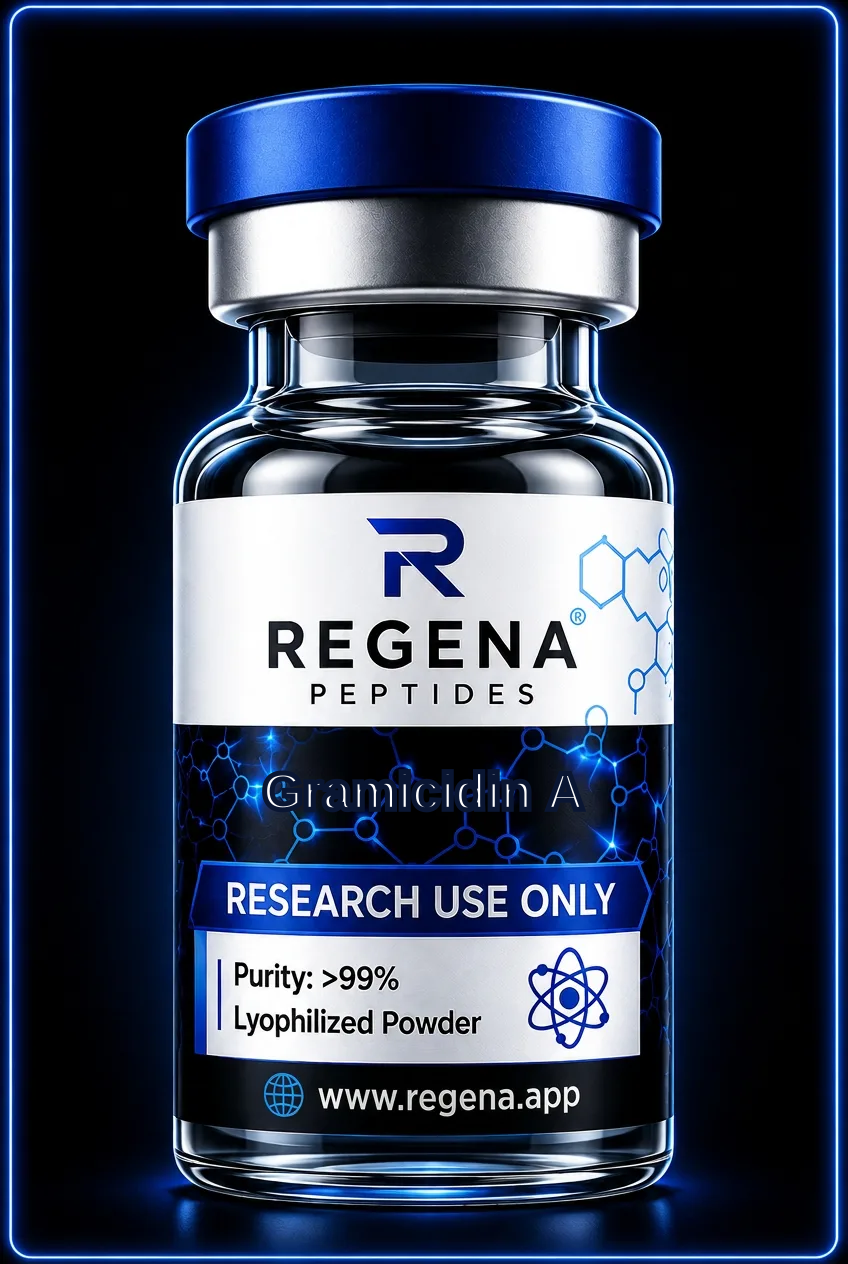
Antimicrobial · Linear polypeptide ionophore
Gramicidin A
Also known as Gramicidin D
A 15-residue ionophore peptide that forms transmembrane channels, used in biophysical studies of membrane transport and ion selectivity.
- Length
- 15 amino acids
- Half-life
- Not well characterised
- Mechanism
- Two gramicidin molecules form a head-to-head dimer across a lipid bilayer, creating a transmembrane channel permeable to monovalent cations.
- Studied in
- It is used as a model system in biophysics to study ion channel formation, membrane dynamics, and lipid-protein interactions.
About Gramicidin A
Gramicidin is a heterogeneous mixture of linear polypeptides produced by the soil bacterium Bacillus brevis. The primary component, Gramicidin A, is a 15-amino acid peptide with alternating L- and D-amino acids, an N-terminal formyl group, and a C-terminal ethanolamine group. This unusual structure facilitates the formation of a beta-helix.
In lipid membranes, gramicidin dimerizes to form a short, selective channel that allows the passage of monovalent cations like Na+ and K+, disrupting the ion gradients essential for cell viability. Due to its non-selectivity between bacterial and mammalian cells, it is a tool for laboratory research, particularly in membrane biophysics. It is also a reference compound with a clinical history for topical applications.
Laboratory notes
- Gramicidin is highly hydrophobic and virtually insoluble in water; it requires organic solvents like ethanol, DMSO, or methanol for solubilisation.
- Commercial gramicidin is often sold as a mixture (Gramicidin D) containing Gramicidins A, B, and C, which differ by a single amino acid.
- Handle with appropriate precautions, as it is cytotoxic to a broad range of cell types, including mammalian cells, by disrupting ion homeostasis.
Storage and reconstitution basics: storage guide.
Questions about Gramicidin A
Why does Gramicidin A have both L- and D-amino acids?
The alternating stereochemistry allows the peptide to form a stable beta-helical secondary structure, which is essential for its function as an ion channel.
Is Gramicidin A a pore-former or a channel-former?
It is a classic channel-former. Two molecules associate to span the membrane, creating a well-defined channel, unlike less-structured pores formed by other antimicrobial peptides.
What is its main use in a lab setting?
It serves as a canonical model for studying the principles of ion transport across biological membranes and for calibrating membrane potential measurements in cell-based assays.
Is Gramicidin A for human use?
No. It is supplied strictly for in-vitro laboratory research and is not for human or animal consumption.
Related research peptides
All products are sold for laboratory research use only. Not for human consumption, not a medicine, not for diagnosing, treating or preventing any condition.