
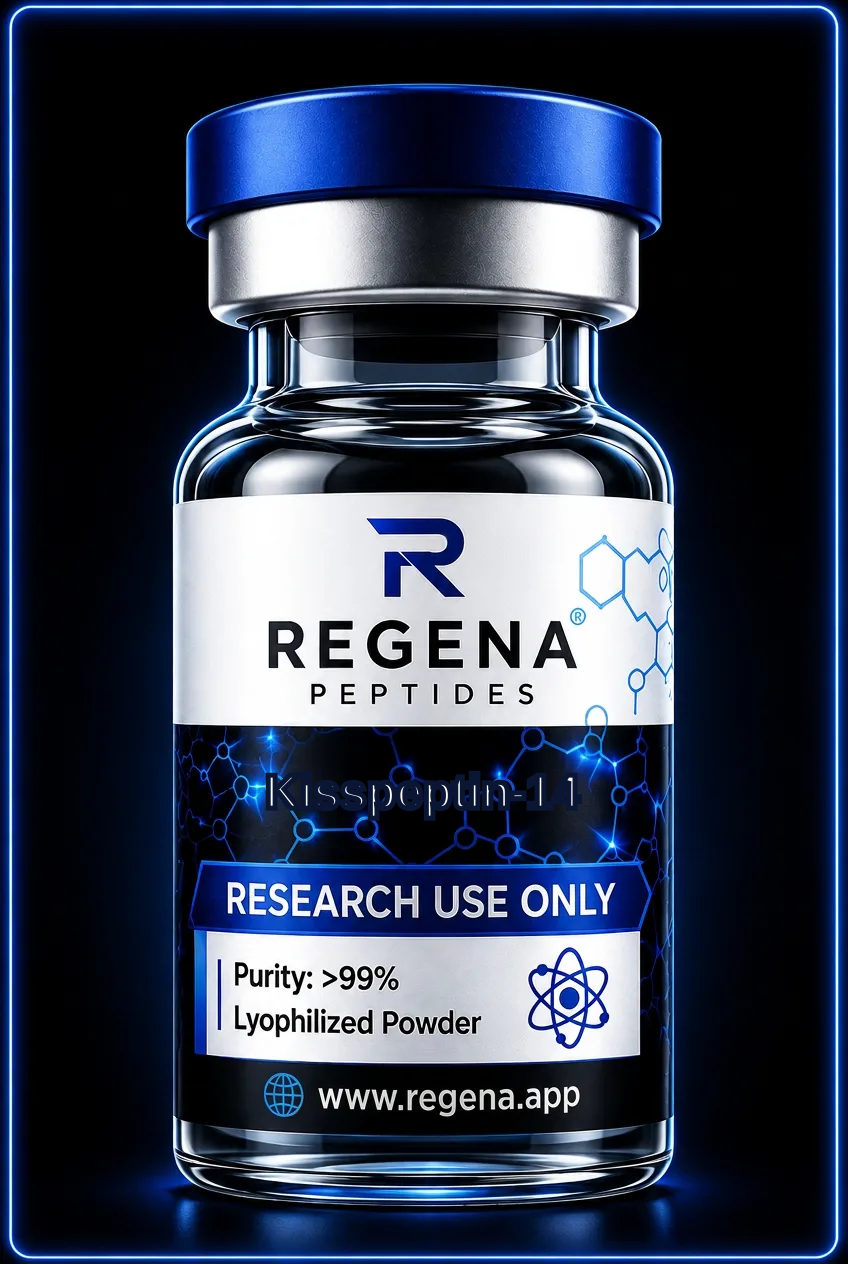
Hormone · C-terminal KISS1-derived RFamide peptide
Kisspeptin-14
Also known as KP-14; KISS1-derived peptide 14
A 14-residue kisspeptin fragment for studying N-terminal extension around the conserved, amidated KISS1R-activating core.
- Length
- 14 amino acids
- Half-life
- Not well characterised
- Mechanism
- Kisspeptin-14 preserves the amidated KISS1R-activating core of human kisspeptin. KISS1R activation predominantly engages Gq/11-dependent phospholipase C signalling, although potency and signalling kinetics require direct characterisation for this fragment.
- Studied in
- Recombinant receptor assays can use this fragment to investigate how N-terminal extension influences KISS1R activation, peptide stability and signalling relative to better-characterised kisspeptins.
About Kisspeptin-14
Kisspeptin-14 denotes a C-terminal fragment of human kisspeptin-54 with the sequence DLPNYNWNSFGLRF-NH2. Relative to kisspeptin-10, it carries the four-residue N-terminal extension Asp-Leu-Pro-Asn. The sequence originates from the KISS1 precursor, whose connection to the receptor GPR54 was established in 2001. Its terminal Arg-Phe-amide motif places it within the RFamide peptide family, while the conserved C-terminal sequence provides the basis for expected KISS1R activity.
Published characterisation of this exact fragment is limited compared with the canonical kisspeptin lengths. It should therefore be treated as a sequence-defined research reagent rather than assumed to be a major endogenous processing product. Side-by-side studies can examine receptor activation, signalling kinetics and proteolytic stability. Receptor expression level and assay timing matter because apparent potency can vary even when peptides share the same C-terminal receptor-activating core.
Laboratory notes
- Verify that the supplied material is DLPNYNWNSFGLRF-NH2; the name alone does not establish sequence or terminal chemistry.
- Use analytical LC–MS or HPLC to assess integrity when comparing storage conditions or protease-containing assay matrices.
- Keep buffer composition and peptide handling consistent across fragment comparisons, including vehicle-only controls.
Storage and reconstitution basics: storage guide.
Questions about Kisspeptin-14
What distinguishes kisspeptin-14 from kisspeptin-13?
The human sequence has one additional N-terminal aspartate; both fragments retain the same amidated C-terminus.
Can kisspeptin-10 potency values be assigned to kisspeptin-14?
No. A shared active core supports a mechanistic relationship, but potency, stability and signalling kinetics should be measured for the exact fragment.
Is kisspeptin-14 necessarily a naturally occurring peptide?
Not necessarily. It is a defined KISS1-derived sequence, but that does not establish endogenous production of the exact 14-residue fragment.
Is Kisspeptin-14 for human use?
No. It is supplied strictly for in-vitro laboratory research and is not for human or animal consumption.
Related research peptides
All products are sold for laboratory research use only. Not for human consumption, not a medicine, not for diagnosing, treating or preventing any condition.