
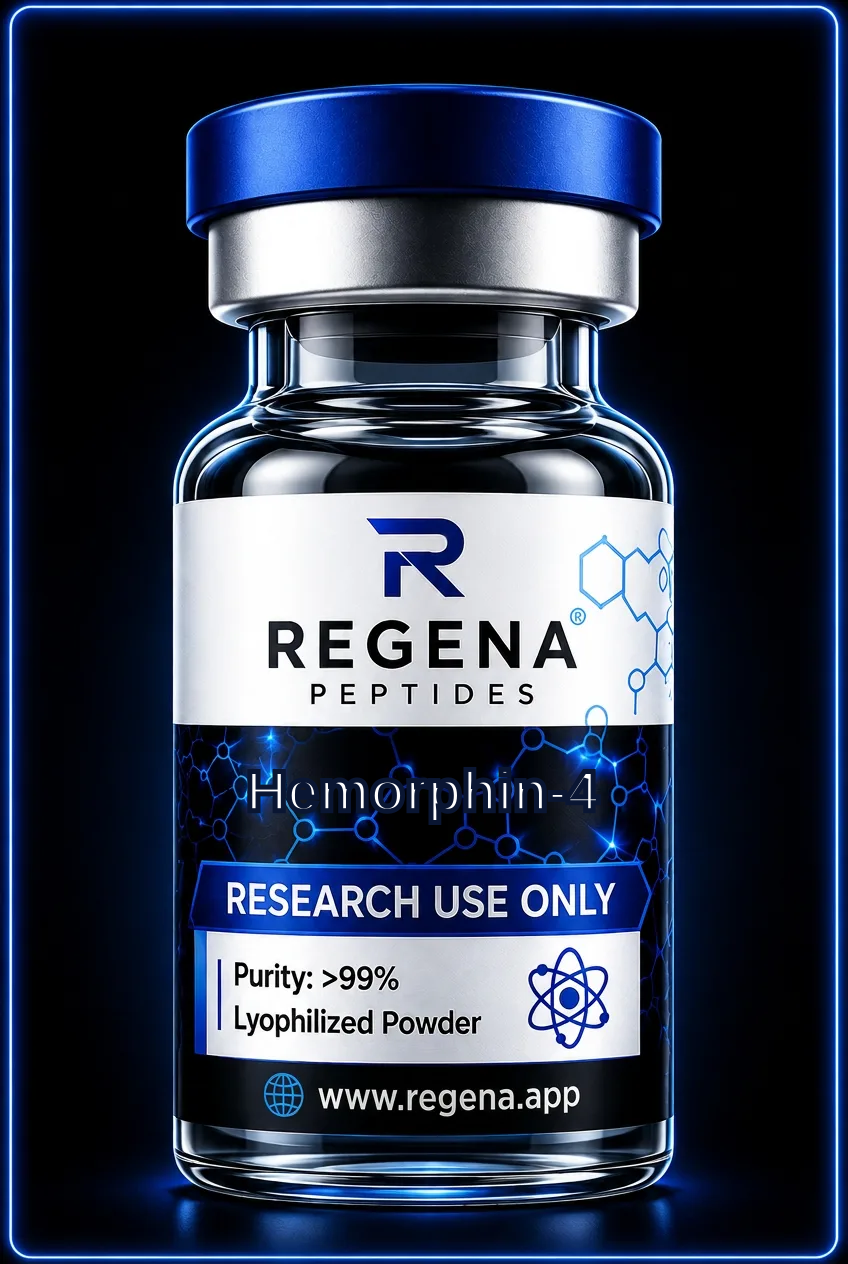
Other · Haemoglobin-derived opioid peptide
Hemorphin-4
Also known as H4; YPWT
The YPWT tetrapeptide core of the haemorphin family, used to investigate haemoglobin proteolysis and opioid receptor recognition.
- Length
- 4 amino acids
- Half-life
- Not well characterised
- Mechanism
- Hemorphin-4 contains the Tyr-Pro-Trp-Thr opioid-active motif and interacts with opioid receptor systems in experimental preparations. Apparent activity and receptor preference depend on the assay, so a fixed selectivity profile across μ-, δ- and κ-opioid receptors should not be assumed.
- Studied in
- Opioid receptor-binding assays, isolated tissue preparations and haemoglobin proteolysis studies investigate its activity and formation.
About Hemorphin-4
Hemorphin-4 has the sequence Tyr-Pro-Trp-Thr, abbreviated YPWT, and represents a short opioid-active fragment of the haemoglobin beta chain. The haemorphin family was identified through work on proteolytic haemoglobin fragments with activity in opioid-sensitive experimental systems. Its name links its haemoglobin origin with that pharmacological observation. The numeral four denotes the total number of residues in this unextended peptide, rather than a receptor subtype, chemical modification or position within the parent protein.
The N-terminal tyrosine and neighbouring aromatic tryptophan contribute to a compact recognition motif investigated in opioid pharmacology. Laboratory comparisons with longer haemorphins examine how sequence extension affects receptor interaction, proteolytic susceptibility and activity in isolated tissues. Binding measurements should be distinguished from functional responses, since receptor occupancy alone does not establish agonist efficacy. As a small peptide with accessible termini, hemorphin-4 can undergo further processing in biological matrices, complicating interpretation of prolonged incubations.
Laboratory notes
- Verify that the material has the intended free N-terminus and C-terminal carboxyl group; terminal modifications create a different assay reagent.
- Include receptor-selective reference ligands and non-specific binding controls when comparing opioid receptor interactions.
- Assess peptide integrity during tissue or lysate incubations using LC–MS or HPLC rather than assuming the starting sequence remains intact.
Storage and reconstitution basics: storage guide.
Questions about Hemorphin-4
What does the number four indicate?
It indicates the four residues in YPWT: tyrosine, proline, tryptophan and threonine.
Is hemorphin-4 interchangeable with hemorphin-7?
No. Hemorphin-7 contains the additional C-terminal sequence Gln-Arg-Phe, which can change receptor interactions and susceptibility to enzymatic processing.
Can haemoglobin digestion generate hemorphin-4?
Appropriate proteolysis can release this haemoglobin-derived sequence, but the product distribution depends on the parent haemoglobin, enzymes and digestion conditions.
Is Hemorphin-4 for human use?
No. It is supplied strictly for in-vitro laboratory research and is not for human or animal consumption.
Related research peptides
All products are sold for laboratory research use only. Not for human consumption, not a medicine, not for diagnosing, treating or preventing any condition.