
Hormone · Synthetic GnRH receptor agonist containing a non-proteinogenic amino acid
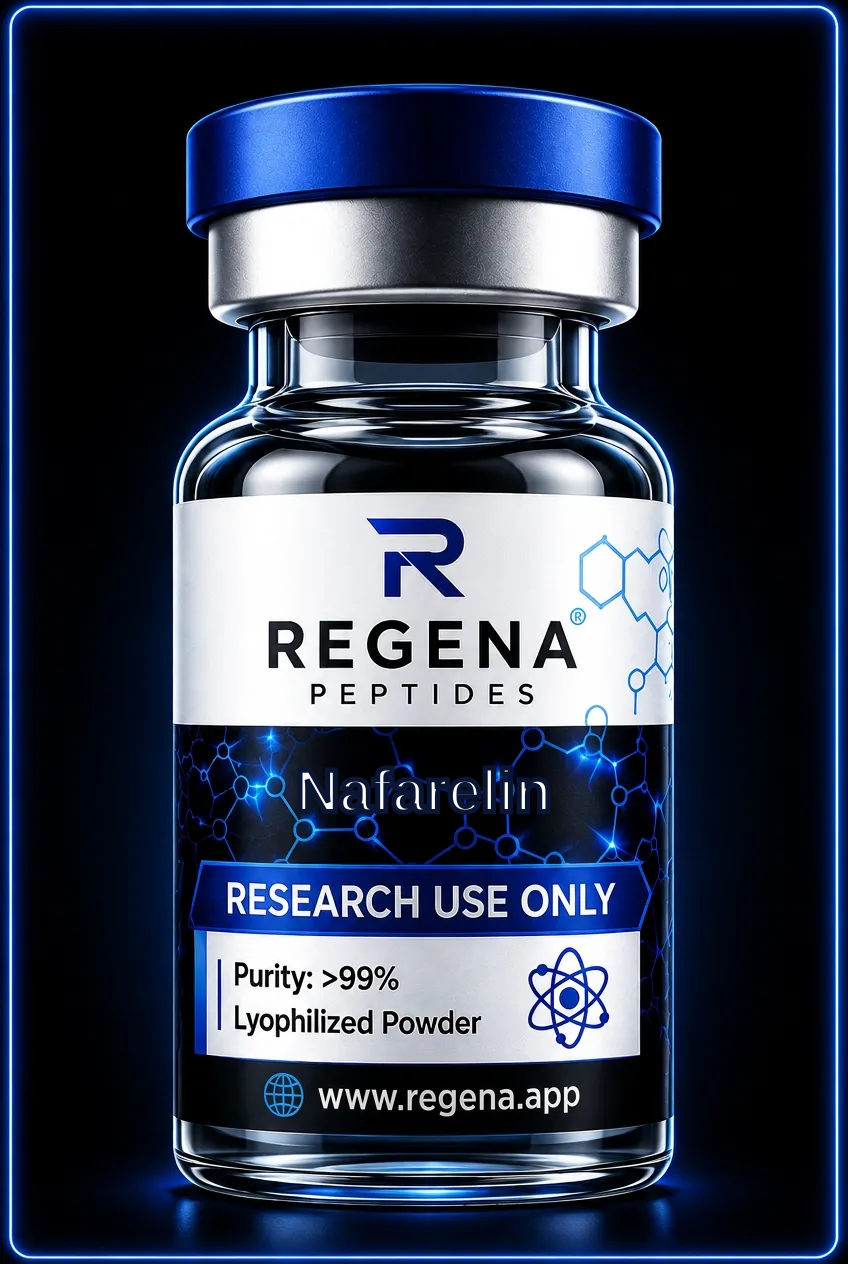
Nafarelin
Also known as [D-Nal(2)6]-GnRH; [D-2-Nal6]-LHRH
A GnRH decapeptide containing D-2-naphthylalanine, used to study aromatic ligand modifications and receptor signalling.
- Length
- 10 amino acids
- Half-life
- Not well characterised
- Mechanism
- Nafarelin activates GnRHR, initiating Gq/11-linked phospholipase C signalling and intracellular calcium mobilisation. Persistent receptor stimulation can lead to adaptive changes in gonadotroph signalling and secretory responsiveness.
- Studied in
- Nafarelin is investigated in receptor-binding assays, GnRHR-expressing cells and pituitary or animal endocrine models exploring aromatic substitutions and agonist-driven adaptation.
About Nafarelin
Nafarelin is a synthetic GnRH decapeptide containing D-2-naphthylalanine at position 6 in place of the native glycine. This non-proteinogenic residue introduces a bulky bicyclic aromatic side chain while preserving the parent peptide's N-terminal pyroglutamate and C-terminal glycinamide. Its sequence is pGlu-His-Trp-Ser-Tyr-D-Nal(2)-Leu-Arg-Pro-Gly-NH2. The design reflects GnRH structure–activity research showing that D-configured substitutions at the sixth position can modify receptor interactions and resistance to peptide-degrading enzymes.
The naphthylalanine substitution makes nafarelin useful for comparisons with position-6 analogues containing D-tryptophan, D-leucine or modified D-serine. Such comparisons can explore how side-chain chemistry influences binding and functional activity, although measured differences also depend on the assay system. Calcium mobilisation and inositol phosphate accumulation provide proximal functional readouts, while pituitary cultures support studies of secretion and transcription. Binding measurements should accompany functional assays when the experimental question specifically concerns receptor affinity.
Laboratory notes
- Confirm that analytical documentation specifies D-2-naphthylalanine; alternative naphthylalanine positional isomers are not equivalent structures.
- Validate solubility and vessel recovery in the selected matrix, as the aromatic substitution may affect nonspecific binding and peptide recovery.
- If a co-solvent is needed for stock preparation, include matched vehicle controls and verify that the final assay matrix preserves receptor responsiveness.
Storage and reconstitution basics: storage guide.
Questions about Nafarelin
What does D-Nal(2) identify?
It identifies D-2-naphthylalanine, an amino acid with a naphthalen-2-yl side-chain group. Both the D configuration and aromatic attachment position define the residue.
How does nafarelin differ from triptorelin?
Both retain the native GnRH terminal framework. Nafarelin contains D-2-naphthylalanine at position 6, whereas triptorelin contains D-tryptophan there.
Does the aromatic substitution establish a longer assay half-life?
Not without measurement. Stability depends on the enzyme environment, matrix and experimental conditions; intact-peptide analysis over time is needed to establish an assay-specific degradation half-life.
Is Nafarelin for human use?
No. It is supplied strictly for in-vitro laboratory research and is not for human or animal consumption.
Related research peptides
All products are sold for laboratory research use only. Not for human consumption, not a medicine, not for diagnosing, treating or preventing any condition.