
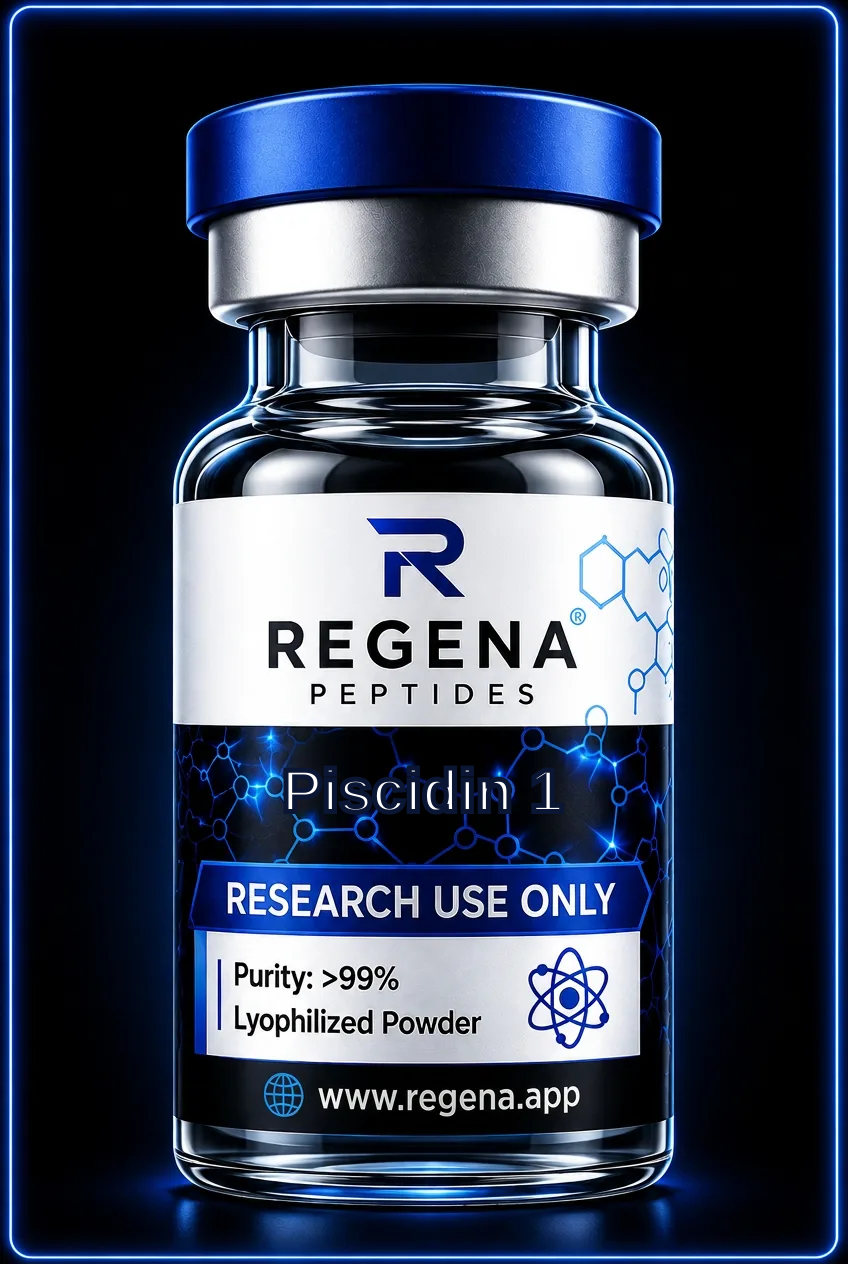
Antimicrobial · Linear, histidine-rich α-helical antimicrobial peptide
Piscidin 1
Also known as Piscidin-1; P1
A 22-residue fish antimicrobial peptide studied for membrane-bound helicity, histidine-dependent behaviour and N-terminal copper binding.
- Length
- 22 amino acids
- Half-life
- Not well characterised
- Mechanism
- Piscidin 1 forms an amphipathic helix at lipid interfaces and disrupts membrane organisation, with activity influenced by lipid composition, pH and peptide-to-lipid ratio. Its N-terminal metal-binding motif can coordinate copper, enabling additional oxidative chemistry in experimental systems; no specific receptor is required for membrane activity.
- Studied in
- Lipid vesicles, supported bilayers, bacterial cultures, biofilm systems and metal-binding assays investigate piscidin 1 membrane structure, permeabilisation and copper-dependent chemistry.
About Piscidin 1
Piscidin 1 was originally isolated from mast cells of hybrid striped bass, a cross between white bass and striped bass. The canonical mature peptide contains 22 residues with the sequence FFHHIFRGIVHVGKTIHRLVTG and is commonly studied with a C-terminal amide. Four histidines and several hydrophobic residues help define its chemistry. Unlike defensins, piscidin 1 contains no cysteine and does not require disulphide folding to develop its membrane-associated α-helical structure in experimental systems.
Biophysical investigations use solid-state nuclear magnetic resonance, circular dichroism and membrane-leakage assays to examine how piscidin 1 aligns within lipid bilayers. Its behaviour varies with anionic lipid content, membrane curvature and histidine protonation. The free N-terminus and third-position histidine form an amino-terminal copper- and nickel-binding motif, often abbreviated ATCUN. Copper coordination introduces a separate experimental variable because metal-bound peptide can support oxidative reactions as well as membrane-associated effects under appropriate laboratory conditions.
Laboratory notes
- Specify C-terminal amidation and confirm a free N-terminus; terminal modifications can alter membrane behaviour and ATCUN metal coordination.
- Control pH and trace-metal content, and include matched metal-only and peptide-only controls in copper-binding experiments.
- Report lipid composition and peptide-to-lipid ratio in membrane assays, with separate checks for aggregation and nonspecific leakage.
Storage and reconstitution basics: storage guide.
Questions about Piscidin 1
Why are the histidines important?
Their protonation changes with pH and influences peptide charge and membrane interactions. The histidine at position three also contributes to the N-terminal ATCUN metal-binding site.
Does piscidin 1 have a defined receptor target?
No specific receptor is required for its established membrane activity. Most mechanistic studies focus on lipid interactions, membrane disruption and, where relevant, metal-dependent chemistry.
Are amidated and non-amidated piscidin 1 equivalent?
No. C-terminal amidation removes the terminal carboxylate charge and can affect physicochemical properties. Comparisons should use explicitly matched terminal chemistry.
Is Piscidin 1 for human use?
No. It is supplied strictly for in-vitro laboratory research and is not for human or animal consumption.
Related research peptides
All products are sold for laboratory research use only. Not for human consumption, not a medicine, not for diagnosing, treating or preventing any condition.