
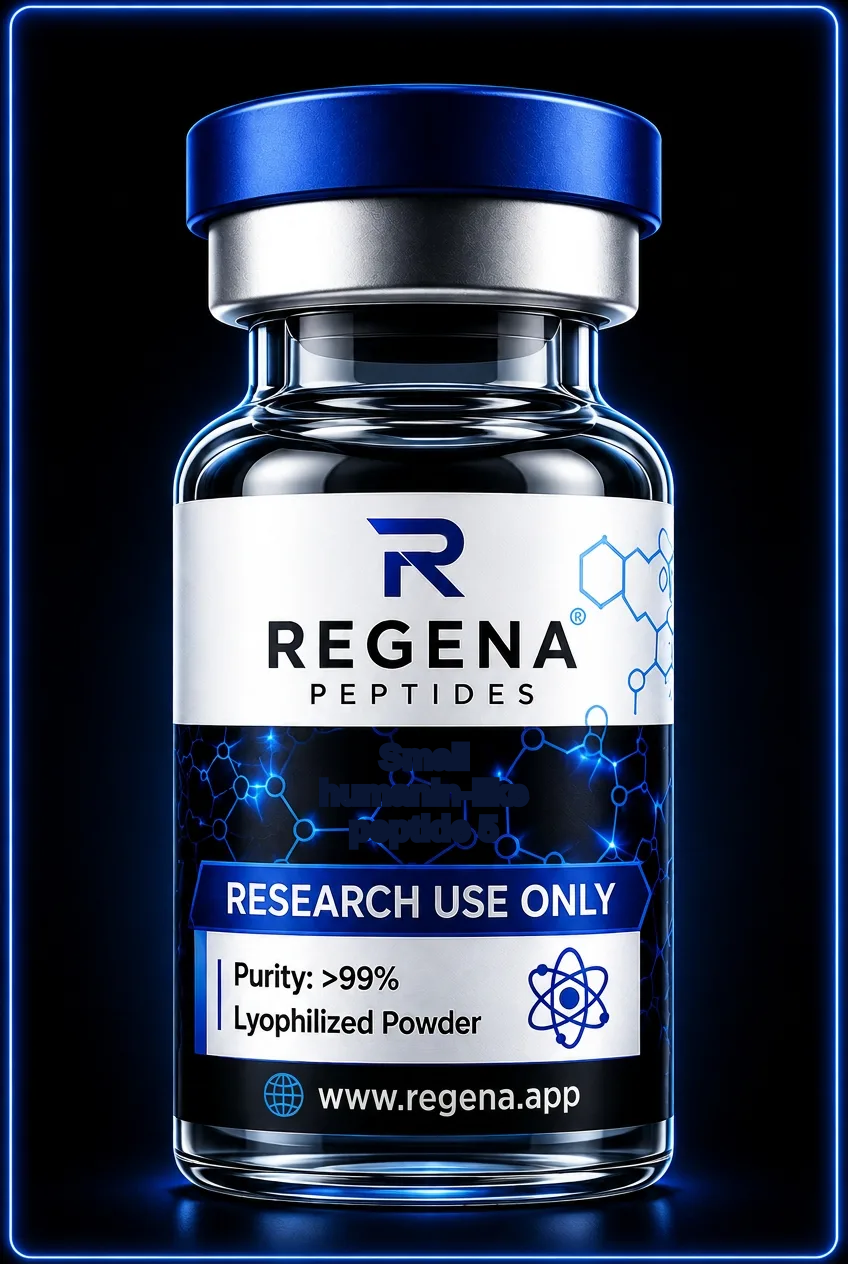
Other · Mitochondrial-derived peptide
Small humanin-like peptide 5 (SHLP5)
Also known as SHLP5
A 24-residue mitochondrial-derived peptide studied within the SHLP family, with no firmly established receptor or signalling mechanism.
- Length
- 24 amino acids
- Half-life
- Not well characterised
- Mechanism
- SHLP5 belongs to a family of putative mitochondrial-derived signalling peptides, but its molecular mechanism remains unresolved. No specific receptor or direct binding target has been firmly established.
- Studied in
- Synthetic SHLP5 has been included in mammalian cell studies comparing mitochondrial-derived peptides through viability, apoptosis and metabolic assay endpoints.
About Small humanin-like peptide 5 (SHLP5)
SHLP5 was described in 2016 as one of six small humanin-like peptides identified through analysis of short open reading frames within the mitochondrial 16S ribosomal RNA gene, MT-RNR2. Its predicted sequence contains 24 amino acids. The family name reflects its genomic relationship to humanin, rather than establishing a shared receptor or identical biological activity. SHLP5 is therefore best understood as a distinct, comparatively undercharacterised member of the mitochondrial-derived peptide literature.
Experimental work on the SHLP family has used synthetic peptides to examine cell survival, apoptosis, mitochondrial activity and related signalling endpoints. Much of the detailed mechanistic evidence concerns other family members, particularly SHLP2 and SHLP3, and should not be transferred to SHLP5. For this peptide, receptor identity, direct molecular partners and the relationship between synthetic-peptide experiments and endogenous biology remain open questions. Comparative assays are useful, but require peptide-specific controls and cautious interpretation.
Laboratory notes
- Confirm sequence, molecular mass and purity against the batch certificate; the SHLP family name does not establish sequence equivalence.
- Use single-use aliquots where feasible and document solvent, storage conditions and freeze–thaw history.
- Pair metabolic viability assays with an orthogonal cell-count or membrane-integrity readout to distinguish metabolic changes from altered cell number.
Storage and reconstitution basics: storage guide.
Questions about Small humanin-like peptide 5 (SHLP5)
Does SHLP5 have a confirmed receptor?
No specific receptor has been firmly established. Receptor assignments reported for humanin or other mitochondrial-derived peptides should not be assumed to apply.
Where does the SHLP5 sequence originate?
It corresponds to a proposed short open reading frame within MT-RNR2, the mitochondrial gene encoding 16S ribosomal RNA.
Can SHLP2 findings be used to describe SHLP5?
Not without direct evidence. These are different peptide sequences, and shared genomic origin does not establish shared activity. SHLP5 is supplied for research use only.
Is Small humanin-like peptide 5 (SHLP5) for human use?
No. It is supplied strictly for in-vitro laboratory research and is not for human or animal consumption.
Related research peptides
All products are sold for laboratory research use only. Not for human consumption, not a medicine, not for diagnosing, treating or preventing any condition.