
Antimicrobial · Disulphide-stabilised, cationic β-hairpin antimicrobial peptide
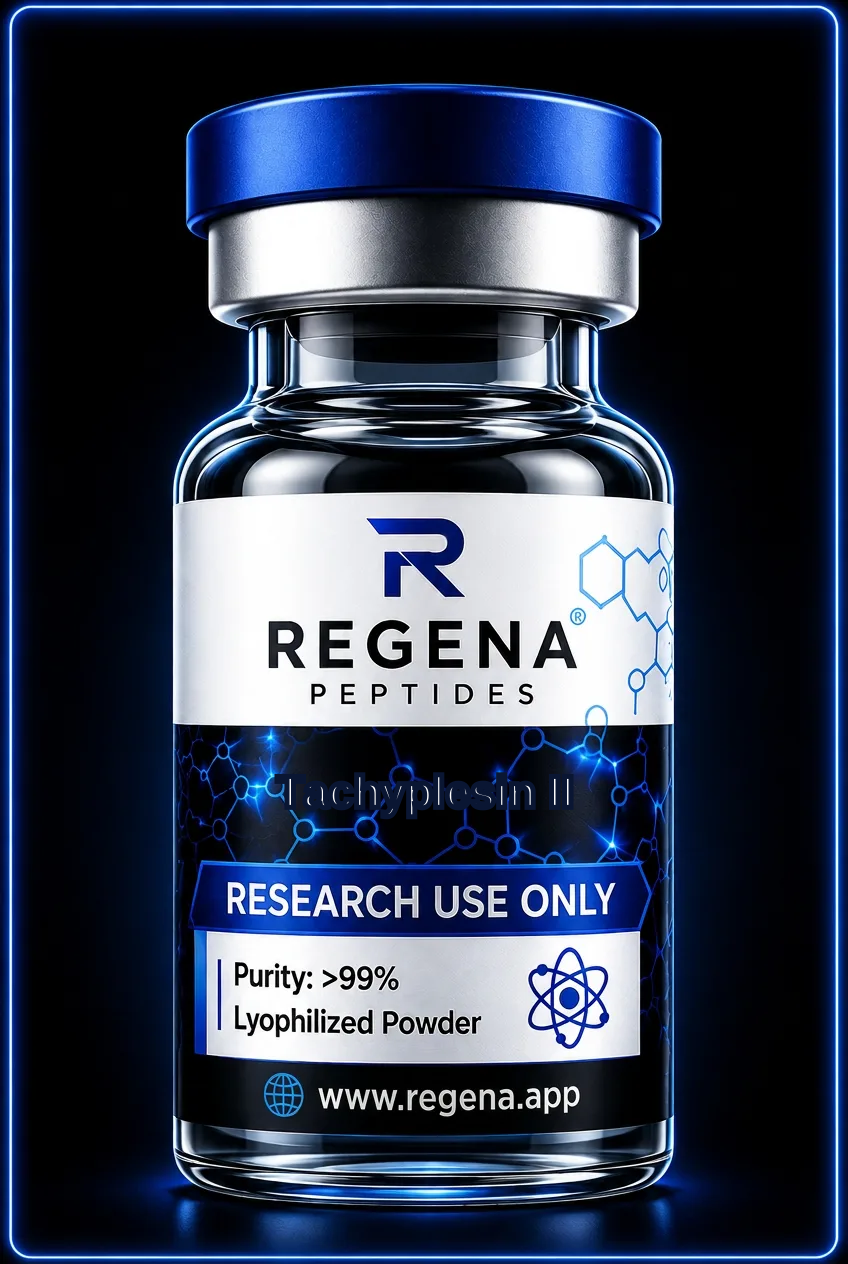
Tachyplesin II
Also known as Tachyplesin 2; TP-II
A horseshoe-crab β-hairpin peptide used to study disulphide-dependent structure and antimicrobial membrane interactions.
- Length
- 17 amino acids
- Half-life
- Not well characterised
- Mechanism
- Tachyplesin II binds anionic membrane components and perturbs lipid bilayers through its cationic, amphipathic β-hairpin structure. Membrane permeabilisation is a principal experimental mechanism, with no single established protein receptor accounting for its activity.
- Studied in
- Bacterial cultures, model lipid membranes and structural assays are used to examine membrane binding, permeabilisation and the contribution of disulphide connectivity.
About Tachyplesin II
Tachyplesin II belongs to a family of antimicrobial peptides identified from horseshoe-crab haemocytes. Its mature sequence is RWCFRVCYRGICYRKCR-NH₂, comprising 17 residues with an amidated C-terminus. Four cysteines form two intramolecular disulphide bonds, connecting residues 3–16 and 7–12. These crosslinks stabilise a compact β-hairpin rather than the membrane-induced α-helical architecture of many frog-skin peptides. Several arginine residues and one lysine give the molecule a strongly cationic character.
The constrained fold presents basic and hydrophobic side chains in an arrangement suited to membrane association. Experiments investigate interactions with negatively charged lipids, permeability changes and the relationship between peptide structure and bacterial membrane disruption. Comparisons with reduced, alkylated or sequence-modified material can test the contribution of the disulphide-stabilised fold. Findings from Tachyplesin I should be distinguished from direct Tachyplesin II evidence, because the related sequences are not identical experimental reagents.
Laboratory notes
- For research use only; verify sequence, C-terminal amidation and disulphide connectivity rather than relying on molecular mass alone.
- Avoid reducing agents in assays intended to preserve the native β-hairpin, unless reduction is an explicit experimental variable.
- Use complementary purity and folding checks, since disulphide isomers can share the same intact molecular mass.
Storage and reconstitution basics: storage guide.
Questions about Tachyplesin II
Which cysteines form the native disulphide bonds?
For the sequence RWCFRVCYRGICYRKCR-NH₂, the native connectivity is Cys3–Cys16 and Cys7–Cys12.
Is Tachyplesin II a backbone-cyclic peptide?
No. It has a linear peptide backbone constrained by two intramolecular disulphide bonds; this is distinct from head-to-tail backbone cyclisation.
Can intact mass confirm correct folding?
Not by itself. Intact mass can support oxidation-state assessment, but alternative disulphide connectivities require additional mapping or structural analysis.
Is Tachyplesin II for human use?
No. It is supplied strictly for in-vitro laboratory research and is not for human or animal consumption.
Related research peptides
All products are sold for laboratory research use only. Not for human consumption, not a medicine, not for diagnosing, treating or preventing any condition.