
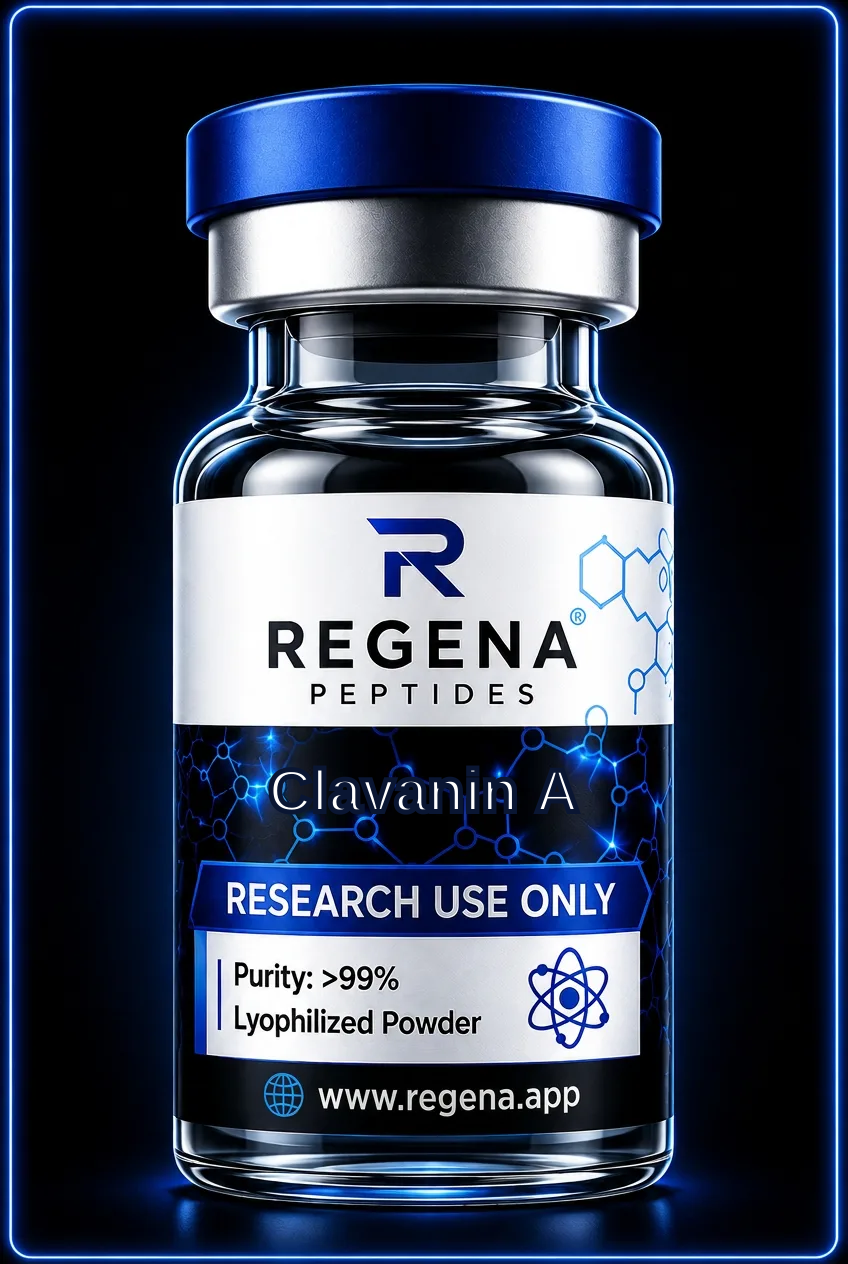
Antimicrobial · Histidine-rich, α-helical antimicrobial peptide
Clavanin A
Also known as ClavA
A histidine-rich tunicate peptide used to investigate pH-dependent bacterial membrane interactions.
- Length
- 23 amino acids
- Half-life
- Not well characterised
- Mechanism
- Clavanin A interacts with bacterial membranes through a mechanism strongly influenced by pH and membrane composition. Protonation of its histidine residues changes its charge and activity; no single specific receptor has been established.
- Studied in
- Bacterial cultures, model lipid vesicles and membrane-biophysics assays are used to investigate pH-dependent antimicrobial activity, membrane permeabilisation and peptide–lipid interactions.
About Clavanin A
Clavanin A was originally isolated from haemocytes of the tunicate Styela clava as part of a family of related antimicrobial peptides. Its mature sequence, VFQFLGKIIHHVGNFVHGFSHVF, contains 23 residues and has an amidated C-terminus. Four histidines distinguish its charge behaviour from peptides dominated by lysine or arginine. The sequence also contains numerous hydrophobic residues, supporting association with lipid bilayers and formation of an amphipathic helix in suitable membrane-like environments.
Laboratory studies examine how acidity, ionic strength and lipid composition alter clavanin A activity. Histidine protonation makes buffer pH particularly important when interpreting bacterial growth assays or vesicle leakage experiments. Membrane interaction is well supported, although its effects cannot always be reduced to simple pore formation. Circular dichroism, fluorescence measurements and bacterial membrane-potential assays provide complementary ways to distinguish peptide folding, lipid association and disruption of membrane function.
Laboratory notes
- Confirm C-terminal amidation and sequence identity; a free-acid analogue is not chemically equivalent to native clavanin A.
- Control buffer pH and ionic strength closely, as both can change histidine protonation and assay behaviour.
- Use low-binding labware and include peptide-free fluorescence controls when measuring vesicle leakage or membrane potential.
Storage and reconstitution basics: storage guide.
Questions about Clavanin A
Why is pH especially important in clavanin A experiments?
Its four histidine residues become more protonated as pH decreases, altering net charge, membrane interactions and antimicrobial assay results.
Does clavanin A have a defined receptor target?
No single receptor has been established. Research primarily examines interactions with bacterial membranes and their lipid components.
Is clavanin A always α-helical?
No. Its conformation depends on the surrounding environment; membrane-like conditions can favour helicity compared with aqueous solution.
Is Clavanin A for human use?
No. It is supplied strictly for in-vitro laboratory research and is not for human or animal consumption.
Related research peptides
All products are sold for laboratory research use only. Not for human consumption, not a medicine, not for diagnosing, treating or preventing any condition.