
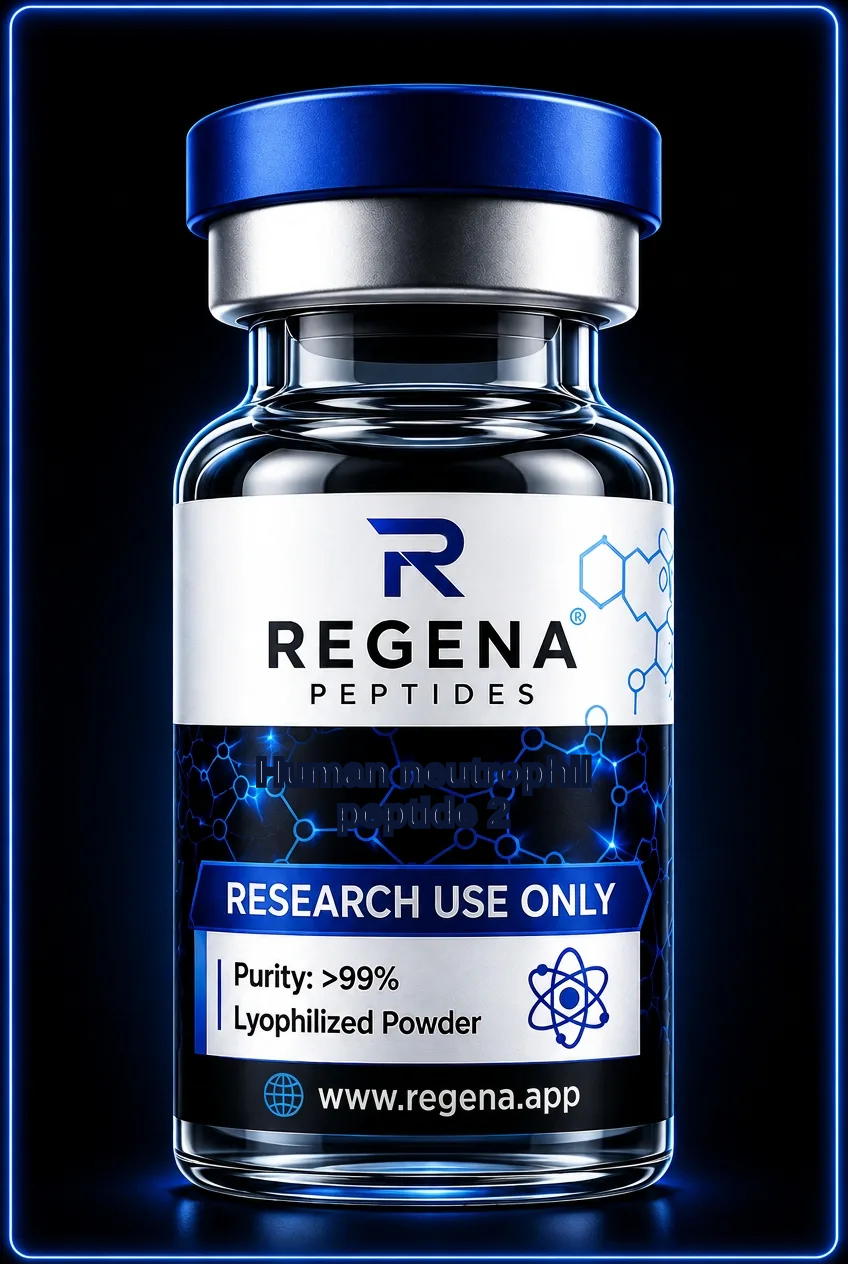
Antimicrobial · N-terminally shortened mammalian α-defensin
Human neutrophil peptide 2 (HNP-2)
Also known as HNP-2; human α-defensin 2
A 29-residue neutrophil α-defensin used to study how N-terminal processing influences defensin structure and microbial interactions.
- Length
- 29 amino acids
- Half-life
- Not well characterised
- Mechanism
- HNP-2 interacts with microbial membranes through its cationic α-defensin surface and can alter membrane permeability under suitable assay conditions. Its activity is not assigned to a single established receptor and depends on folding, microbial envelope composition and the surrounding medium.
- Studied in
- Microbial culture assays, model membranes and comparative defensin studies examine how N-terminal shortening affects HNP-2 structure and molecular interactions.
About Human neutrophil peptide 2 (HNP-2)
HNP-2 belongs to the original group of human neutrophil α-defensins characterised in the 1980s. Its 29-amino-acid sequence corresponds to HNP-1 or HNP-3 without the first residue, leaving cysteine at the N-terminus. It is generally regarded as a proteolytically generated product rather than the mature product of a separate HNP-2 gene. Like its close relatives, HNP-2 occurs in neutrophil azurophilic granules and contains six cysteines forming a compact three-disulphide framework.
Removing the first residue preserves the shared defensin core but changes the local chemical environment at the N-terminus. HNP-2 therefore provides a useful comparison for experiments testing how small sequence differences affect membrane association, oligomerisation and microbial susceptibility. Its canonical disulphide pattern remains Cys I–VI, II–IV and III–V. Although family members share many properties, mechanistic findings obtained with HNP-1 should not automatically be attributed to HNP-2 without direct experimental support.
Laboratory notes
- Use mass spectrometry or sequence analysis to distinguish HNP-2 from closely related HNP-1 and HNP-3 preparations.
- Avoid reducing agents when the assay requires the native disulphide-stabilised structure, and document any deliberate reduction.
- Match buffer composition and microbial growth phase across head-to-head defensin comparisons.
Storage and reconstitution basics: storage guide.
Questions about Human neutrophil peptide 2 (HNP-2)
Does HNP-2 have its own dedicated encoding gene?
A separate HNP-2 gene is not established. HNP-2 is generally understood to arise through N-terminal processing of HNP-1 or HNP-3.
Does its shorter sequence remove a disulphide bond?
No. The missing N-terminal residue is not cysteine. HNP-2 retains all six cysteines and the three-disulphide α-defensin framework.
Can HNP-1 assay results substitute for HNP-2 data?
Not reliably. Closely related defensins can differ in interactions and assay responses, so sequence-matched controls and direct measurements are needed. HNP-2 is for research use only.
Is Human neutrophil peptide 2 (HNP-2) for human use?
No. It is supplied strictly for in-vitro laboratory research and is not for human or animal consumption.
Related research peptides
All products are sold for laboratory research use only. Not for human consumption, not a medicine, not for diagnosing, treating or preventing any condition.