
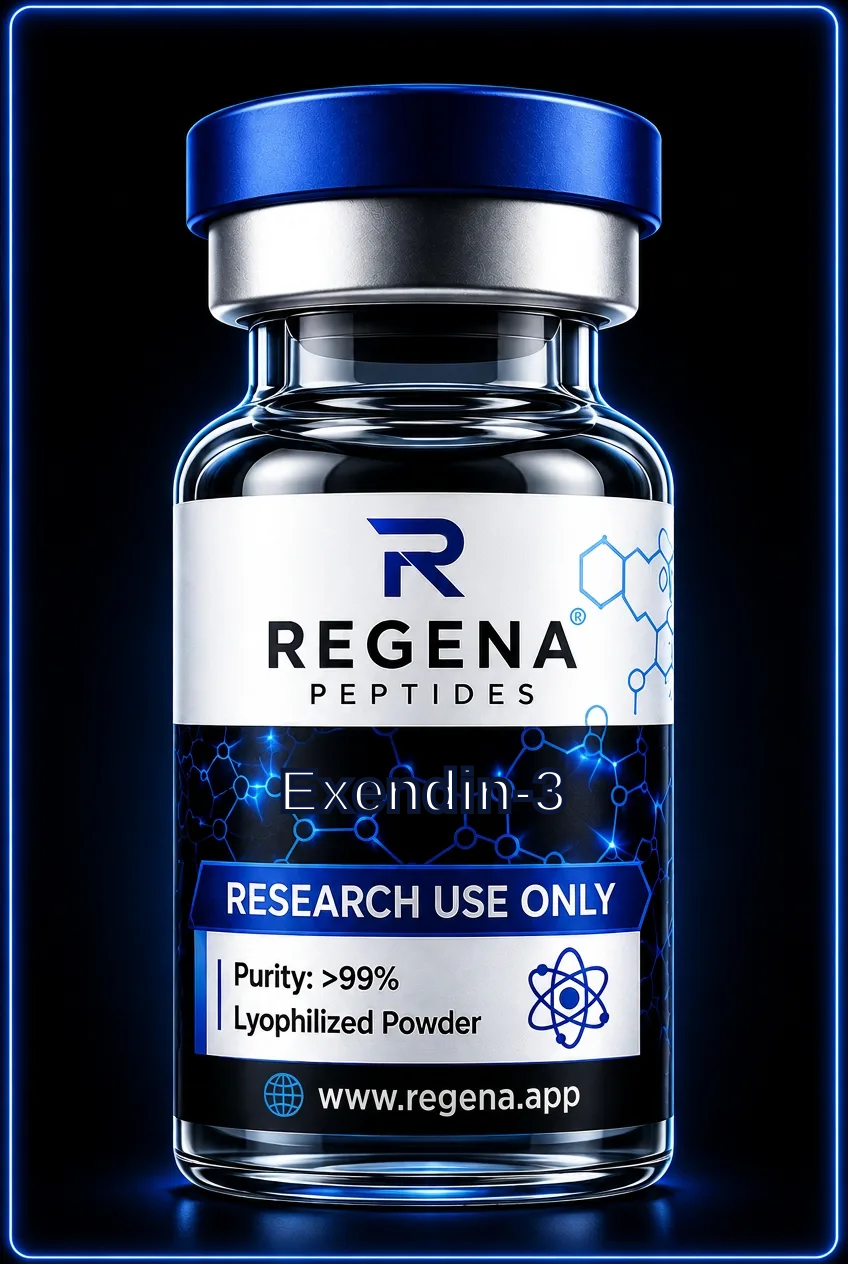
Metabolic · Incretin Mimetic Peptide
Exendin-3
A 39-amino acid peptide from lizard venom, notable as a dual agonist for GLP-1 and VIP receptors, used for comparative signaling studies.
- Length
- 39 amino acids
- Half-life
- Not well characterised, but presumed long-acting due to DPP-4 resistance
- Mechanism
- Exendin-3, an analogue of Exendin-4, is a potent agonist for glucagon-like peptide-1 (GLP-1) and vasoactive intestinal peptide (VIP) receptors.
- Studied in
- It is used in comparative studies with Exendin-4 to parse the distinct and overlapping roles of GLP-1 and VIP receptor signaling in various tissues.
About Exendin-3
Exendin-3 is a 39-amino acid peptide isolated from the venom of the Mexican beaded lizard (Heloderma horridum). It is a close structural analogue of Exendin-4, differing by only two amino acids at positions 2 and 3 (Asp-Ser in Exendin-3 vs. Gly-Glu in Exendin-4). This peptide is also resistant to degradation by the enzyme dipeptidyl peptidase-4 (DPP-4).
Unlike the more selective Exendin-4, Exendin-3 exhibits potent agonist activity at both the GLP-1 receptor and receptors for vasoactive intestinal peptide (VIP). This dual-receptor activity makes it a unique pharmacological tool. Researchers use it in comparative experiments against more selective agonists to differentiate the physiological outcomes of activating GLP-1 receptors, VIP receptors, or both simultaneously in a given cellular or tissue model.
Laboratory notes
- The primary experimental value of Exendin-3 lies in its dual agonism at GLP-1 and VIP receptors, contrasting with the more GLP-1R-selective Exendin-4.
- Like other exendins, it is a stable peptide due to its natural resistance to common peptidases.
- When interpreting data, it is crucial to consider the potential for confounding effects from the activation of both receptor systems.
Storage and reconstitution basics: storage guide.
Questions about Exendin-3
How does Exendin-3 differ from Exendin-4?
Exendin-3 differs from Exendin-4 by two amino acids and, most importantly, it acts as a potent agonist at both GLP-1 and VIP receptors, whereas Exendin-4 is more selective for the GLP-1 receptor.
What is the origin of Exendin-3?
It was originally isolated from the venom of the Mexican beaded lizard, Heloderma horridum.
Why would a researcher choose Exendin-3 over Exendin-4?
A researcher would use Exendin-3 specifically to investigate the combined or comparative effects of activating both GLP-1 and VIP signaling pathways simultaneously.
Is Exendin-3 for human use?
No. It is supplied strictly for in-vitro laboratory research and is not for human or animal consumption.
Related research peptides
All products are sold for laboratory research use only. Not for human consumption, not a medicine, not for diagnosing, treating or preventing any condition.