
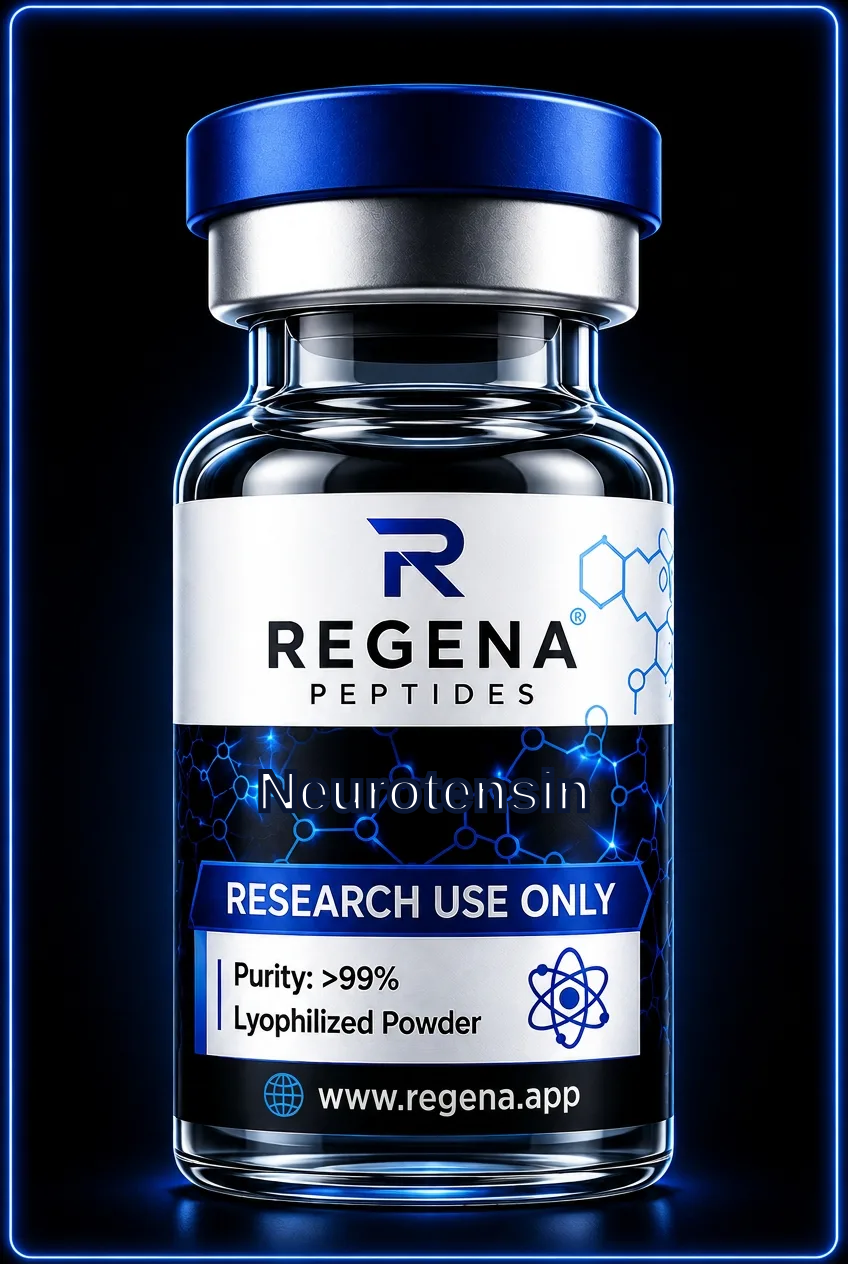
Cognitive · Neuropeptide fragment
Neurotensin (8-13)
Also known as NT(8-13)
The active C-terminal hexapeptide of neurotensin, NT(8-13) is a potent agonist at neurotensin receptors used to study neurotransmission.
- Length
- 6 amino acids
- Half-life
- Not well characterised
- Mechanism
- This C-terminal fragment acts as a potent agonist at neurotensin receptors, particularly NTS1, retaining the primary binding and signaling activity of full-length neurotensin.
- Studied in
- It is used in neuroscience research to study neurotensin receptor signaling and its modulation of dopaminergic systems in vitro and in ex vivo tissue.
About Neurotensin (8-13)
Neurotensin (8-13) is a hexapeptide fragment corresponding to the C-terminal portion of the full 13-amino acid neurotensin peptide. This fragment, with the sequence Arg-Arg-Pro-Tyr-Ile-Leu, is widely recognized as the core active region of the parent molecule. It is responsible for high-affinity binding to neurotensin receptors and subsequent initiation of intracellular signaling cascades.
Compared to full-length neurotensin, NT(8-13) exhibits similar or even greater potency at the high-affinity neurotensin receptor, NTS1, but is more susceptible to enzymatic degradation. Researchers utilize this fragment as a direct and potent tool to investigate the physiological roles of NTS1 activation. Its applications include studying dopamine release in striatal slices and exploring G-protein coupling in NTS1-expressing cell lines.
Laboratory notes
- This hexapeptide contains the essential binding domain of the full neurotensin peptide.
- It is more metabolically labile than full-length neurotensin, a factor to consider in the design of longer-duration experiments.
- Potency can be cell-type or tissue dependent, based on the local expression levels of peptidases and receptor subtypes.
Storage and reconstitution basics: storage guide.
Questions about Neurotensin (8-13)
Why use Neurotensin (8-13) instead of the full peptide?
NT(8-13) can be used as a more minimal, potent agonist to specifically probe the binding site and core activation mechanism of neurotensin receptors without the N-terminal portion.
What are the primary receptors for this peptide fragment?
It is a potent agonist at neurotensin receptor subtypes NTS1 and NTS2, which are G-protein coupled receptors.
How should this peptide be handled in the lab?
Like most peptides, it should be reconstituted in an appropriate sterile buffer, aliquoted to avoid repeat freeze-thaw cycles, and stored at -20°C or colder.
Is Neurotensin (8-13) for human use?
No. It is supplied strictly for in-vitro laboratory research and is not for human or animal consumption.
Related research peptides
All products are sold for laboratory research use only. Not for human consumption, not a medicine, not for diagnosing, treating or preventing any condition.